

Ask most buyers whether they want a Tier III or a Tier IV data centre and they will pick the higher number. It sounds like a safer choice, and nobody gets criticised for buying more resilience. Bank Negara does not ask for Tier IV. Its Risk Management in Technology policy, RMiT, requires financial institutions to […]

Ask most buyers whether they want a Tier III or a Tier IV data centre and they will pick the higher number. It sounds like a safer choice, and nobody gets criticised for buying more resilience.
Bank Negara does not ask for Tier IV. Its Risk Management in Technology policy, RMiT, requires financial institutions to keep their production data centres concurrently maintainable, and to hold a recovery data centre as well. Concurrently maintainable is the definition of Tier III. The regulator with Malaysia’s most demanding resilience rules has drawn its line at Tier III and then asked for a second site.
That is not a compromise. It is a considered view of where the risk in a data centre actually sits, and it is the right starting point for almost any production workload in this country. It also means the Tier III you buy must be the real thing.
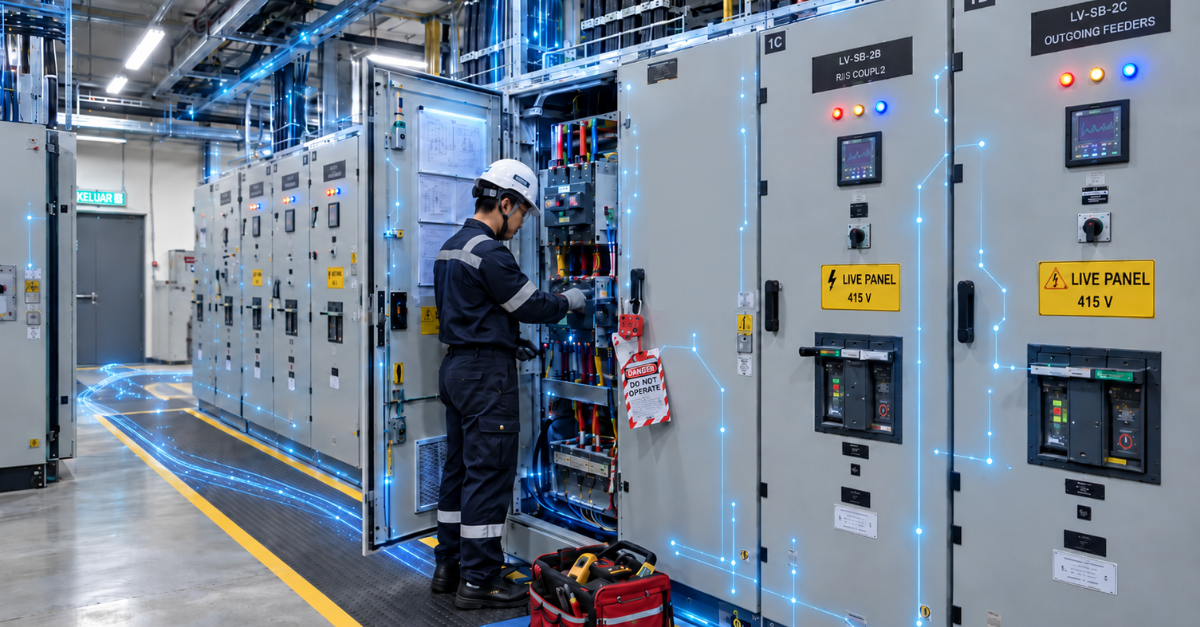
Tier III makes one promise: concurrent maintainability.
Uptime Institute, which created the Tier Classification, defines it this way. Every capacity component and every distribution path serving the IT equipment can be taken out of service on a planned basis without affecting the IT load. Capacity components are the generators, UPS modules, chillers and pumps. Distribution paths are the switchboards, transformers, panels, cables and pipes that carry power and cooling to the racks.
In practice, the operator can service, test, repair or replace any single piece of critical infrastructure on a scheduled day, and your servers keep running throughout. There is no maintenance window to negotiate and no weekend outage to approve.
Over a facility’s twenty-year life, this is the guarantee that matters most. Every component needs maintenance.
A building that cannot be maintained without an outage ends either taking outages or deferring maintenance and deferred maintenance is how most unplanned failures begin. Tier III removes that trade-off entirely.
N+1 is the most quoted resilience figure in a colocation proposal, and it is part of Tier III. It is not the whole thing.
N+1 means one more capacity component than the load needs. If a hall needs four chillers, an N+1 design installs five. It is easy to count and easy to photograph.
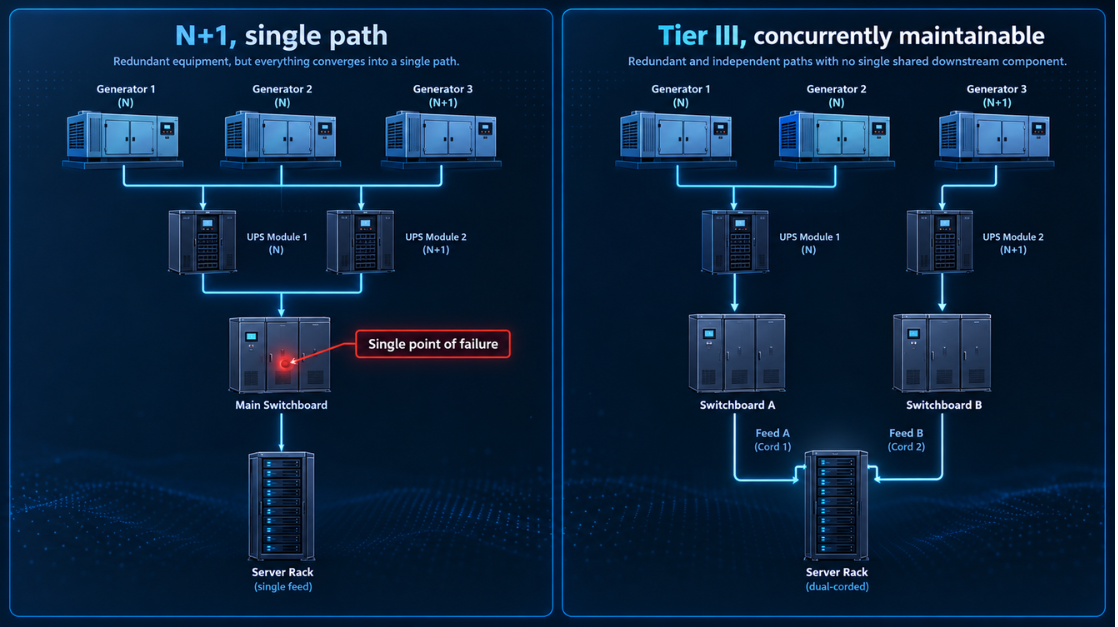
On its own, N+1 describes Tier II. A facility can have spare generators, UPS modules and chillers and still feed the hall through a single switchboard or a single chilled-water header. When that switchboard needs maintenance, the hall goes down, however many generators are standing by. Uptime’s guidance is explicit that component count does not determine Tier.
Tier III adds the paths. There must be more than one route for power and cooling to reach the IT equipment, so any single route can be isolated. On the critical power side, Uptime’s guidance requires both paths below the UPS to be active and serving the load, with the IT equipment drawing from both through dual power cords or rack-mounted transfer switches.
So when a proposal lists generators and UPS modules, the useful follow-up is about the paths: how many switchboards feed the hall, how many chilled-water headers, and whether each rack receives two independent feeds.
Fault tolerance is what Tier IV adds. A Tier IV facility can survive an unplanned failure of any single component or path, not only a planned shutdown, without affecting the IT load. That is a real capability. The question is what it costs, and what it protects you from.
It roughly duplicates the building’s critical plant. Fault tolerance needs independent, physically separated systems, each able to carry the full load alone. Two complete systems mean more capital, more equipment to maintain, and more floor space given over to plant rather than racks. Uptime itself lists “Tier IV is the best” as a misconception. The right Tier is the one that matches the business’s need, and paying for fault tolerance a workload does not need is money that cannot go elsewhere.
It makes efficiency harder. Each of those independent systems normally runs at half load or less, so that can take over. Electrical and cooling plants tend to run less efficiently at low loads. Under Malaysia’s sustainability guidelines,
purpose-built colocation is held to a PUE of 1.6, and every point of PUE is paid for on every kilowatt-hour of the contract.
Tier III leaves more room to run a plant where it performs best.
It protects one building, and the building is not usually a problem. Fault tolerance guards against one failure inside one facility. The events that take a service down for hours tend to be bigger than that: a regional utility disturbance, a fibre cut outside the fence, a flood, a fire, or a human error that propagates across systems. Tier IV does nothing for those.
A second site does.
That last point is why RMiT is shaped the way it is. A concurrently maintainable production site, plus a recovery site elsewhere, protects against both planned work and the loss of a whole facility. Two Tier III sites in different locations cover more of the risk than one Tier IV site, and usually less than the Tier IV premium.
Tier IV has its place. A workload that genuinely cannot be replicated to a second site, and cannot tolerate any interruption at all, may justify it. For most banking, enterprise, cloud and AI workloads, the stronger design is two certified Tier III facilities, connected well.
The Malaysian market reflects that. Uptime’s public register lists nine Malaysian facilities with Tier III certification for the constructed building, against two at Tier IV.
Two certification schemes are in use in Malaysia.
Uptime Institute Tier uses Roman numerals, Tier I to Tier IV, and Uptime certifies facilities itself.
ANSI/TIA-942 uses Arabic numerals and the word “Rated”, Rated 1 to Rated 4. It is currently in its C revision, published in May 2024. Certification is carried out by independent conformity assessment bodies accredited under TIA’s scheme. TIA-942 covers a wider scope than Uptime’s topology review, including architecture, physical security, telecommunications cabling, and electrical and mechanical systems, with a rating for each area as well as overall.
Rated 3 and Tier III share the same core definition, concurrently maintainable. The audits differ in detail, but both are independent, both inspect the finished building at the site stage, and both are recognised by assessors. What matters is that a claim names one of them and has a certificate behind it.
Plenty of proposals describe a facility as “Tier III designed”, “Tier III compliant” or “built to Tier III standards”. None of those phrases involves an independent audit, and Uptime says terms of this kind have no basis in Tiers. A certified facility can answer five checks in an afternoon.
1. The standard and the certifying body. Uptime Tier or TIA-942 Rated, the body that issued it, and the certificate number. Uptime certificates are on Uptime’s public register. TIA-942 certificates can be verified with the issuing body.
2. The stage. A design certificate means the drawings were reviewed. A site, facilities or constructed-facility certificate means assessors inspected the finished building. Uptime reports finding post-design changes that break compliance “in almost every site visit”, so the site stage is the one that counts.
3. The dates. Issue, expiry and, for TIA-942, the latest surveillance audit. Uptime design certificates lapse after two years. TIA-942 site certificates run for three years with annual surveillance.
4. The scope. Which building and which halls. Under TIA-942, ask for the rating in each area as well as the overall rating.
5. The maintenance record. When a UPS module, a chiller and a switchboard section were last taken out of service under live load, and what the IT load did. Concurrent maintainability is proven by doing it.
For a bank, these checks matter twice. RMiT requires an external data centre resilience and risk assessment at least every three years and after any material change, and the operator’s certification becomes part of the bank’s own evidence.
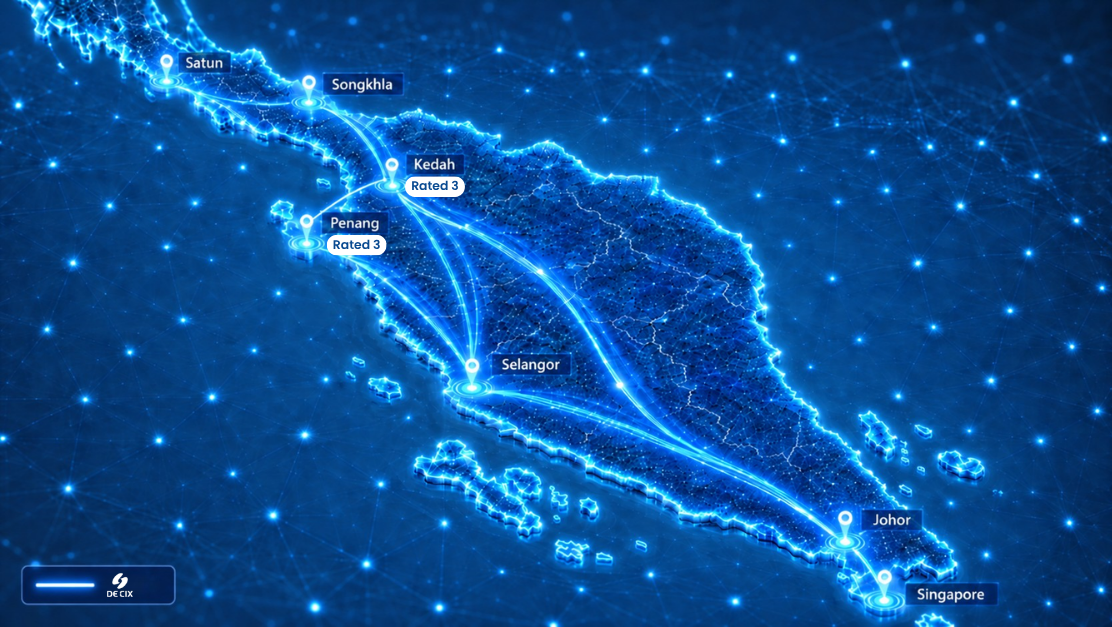
Two of our facilities are certified to TIA-942 Rated 3, and together they make the two-site design described above available today.
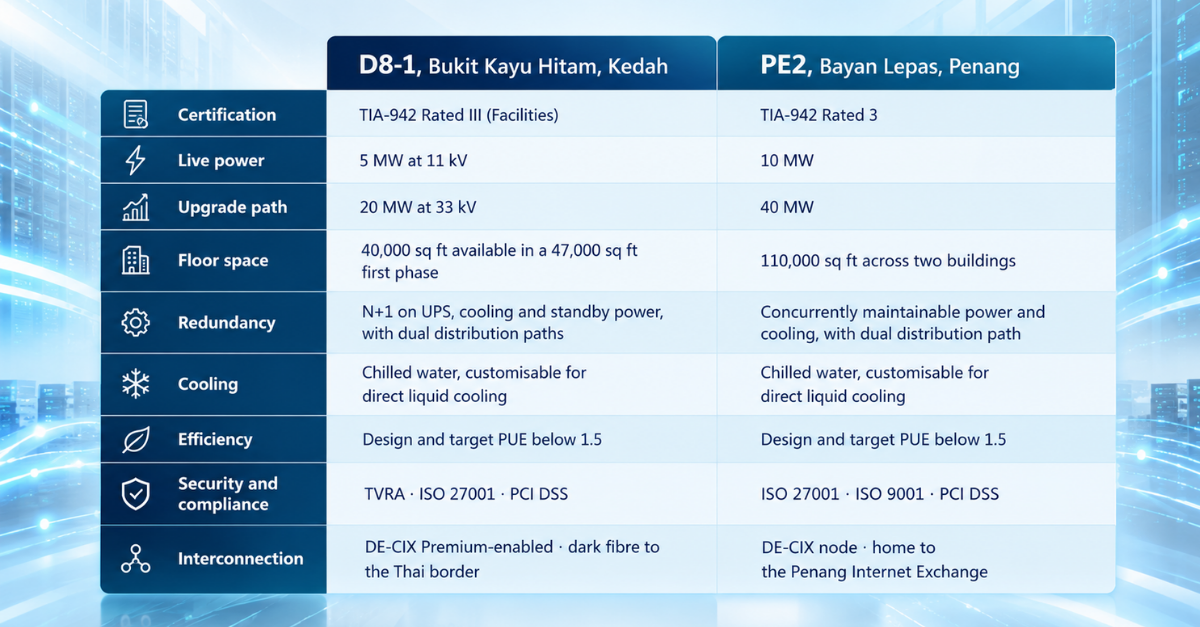
D8-1 is Kedah’s only Rated III facility, inside the Delapan Special Border Economic Zone, with reach into Thailand. PE2 sits in Penang’s semiconductor and industrial AI cluster. Both are designed with headroom for direct liquid cooling, so a Tier III hall today does not limit the density you can deploy next year. Both run below the 1.6 PUE threshold by design.
Placed together, they give a production and recovery pair in two states, each concurrently maintainable, with DE-CIX interconnection on both sides. That is the arrangement RMiT describes, built from certified buildings.
The rest of our estate extends that reach. JB1 in Johor Bahru carries 20 MW with 2 MW of critical load per floor, two kilometres from the Causeway, and hosts the DE-CIX JB node and JBIX. CJ1 in Cyberjaya adds a DE-CIX node in the Klang Valley, and PE1 and JB2 host exchange nodes in Penang and Johor Bahru. A workload certified at D8-1 or PE2 can reach all of them.

Empowering Southeast Asia’s Digital Future.
For further enquiries
☎️: 03 8888 8188 (General Line)
📱: 012 3188 0446 (Sales)
Operating Hours: Monday – Friday, 9am – 6pm


Copyright © Open DC Sdn Bhd (1138988-T) | All Rights Reserved.