

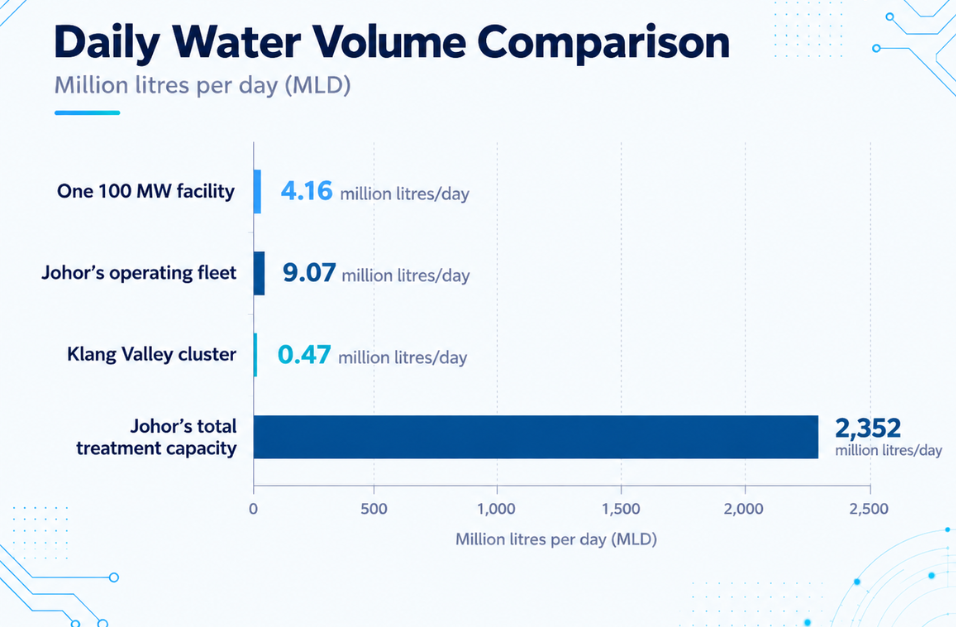
Cooling a 100 megawatt data centre takes somewhere around 4.16 million litres of water a day. That is roughly what a town of ten thousand people gets through in the same twenty-four hours. It is a large number and an uncomfortable one, and for about two years now the industry has answered the water question […]

Cooling a 100 megawatt data centre takes somewhere around 4.16 million litres of water a day. That is roughly what a town of ten thousand people gets through in the same twenty-four hours.
It is a large number and an uncomfortable one, and for about two years now the industry has answered the water question with percentages instead. Nought point six per cent of state consumption. A fraction of a per cent nationally. Those figures are accurate. They have also persuaded almost nobody, because a percentage is not what anyone is actually asking for. People want to know how much water goes into the building at the end of their road, where it comes from, and what happens to their supply in a dry month.
So here are the litres.
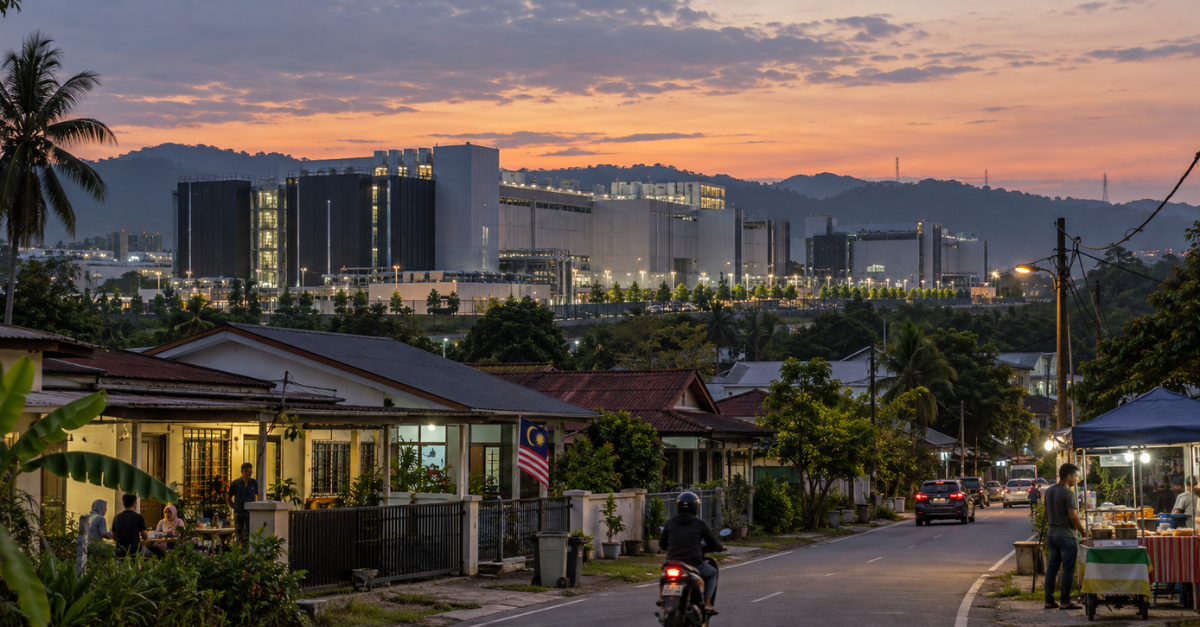
A data centre is a building full of computers, and computers turn electricity into heat. Almost all of it. A hall drawing 10 megawatts of power is producing close to 10 megawatts of heat, continuously, and in the Malaysian climate that heat has nowhere convenient to go.
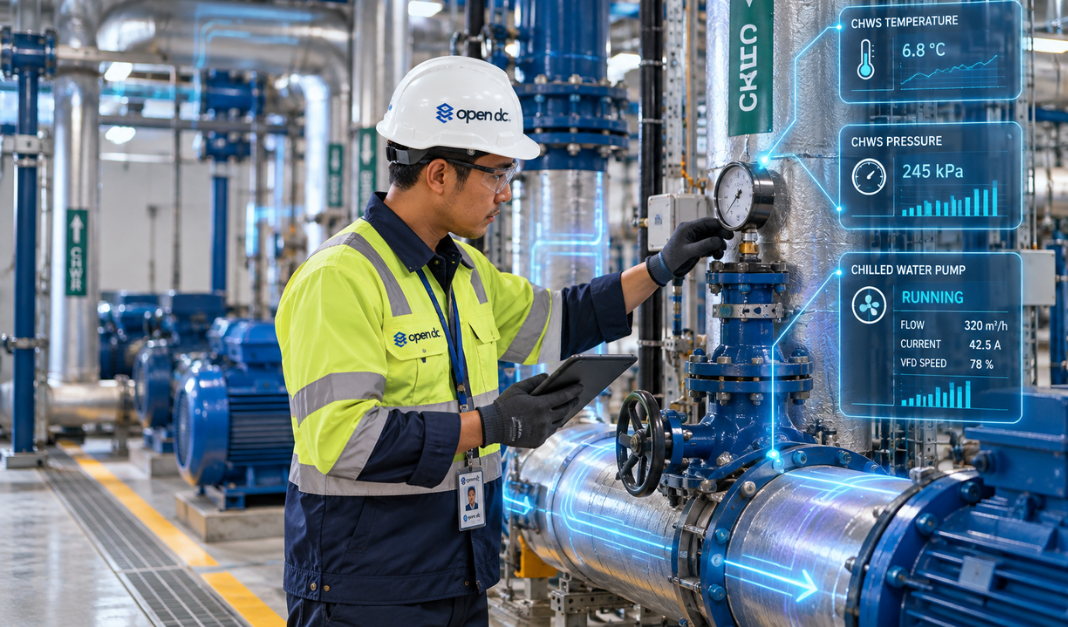
Most large facilities move that heat with chilled water. Water is pumped through the building, picks up heat from the air in the server halls, and carries it out to a plant on the roof or beside the building where the heat is shed. In a closed system the same water goes round and round, and the losses are small. In a system that uses evaporation to shed heat more cheaply — a cooling tower — a portion of the water is deliberately turned to vapour, because evaporating water carries a great deal of heat away with it. That portion has to be replaced. That replacement is what shows up on the water bill, and it is the number the public argument is really about.
This is why two facilities of identical size can have completely different water figures. The one that sheds heat by evaporation uses less electricity and more water. The one that sheds it with air-cooled or closed-loop equipment uses more electricity and far less water. Neither is free. The choice between them is a trade, and in a country where both the grid and the reservoirs are under pressure, it is a trade worth making in public rather than in a design review.
Johor carries the largest concentration of data centres in the country. Its operating facilities together draw about 9.07 million litres a day, which works out at roughly 0.6 per cent of the state’s consumption.
An Olympic swimming pool holds about 2.5 million litres. So the whole operating fleet in Johor, on an average day, is about three and a half pools.
Set that against what the state can actually produce. Johor’s treatment plants have a combined capacity of around 2,352 million litres a day across 48 sites. The data centre draw is a rounding error against that figure, and more plants are being built — a 50 million litre package at Semanggar and a 160 million litre second phase at Layang are both due within two years.
In the Klang Valley the numbers are smaller again. Data centres across Selangor, Kuala Lumpur and Putrajaya draw about 0.47 million litres a day, roughly 0.12 per cent of consumption there.
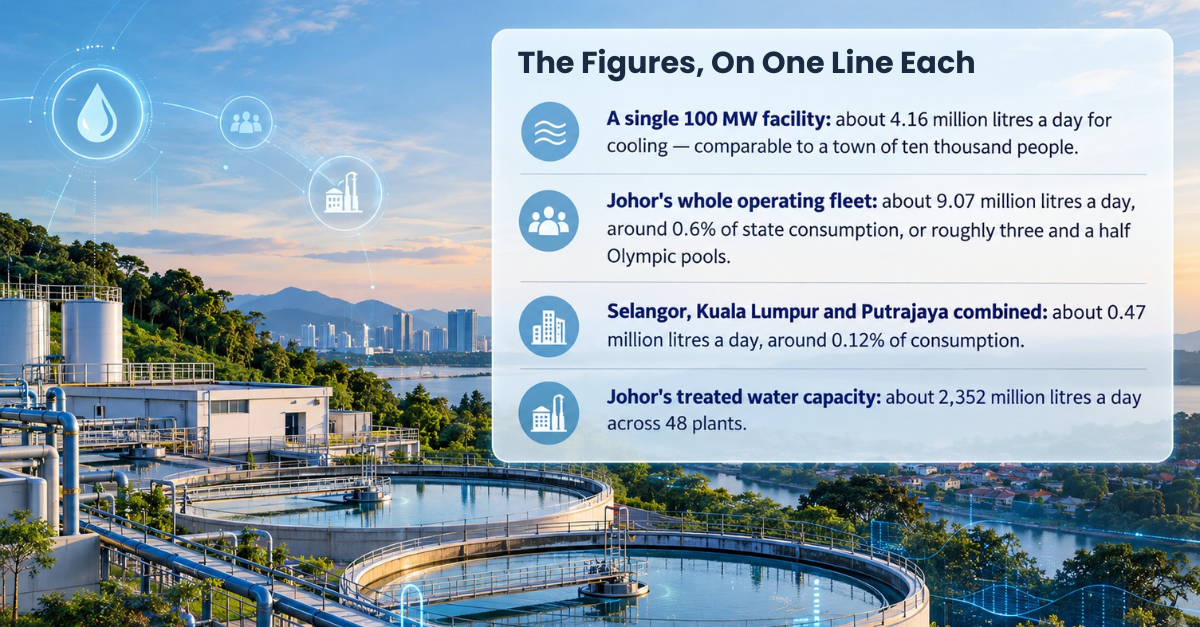
Those four lines are the entire factual basis of the water argument in Malaysia, and until very recently they were not in general circulation. That absence did more damage to the sector than the consumption ever did.
A reader who has got this far might reasonably conclude that the water objection is overblown. That conclusion would be half right and would miss what actually happened.
Total consumption was never the binding constraint. Timing and placement were. A reservoir under stress in a dry February does not care that the annual average is comfortable, and a district whose supply is interrupted does not experience a state-level surplus. Johor’s own investment executive councillor, Lee Ting Han, put it about as plainly as it can be put: the issue is not sufficiency, it is management, and making sure water is channelled to the right place.
There is a second reason, and it is the sector’s own doing. When supply was disrupted at Pontian, Simpang Renggam and Benut in February 2026, the Johor state government publicly attributed the cause to dry weather rather than to data centres. That was the correct finding on the facts. It settled nothing, because not one operator could produce its own consumption record to put alongside it. An industry that does not measure itself is permanently dependent on somebody else defending it, and that defence will not always come.
In November 2025 the state stopped approving what it classifies as Tier 1 and Tier 2 data centres — the heavy water users. Tier 3 and Tier 4 facilities, which the state puts at roughly 200,000 litres a day, remain welcome, on condition that they sit inside designated industrial zones, draw reclaimed water from Syarikat Air Johor, and meet a set of criteria the state summarises as high compute, low impact.
Alongside that, developers whose designs depend on water-based cooling have been told to expect a wait of around eighteen months, into the middle of 2027, while supply infrastructure catches up.
The more interesting development is the one that attracted the least coverage. Since June 2026, Indah Water Konsortium and Johor Special Water have been supplying about 12 million litres a day of treated effluent from thirteen waste treatment plants to data centres in the state. Bridge Data Centres runs its own reclamation plant at its Ulu Tiram facility, currently processing about 5 million litres a day with expansion planned towards 20 million. Water that was previously discharged is now being used to cool servers instead of being drawn fresh from the reservoir.
Put beside the 9.07 million litres the fleet draws, a 12 million litre reclaimed supply is not a gesture. It is enough, in principle, to cover the current operating draw several times over. Whether it actually does depends on which facilities are plumbed into it, and that is not published anywhere.
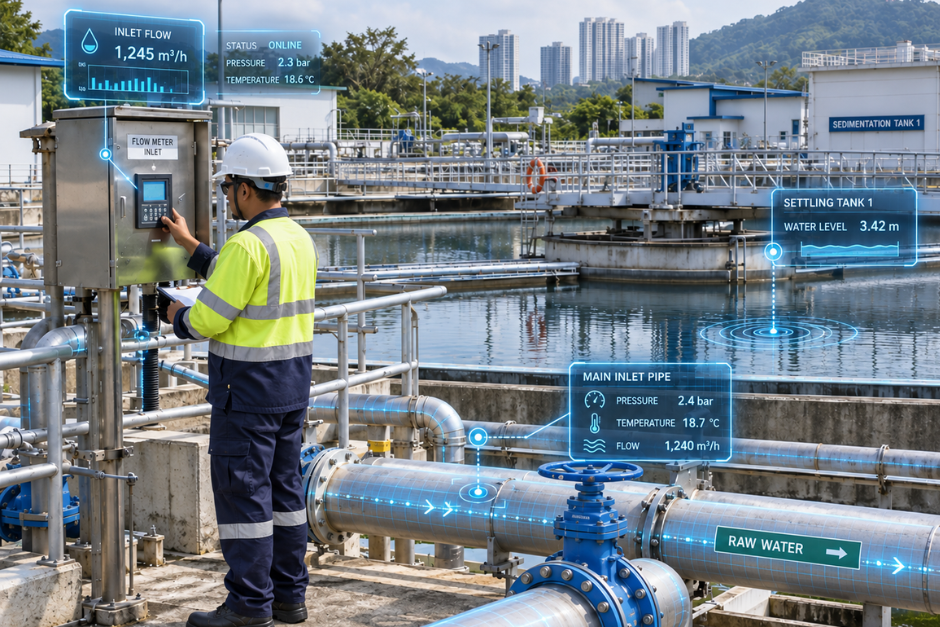
Until recently there was no agreed way to compare one operator with another. There is now.
The government’s guidelines for sustainable data centre development set a figure called water usage effectiveness. It is simpler than it sounds. It measures how much water a facility uses for every unit of computing energy it delivers — water in, work out. A facility that uses less water to do the same amount of computing scores lower, and lower is better.
The design target is 2.2 cubic metres of water per megawatt-hour, with an expectation of improving to 2.0 within ten years. A cubic metre is a thousand litres, so 2.2 means roughly 2,200 litres of water for every megawatt-hour of computing energy delivered.
The reason this matters to a resident rather than an engineer is that it makes comparison possible. Two proposed facilities in the same district can now be set side by side on a single figure. An operator that will not state the figure is telling you something, and so is a council that does not ask for it.
Not a technical audit. Three questions, in order, that any operator ought to be able to answer about any of its buildings.
1. How many litres a day does this facility draw, on average and at A building that does not know its own peak has not planned for a dry month.
2. Where does the water come Municipal supply, reclaimed supply, groundwater, or a mix — and what the split is.
3. What proportion is reclaimed rather than This is the number that moves fastest, because it is the one an operator can actually change.
Three figures, a stated as-at date, and a commitment to publish them again on the same basis next year. That is the whole standard. It costs an operator nothing it does not already know.
On 15 September, after Data Centre Nexus, we published our own answers pillar by pillar and marked each one as either evidence or intent. Water was the weakest answer we gave all day, and we said so in those words. This post is the follow-through, and it would be worth very little without the admission attached.
What we can publish today. Each of our six facilities — CJ1 in Cyberjaya, PE1 and PE2 in Bayan Lepas, D8-1 at Bukit Kayu Hitam, and JB1 and JB2 in Johor Bahru — runs chilled water plant, with a design and target power usage effectiveness below 1.5. PE2 holds TIA-942 Tier III certification and D8-1 operates Rated III facilities, with ISO 27001 and PCI DSS across the estate.
What we cannot publish today, stated plainly. We do not yet publish water usage effectiveness per site. We do not publish water source per site, or the proportion drawn from reclaimed supply. Design intent is a specification, not a measurement, and we are aware of the difference. Until an operator publishes measured consumption rather than design targets, the objection case will keep winning on the evidence available, and on the evidence available it deserves to.
We will publish all three figures, for all six sites, with their definitions and an as-at date, by [WUE_PUBLICATION_DATE]. A commitment without a date is a press release, so the date is the commitment.
The figures in this post are small enough to have made the argument straightforward, had they been in circulation two years ago. They were not. The sector spent that time explaining that public concern was disproportionate, which is both broadly true and completely useless as a response, because a community does not need permission to want the numbers.
Johor now has a tier rule, an eighteen-month deferral and a reclaimed water supply because the industry left the question unanswered long enough for somebody else to answer it. The next set of rules will be written the same way unless operators start publishing first.
Three numbers for every building. Litres a day, the source, and the reclaimed share. We can currently give you one of the three, and we have put a date against the other two. If you live near a data centre, or sit on the council that approves one, ask for all three — from us and from everyone else. Get in touch and we will send what we hold today, including the gaps.
Empowering Southeast Asia’s Digital Future.
For further enquiries
☎️: 03 8888 8188 (General Line)
📱: 012 3188 0446 (Sales)
Operating Hours: Monday – Friday, 9am – 6pm



Copyright © Open DC Sdn Bhd (1138988-T) | All Rights Reserved.