

Malaysia’s data centre market is shifting from unconstrained build-out to strict operational governance. As the Finance Ministry prepares to table Budget 2027 on Friday, 9 October 2026,(to reconfirm the date) enterprise procurement teams and infrastructure heads face a changing regulatory landscape. Facility selection can no longer rely on baseline power availability and floor space alone. […]

Malaysia’s data centre market is shifting from unconstrained build-out to strict operational governance. As the Finance Ministry prepares to table Budget 2027 on Friday, 9 October 2026,(to reconfirm the date) enterprise procurement teams and infrastructure heads face a changing regulatory landscape.
Facility selection can no longer rely on baseline power availability and floor space alone. Policy signals indicate that national priorities are shifting toward grid stability, power efficiency, and local economic value creation.
Here are five key policy shifts and market developments that will define enterprise infrastructure planning under
data centre budget 2027.
Unrestricted infrastructure expansion is giving way to targeted approval frameworks. Jointly managed by the Ministry of Investment, Trade and Industry (MITI) and the Ministry of Digital, the Data Centre Task Force (DCTF) is refining the criteria required for project development.
Rather than evaluating facilities solely on foreign direct investment value, the DCTF is prioritising operations that deliver technological spillover, high energy efficiency, and direct support for local enterprise digitisation.
Key Takeaway: Enterprise buyers must assess prospective providers for DCTF regulatory alignment to avoid onboarding facilities that encounter expansion caps or compliance delays later in their lifecycle.

Data facilities now account for a significant portion of Peninsular Malaysia’s peak electricity demand. In response, utility allocation models and pricing structures are undergoing active review.
Budget 2027 is set to introduce clearer guidelines on long-term power tariffs and grid connectivity. Key adjustments to watch include:
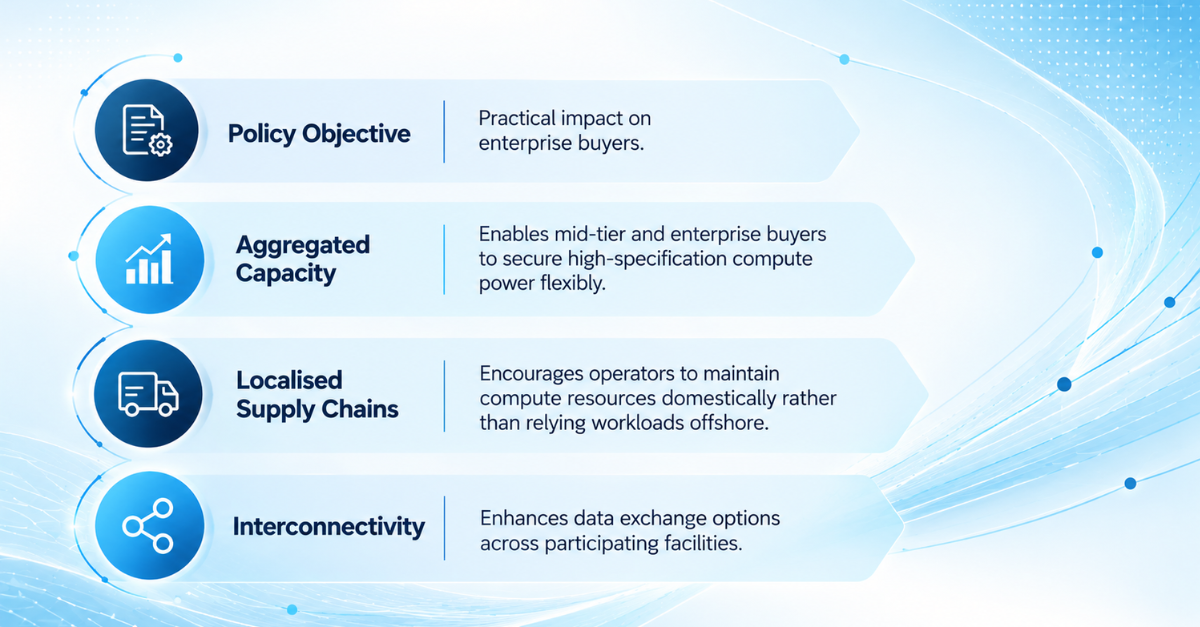
A primary initiative on the horizon is the National AI Compute Exchange (NACX), led by the Malaysia Digital Economy Corporation (MDEC) and scheduled for launch in early 2027.
The initiative aims to transition data infrastructure from passive real estate into an active national resource. NACX operates as a central marketplace to match domestic business demand with available compute capacity.
Managing heat density remains a primary cost driver in tropical environments, particularly as high-density computing workloads expand.
Budget 2027 is expected to introduce capital allowances and tax incentives for operators investing in sustainable infrastructure. This includes direct liquid cooling, immersion cooling, and on-site renewable energy integration.
Facilities leveraging these technologies offer corporate tenants lower operational overheads and cleaner power profiles, simplifying corporate ESG reporting.
Government incentives are increasingly moving away from pure real estate footprint toward network utility and connectivity.
For enterprise buyers, carrier-neutral facilities with direct access to local internet exchanges, regional fibre routes, and edge networks present lower latency and greater operational flexibility. Choosing an operator integrated into the broader local ecosystem minimizes cross-border routing dependencies and supports national data governance standards.
Budget 2027 marks a clear transition toward institutional maturity in Malaysia’s digital infrastructure. For corporate buyers, long-term risk mitigation requires evaluating facility partners on regulatory standing, power efficiency, and network integration—not just available megawatt capacity.
Empowering Southeast Asia’s Digital Future.
For further enquiries
☎️: 03 8888 8188 (General Line)
📱: 012 3188 0446 (Sales)
Operating Hours: Monday – Friday, 9am – 6pm



Copyright © Open DC Sdn Bhd (1138988-T) | All Rights Reserved.