

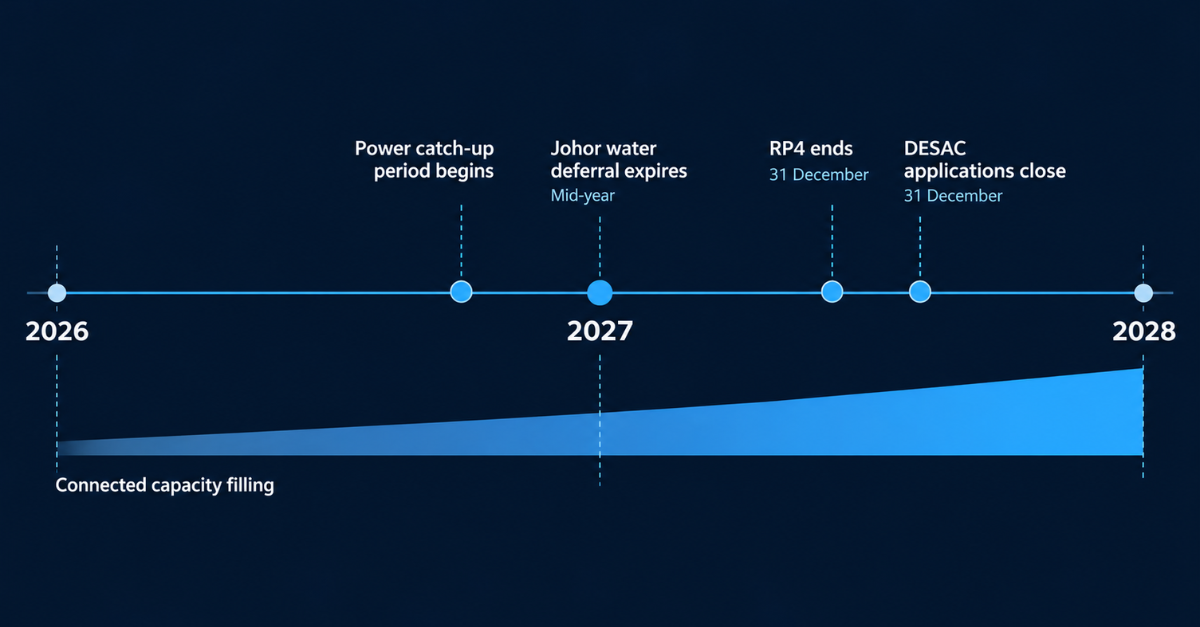
Four unrelated clocks run out in 2027. The power catch-up period begins, and no new gas-fired generation is expected to arrive that year. Regulatory Period 4 ends on 31 December, so the tariff structure is reset. Applications to the Digital Ecosystem Acceleration scheme close on the same date, and with them the incentive position that […]

Four unrelated clocks run out in 2027.
The power catch-up period begins, and no new gas-fired generation is expected to arrive that year. Regulatory Period 4 ends on 31 December, so the tariff structure is reset. Applications to the Digital Ecosystem Acceleration scheme close on the same date, and with them the incentive position that sits behind a lot of current pricing. And Johor’s deferral on water-cooled expansion runs out around the middle of the year.
None of those is a data centre story by itself. Three of them were reported by different outlets to different audiences, and the fourth is in a guidelines document most buyers have never opened. Put together, they describe the tightest twelve months this market will see, and a contract being negotiated now for occupancy next year is being signed into all four at once.
Underneath them, the paper headroom is closing. As at June 2026 Malaysia had 61 secured data centre projects totalling 8.35 GW. Of those, 42 projects and 5.65 GW were connected to the grid, but only about 1.26 GW were actually drawing power. The comfort visible in that gap is being consumed as those halls fill, and it will be consumed across precisely the window described above.
What follows is a due diligence set built for that year. Twelve questions in four groups. Each can be answered in a sentence or two by an operator that knows its own position, and each produces something comparable between proposals.
The prior question to everything else, and the one most often answered with a portfolio total. We set out the five different capacity figures circulating in this market in an earlier post; these three questions are how a buyer resolves them for a specific hall.
Question one. Of the megawatts in this proposal, how many are live today, how many are reserved to other customers, and how many are sellable to me — with the energization date and the dependency behind each figure?
A single quoted capacity figure can be planning-stage, an anchor tenant’s reservation, or several years and one substation queue away. The three-way split is the only version a buyer can price. A good answer gives three numbers, a date against the third, and names the dependency — a transformer delivery, a substation energisation, a planning condition.
Question two. What is the design rack density for this hall, and what will it support as my deployment moves towards higher density?
Rack densities across the industry are moving from the familiar 5kW to 10kW per rack towards thirty to a hundred and beyond as AI workloads land. A 5 MW allocation in a hall designed for 6kW a rack is not the same product as 5MW in a hall built for forty, and the difference is invisible in a megawatt figure. A good answer states the design density, the cooling architecture supporting it, and whether direct liquid cooling can be accommodated without displacing the allocation.
Question three. What is the substation and grid queue position behind the upgrade path, and what is the current connection lead time for the increment I would need?
The fast-track connection route brought data centre supply connections down from roughly 3 or 4 years to around 1 year, and dozens of projects have been delivered under it. That applies to new supply, not to every increment, and queue position is regional. An operator in a less concentrated corridor is in a different queue from one in the middle of the largest cluster. A good answer names the substation, states the current position and gives a date rather than a duration.
Power is the largest line in the contract and the least modelled. The mechanics are set out in full in a companion post; these three questions are the contractual expression of them.
Question four. On what basis is electricity passed through — at cost, at cost plus a stated margin, or at a fixed rate — and what automatic fuel adjustment assumption is embedded in any fixed figure?
The fuel adjustment moves monthly. A proposal quoting a single blended number has made an assumption about it that the buyer has not seen and cannot test. A good answer states the basis in one word and, if fixed, discloses the assumption and what happens when it is wrong in either direction.
Question five. How is maximum demand measured for my allocation, and if it is measured at building level, what method apportions it between tenants?
Maximum demand is the highest average draw across any single half-hour in the billing cycle, and at medium and high voltage it sets two of the four charges on the bill, every month. A building has one maximum demand and several tenants contributed to it, not necessarily in proportion to their consumption. In a surprising number of agreements the allocation method is not written down at all. A good answer describes the measurement point and the apportionment formula and is willing to put both in the agreement.
Question six. What happens at the reset on 1 January 2028, when the current regulatory period ends?
This is the question almost nobody asks, and it lands inside the term of most contracts being signed now. A good answer is whether pricing follows the new schedule automatically, whether there is a cap, and whether either party may reopen. A blank answer is not neutral — it means the risk sits wherever the drafting happens to leave it.

Malaysia’s guidelines for sustainable data centre development set efficiency thresholds by facility category, a water target, and a carbon formula. The full reading is in a companion post; the three questions below are what a buyer needs from it.
Question seven. Which guideline category does this facility fall into, and what is the applicable threshold for power usage effectiveness in that category?
The threshold is not one figure for the whole industry. It varies by category — tighter for hyperscale, tighter for purpose-built colocation constructed after 2020 than for older or converted buildings. Two operators can report identical efficiency figures and sit on opposite sides of the line. An efficiency number collected without its category cannot be evaluated, and most RFPs collect it that way.
Question eight. What is the measured annualised power usage effectiveness for this hall, at a stated load factor, and what is the water usage effectiveness and water source for this site?
Design efficiency is a specification; measured efficiency is a record. The gap between them is real in a tropical climate and widens at partial load, which is why the load factor must travel with the figure. On water, the site’s source and its reclaimed share matter as much as the ratio, because they determine exposure to state-level conditions. A good answer gives measured figures with their basis and says plainly where a measurement does not yet exist.
Question nine. What is the facility’s incentive status, and which efficiency commitments attached to it persist through my term?
Applications under the incentive scheme close on 31 December 2027. An operator’s incentive position affects its cost base, its appetite to invest in the building across a ten-year lease, and eventually its pricing. Commitments made to secure it may also bind operating parameters inside the tenant’s term. A good answer states the status and lists any commitment that outlives the application.
The three questions most likely to be skipped, and the three most likely to matter on the day something goes wrong.
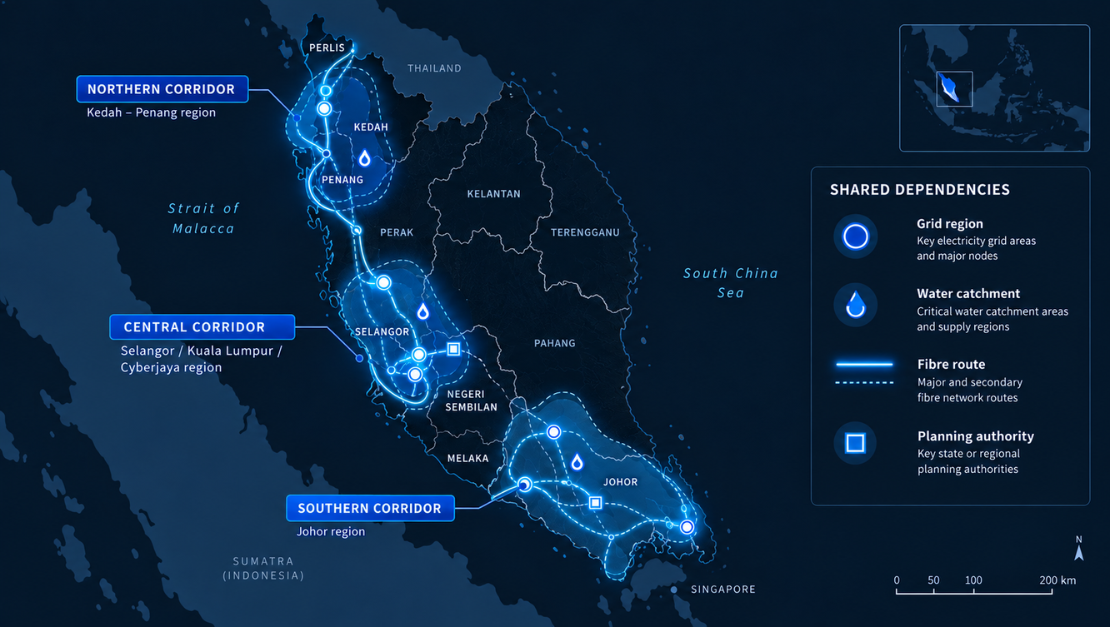
Question ten. Where does my recovery site sit relative to this one — corridor, grid region, water catchment — and which upstream dependencies do the two share?
Two sites 40 KMs apart can share a grid region, a water catchment, a fibre route and a planning authority. Distance is a poor proxy for independence, and a dual-site mandate satisfied on distance alone may not be satisfied at all. This is the question a regulator asks after an incident rather than before one. A good answer maps the shared dependencies rather than quoting a separation in kilometres.
Question eleven. What is the interconnection position at this site — which exchanges are on-net, how many networks are reachable, and what is the documented route between my two sites?
Connectivity is specified last, in adjectives, and inherited for the life of the contract. Power can be phased and cooling retrofitted; network position cannot be changed once racks are deployed. A good answer names the exchanges, gives a figure for reachable networks, and can produce the route between sites as a document rather than a description.
Question twelve. What approvals or conditions remain outstanding on this site, or on any phase I am depending on, including community consultation and state-level water conditions?
This is now a live category rather than a formality. An application in Kota Damansara was withdrawn in July 2026 after organised resident objection. Johor halted approvals for its two highest water-use tiers in November 2025 and deferred water-cooled expansion into mid-2027. A phase that exists on a roadmap but not in consent is a schedule risk the buyer carries, and it is rarely disclosed unless asked.
Three things are worth saying about how this list behaves in practice.
No operator answers all twelve well. That is not cynicism about the market, it is a description of it. Several of these require measurements the industry has only recently started taking, and some require disclosures nobody is yet obliged to make. A perfect score would be more suspicious than a partial one.
The useful signal is which questions get a straight admission. An operator that says “we do not publish measured efficiency per hall yet, and here is when we will” has told the buyer something reliable about how it will behave when a harder question arrives mid-contract. An operator that produces a confident answer to all twelve has told the buyer something too.
Ask them in writing and keep the answers. Almost every question here concerns a position that will change during the term. The answers are most valuable eighteen months later, when the tariff has reset or a phase has slipped, and somebody needs to establish what was represented at the point of signature.
Publishing a twelve-question standard and then declining to be measured against it would be worthless, so here is where we sit.
On group one. We publish specifications per site rather than portfolio totals. JB1 in Johor Bahru carries 20 MW with 2 MW of critical load per floor across 200,000 sq ft. PE2 in Bayan Lepas is now upgradeable to 100MW across 110,000 sq ft. D8-1 at Bukit Kayu Hitam runs 5 MW live, upgradable to 20 MW at 33 kV, with cooling customisable to support direct liquid cooling. The live, reserved and sellable split, with energisation dates and dependencies, is available per site on request. Publishing that three-way split on the site pages themselves is work in progress rather than work completed, and until it ships, “on request” is the honest description.
On group two. Our purpose-built colocation facilities sit in the post-2020 category, against a design and target power usage effectiveness below 1.5 across the estate. PE2 holds TIA-942 Tier 3 certification, D8-1 operates Rated III facilities, and ISO 27001 and PCI DSS run across the estate.
On group three. Six sites across three corridors means three grid regions and three water catchments, with sites both inside and outside the Johor tiering regime — which is the fact question ten is actually asking about. On interconnection, the position is a matter of record rather than description: JB1 hosts the DE-CIX JB node and JBIX, CJ1 and JB2 are listed DE-CIX Malaysia facilities, PE1 is home to the Penang Internet Exchange (PIX), and D8-1 is a premium-enabled site with dark fibre reaching the Thai border. On outstanding conditions, we will disclose them per site and per phase, and we would encourage any buyer to require the same of everyone else on the shortlist.

Empowering Southeast Asia’s Digital Future.
For further enquiries
☎️: 03 8888 8188 (General Line)
📱: 012 3188 0446 (Sales)
Operating Hours: Monday – Friday, 9am – 6pm



Copyright © Open DC Sdn Bhd (1138988-T) | All Rights Reserved.