The Asia-Pacific digital infrastructure landscape is undergoing a massive structural transformation, driven by escalating AI workloads and localized grid constraints. According to a report by Real Estate Asia, regional data centre investments have surged to US$11.6 billion, positioning Malaysia, Australia, and India as the primary focal points for next-generation development.
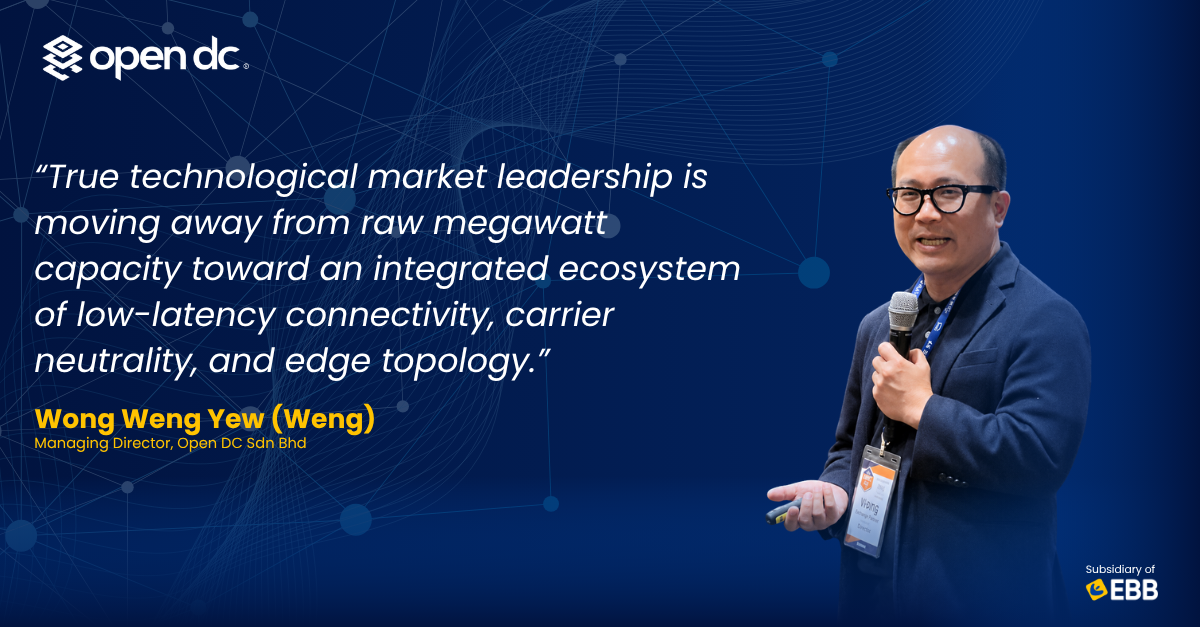
Wong Weng Yew (Weng), Managing Director of Open DC, shares his thoughts during the recent NANOG 97, Seattle, USA. “True technological market leadership is moving away from raw megawatt capacity toward an integrated ecosystem of low-latency connectivity, carrier neutrality, and edge topology.”
Here are some of Weng’s observations:
Key Projections & Ecosystem Growth
The criteria for data centre market leadership are shifting rapidly from local sprawl to a unified regional fabric.
- Capacity Explosion: Between 2025 and 2030, Malaysia’s total data centre capacity is projected to double, rising from 1.26 GW to 2.53 GW.
- Abundant Resource Advantages: Growth is heavily supported by Malaysia’s competitive land availability, lower construction costs, and stable access to water and electricity power grids.
- The AI Ecosystem: Major global cloud players are aggressively investing in the SEA region of more than USD$58 billion; creating a highly integrated and robust AI-ready infrastructure network.
Open DC’s Regional Interconnectivity Core
Weng emphasised at NANOG 97 Seattle that Open DC is actively establishing an interconnected network architecture across five core regional nodes, bridging over 150MW under construction and 200,000 square feet of high-density white space:
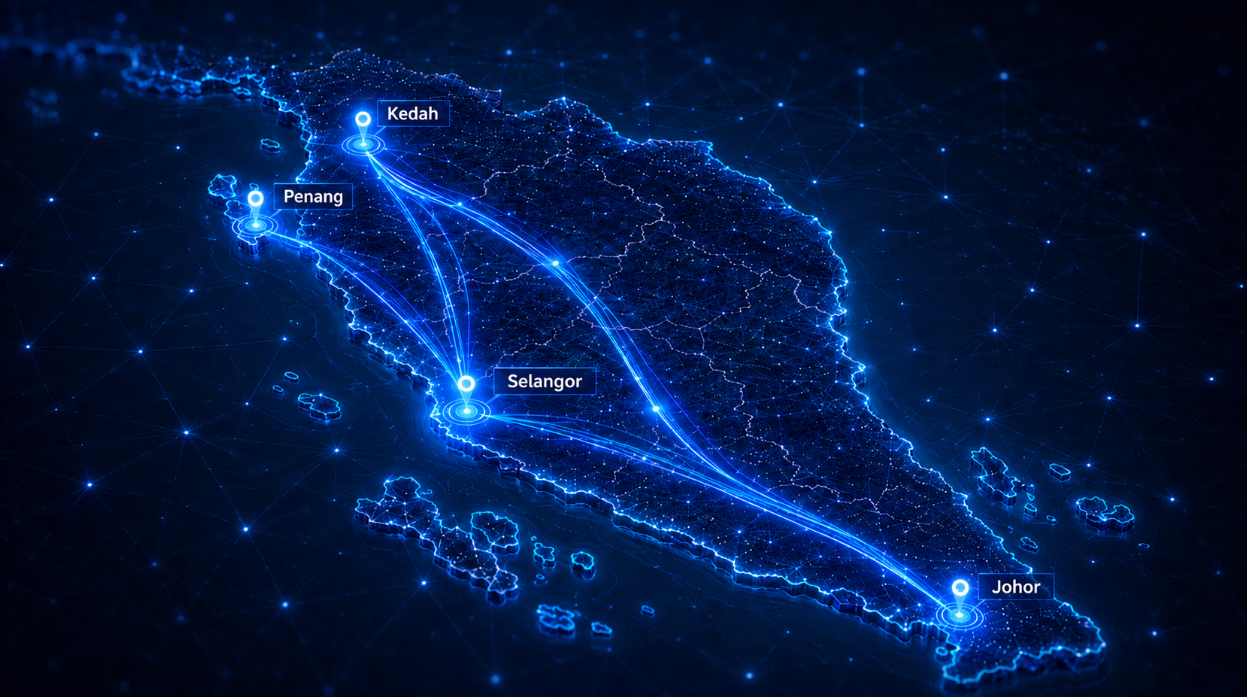
1. Southern Hub, Telco Nestled (JB1 & JB2, Johor Bahru)
- Formulates a vital gateway directly adjacent to Singapore’s established network footprint; just 2 KM away from the MY-SG Causeway.
- Deep Peering: Houses 17 distinct telco/service providers alongside the DE-CIX Johor Bahru Internet Exchange.
- JB1 Re-Architecture: Weng highlighted that JB1 is being transformed into a premier 30-floor vertical high-density telco hub featuring a 15MW IT load and an (N+1) dedicated chilled-water cooling configuration.
- The 2026 RTS Link Advantage: Strategically positioned to leverage the upcoming Rapid Transit System (RTS) link by 2026, creating a near-zero latency twin-hub architecture with Singapore’s financial core.
2. Northern Corridor, Digital Gateway to ASEAN
(PE1 & PE2, Penang; D8-1, Kedah)
- Designed to bypass traditional metropolitan bottlenecks to unlock direct international data corridors.
- Global Latency Benchmarks: D8-1 in Kedah delivers incredible cross-border transit times, reaching Chennai in 20ms, Hong Kong in 30ms, and Japan in 66ms.
- Subsea Proximity: Located less than 120km from four critical Cable Landing Stations across Thailand and Malaysia (Satun, Songkhla, Georgetown, and Penang), offering seamless access to 16 international submarine cables.
- The Indo-China Traffic Corridor: The D8-1 campus in Kedah’s Delapan Special Border Economic Zone (SBEZ) acts as a critical routing pivot, pulling terrestrial transit from Indo-China directly southbound into Kuala Lumpur and Singapore.
- Sustainable AI Scaling: Features a 20-to-50 acre campus capable of expanding to a 70MW total IT load, with an optional 30MW dedicated solar farm to protect operators from energy volatility.
3.Central Corridor (CJ1, Cyberjaya)
- Positioned at the heart of Malaysia’s mature enterprise digital zone.
The Interconnectivity Catalyst: Every Open DC facility features premium integration with the DE-CIX Internet Exchange (the world’s largest internet exchange operator from Germany). This structural integration ensures localized peering that optimizes routing for high-performance AI applications, content providers, and global carriers.
Read more: https://realestateasia.com/industrial/in-focus/malaysia-australia-and-india-emerge-focal-points-apac-data-centre-investment
Empowering Southeast Asia’s Digital Future
For further enquiries:
📞: +6012 388 0446
📧: enquiry@opendc.my