

Why kilowatts per rack are becoming one of the clearest signals of AI readiness The Same Number of Racks Can Hide a Very Different Requirement Two organisations may each request space for 20 server racks. On paper, their requirements appear identical. In practice, they could be asking for two completely different data centre environments. […]

The Same Number of Racks Can Hide a Very Different Requirement
Two organisations may each request space for 20 server racks. On paper, their requirements appear identical.
In practice, they could be asking for two completely different data centre environments.
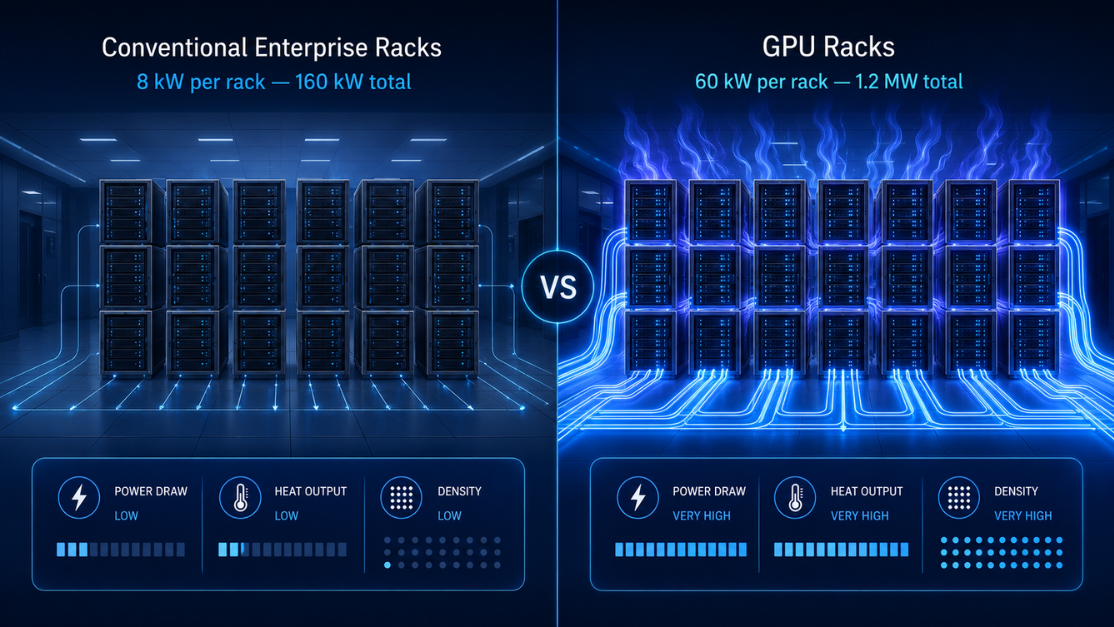
A conventional enterprise deployment operating at 8kW per rack would require approximately 160kW of IT capacity.
An AI deployment operating at 60 kW per rack would require 1.2 MW
The number of racks has not changed. The power requirement has increased by more than seven times.
Rack density is becoming one of the clearest signals of whether a data centre is genuinely ready for AI.
This is why buyers evaluating colocation space must look beyond floor area and rack availability. The more important question is whether the facility can deliver, cool, and protect the required power at every rack.
Rack density describes the amount of IT power consumed by the equipment installed within a single rack; and it’s normally expressed kW (kilo Watt) per rack.
It is not simply a measure of how many servers can physically fit inside a cabinet. A rack may still have available space while having already reached its power or cooling limit. Conversely, a rack containing fewer high-performance GPU servers may demand substantially more power than a fully populated rack of conventional enterprise hardware.
Rack density connects three critical infrastructure questions:
“How much electricity will the equipment consume?”
“How much heat will that equipment generate?”
“Can the data centre deliver the required power and remove the resulting heat reliably?”
For enterprise buyers, rack density should not be treated as a purely engineering term. It is a commercial capacity metric that affects deployment cost, scalability, operational resilience and the ability to adopt future technology.
Traditional enterprise applications, databases, storage platforms and virtualised environments can often operate within relatively modest density ranges. AI changes the calculation.
GPU-based systems concentrate enormous computing capability into a much smaller physical footprint. More processors, memory and high-speed networking are placed close together to accelerate communication between systems. The result is greater performance, but also substantially higher power consumption and heat generation within each rack.
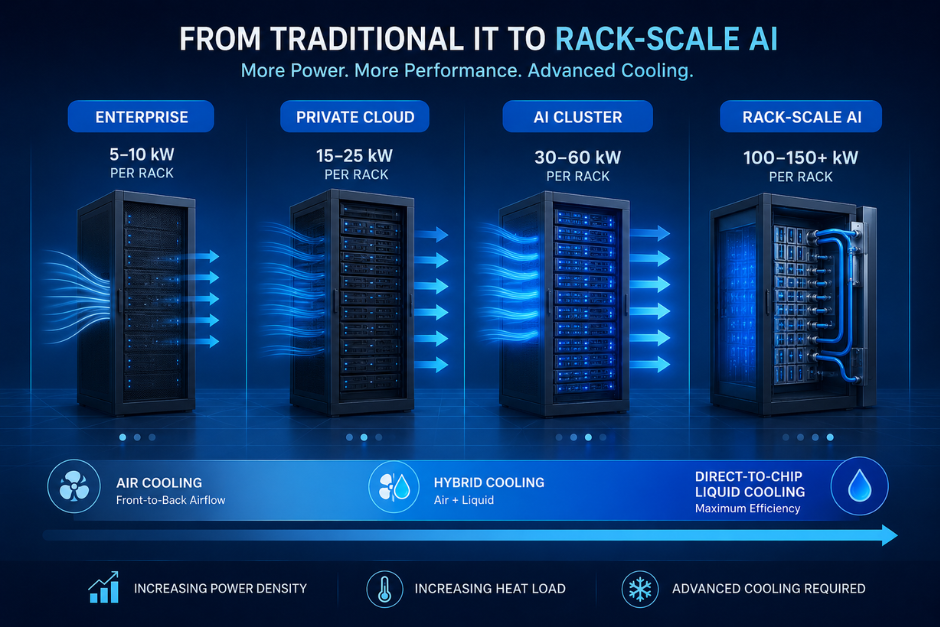
Industry research shows that the workload mix begins shifting noticeably towards AI and high-performance computing as rack density increases. At the upper end, rack-scale AI platforms can move beyond 100 kW per rack, making advanced cooling methods increasingly important.
Open DC’s Southeast Asian market research similarly identifies a widening difference between conventional cloud infrastructure and AI-ready environments. New AI-oriented facilities are being planned for materially higher-density deployments, while liquid-cooled GPU clusters are pushing rack requirements well beyond traditional enterprise ranges.
A common colocation mistake is to evaluate available space before confirming available power. A provider may have enough empty racks, cages or floor area for a proposed deployment. That does not necessarily mean the facility can deliver the required kilowatts to every rack.
Consider an organisation planning to deploy a new analytics or AI platform. It secures 20 racks based on initial space availability, only to discover later that the selected data hall supports 10 kW per rack while the hardware requires 30 kW.
The organisation may then face several expensive choices:
Each option can affect cost, implementation time, network architecture and operational complexity. For banks, financial institutions, government agencies and regulated industries, a late infrastructure redesign may also require new risk assessments, security reviews, migration plans, compliance approvals and business continuity testing.
Do not ask only, “How many racks are available?”
Ask “How many kilowatts can be delivered, cooled and protected at each rack?”
Rack density becomes easier to evaluate when it is translated into a small number of commercial and technical questions.
Start with the application rather than the available floor space. A core banking platform, private cloud environment, storage cluster, AI inference platform and GPU training system may all have different power, cooling and connectivity requirements.
The data centre provider should understand both the current equipment specification and the likely technology roadmap. Infrastructure that supports today’s servers may not automatically support the next hardware refresh.
Use a simple initial calculation:
Required IT load = Number of racks × Planned kW per rack
A 30-rack deployment operating at 12 kW per rack requires 360 kW of IT power. The calculation should then be refined to consider:
The contracted figure should reflect usable capacity at the rack, not merely the headline power capacity of the overall building.
High rack density requires more than sufficient utility power. The complete power path must be considered, including switchgear, transformers, uninterruptible power supply systems, power distribution units, busways,
rack-level distribution and backup generation.
A data centre may possess significant total power capacity but still be unable to deliver the required density in a particular hall or row. Buyers should ask whether the proposed rack density is supported during normal operation, maintenance and component failure — not only under ideal operating conditions.
Nearly all electrical energy consumed by IT equipment ultimately becomes heat. As rack density rises, the cooling system must remove more heat from a smaller area.
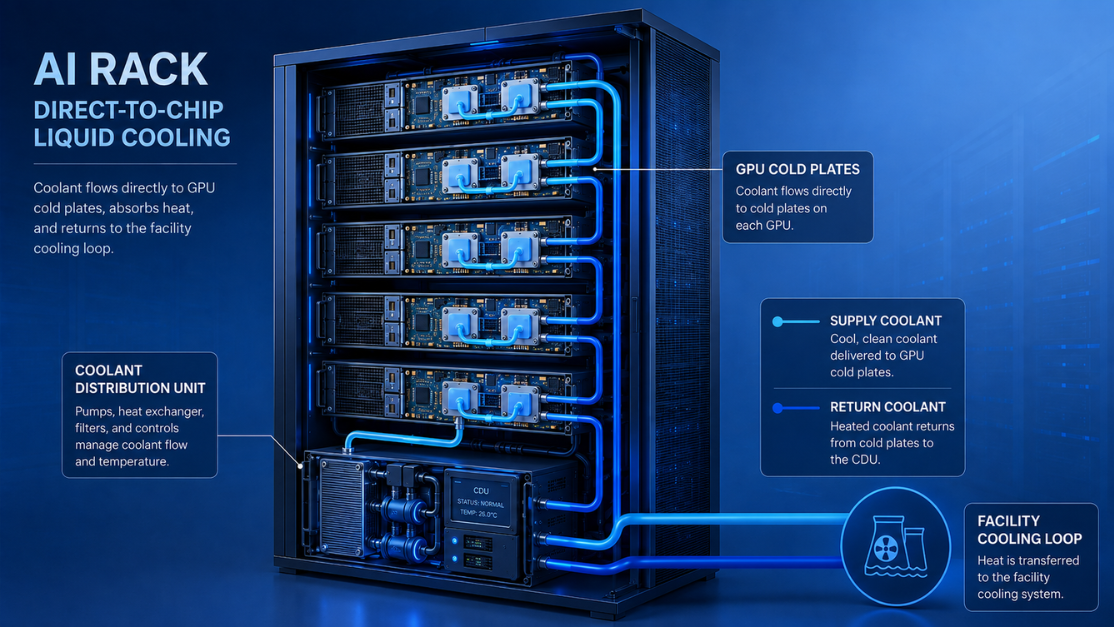
Conventional airflow may be adequate for standard enterprise racks, while higher-density environments may require containment, close-coupled cooling, rear-door heat exchangers or direct liquid cooling. Cooling readiness should therefore be treated as a strategic site-planning question rather than a late equipment-selection detail.
The first deployment phase may not represent the final requirement. An organisation could begin with 10 kW racks and move towards 20 kW or 30 kW during its next refresh cycle. AI adoption may also introduce a smaller number of extremely dense racks alongside conventional enterprise systems.
The provider should be able to explain:
Scalability should be confirmed before contracts are signed, not after the first rack has been installed.
For CIOs and IT leaders in BFSI, government and other regulated sectors, rack density must be evaluated alongside security, availability, compliance and operational governance.
A high-density facility should still provide disciplined access control, monitoring, redundancy, maintenance procedures and incident-response capabilities. Buyers should request clear answers to five questions:
These questions help prevent a technically available data hall from becoming a commercially unsuitable deployment environment.
Open DC has developed a portfolio of carrier-neutral facilities to support different enterprise, cloud, connectivity and
AI requirements across Malaysia.
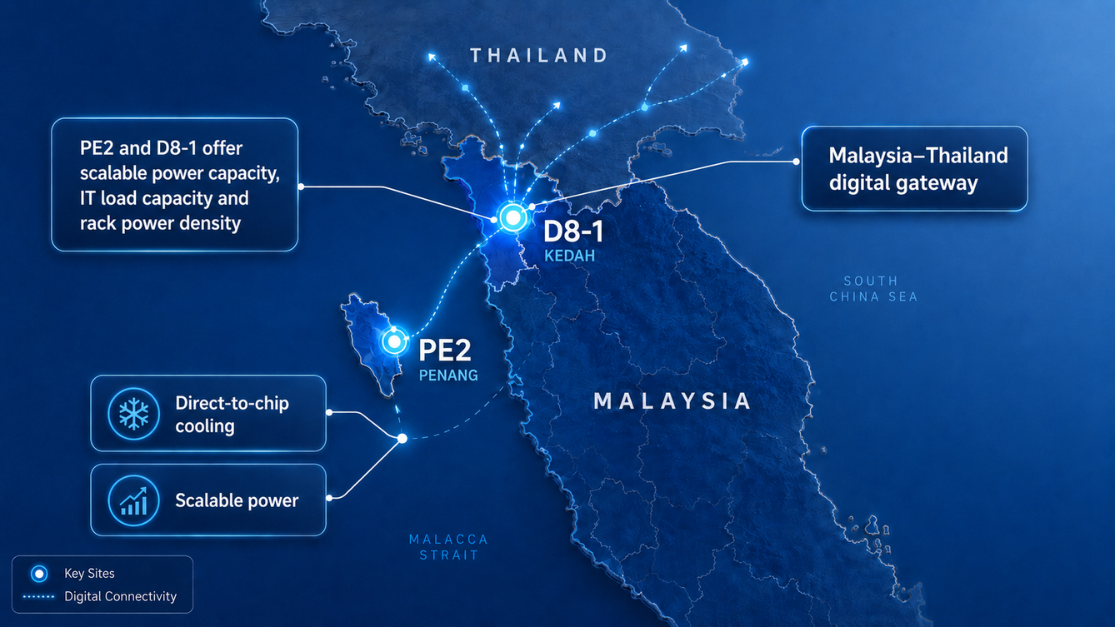
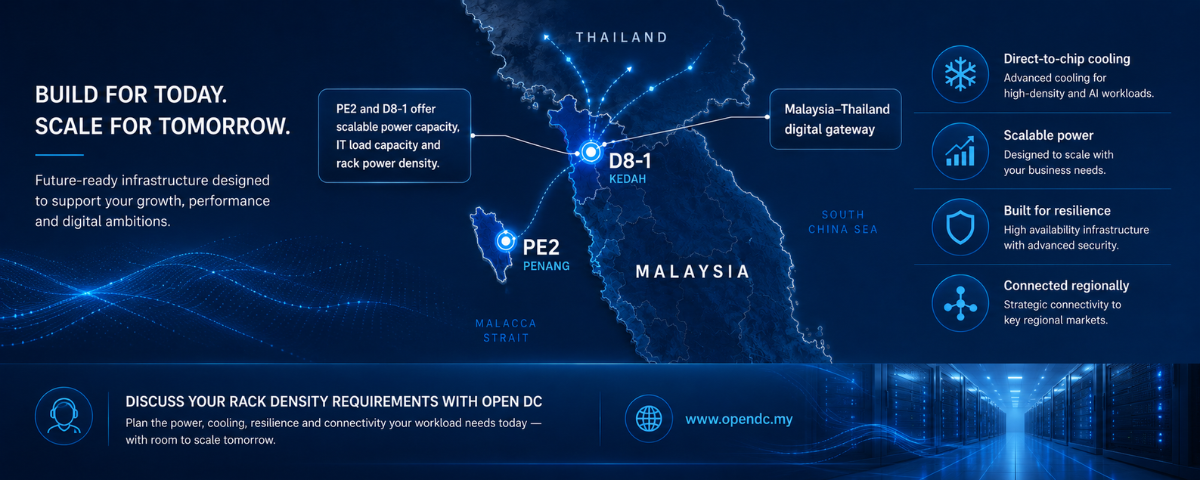
Located in Bayan Lepas Technology Park, Penang, PE2 provides a next-generation environment designed for AI, cloud computing and high-density workloads.
The facility offers scalable power capacity, IT load capacity and rack power density. Its cooling architecture includes air cooling, chilled water and direct-to-chip options, enabling customers to match cooling methods to their workload density. PE2 is designed to TIA-942 Rated 3 standards and targets a PUE below 1.5.
For organisations requiring a northern gateway and cross-border reach, D8-1 in Delapan, Kedah offers AI-ready infrastructure with scalable power capacity, IT load capacity and rack power density.
Located within the Malaysia–Thailand digital corridor, D8-1 supports regional connectivity strategies for cloud, content, telecommunications and enterprise deployments. It is designed to TIA-942 Rated 3 standards and forms part of Open DC’s carrier-neutral ecosystem.
Together, PE2 and D8-1 allow buyers to select infrastructure according to the actual workload rather than forcing every deployment into the same technical model.
Rack density may be expressed as a technical number, but its consequences are commercial. It influences how much equipment can be deployed, how efficiently floor space is used, which cooling architecture is required, how much expansion is possible and whether the infrastructure can support the organisation’s next generation of applications.
For AI deployments, rack density is also becoming a test of credibility. A data centre should not be considered AI-ready merely because it has available space or permits GPU equipment. It must be able to deliver the required power, remove the heat, maintain resilience and scale as the workload evolves.
Before selecting colocation capacity, establish the expected kW per rack, validate the full power and cooling path, and confirm how future density increases will be supported.
Empowering Southeast Asia’s Digital Future
For further enquiries
☎️: 03 8888 8188 (General Line)
📱: 012 3188 0446 (Sales)
Operating Hours: Monday – Friday, 9am – 6pm



Copyright © Open DC Sdn Bhd (1138988-T) | All Rights Reserved.