

Southeast Asia (SEA) represents the primary growth frontier for global hyperscalers, over-the-top (OTT) media platforms, content delivery networks (CDNs), and cloud service providers (CSPs). Driven by unprecedented compute demand and regional digitisation, data centre capacity across the region is projected to scale at an aggressive 24% CAGR over the coming years. For enterprise leadership and board members, scaling successfully across this […]

Southeast Asia (SEA) represents the primary growth frontier for global hyperscalers, over-the-top (OTT) media platforms, content delivery networks (CDNs), and cloud service providers (CSPs). Driven by unprecedented compute demand and regional digitisation, data centre capacity across the region is projected to scale at an aggressive 24% CAGR over the coming years.
For enterprise leadership and board members, scaling successfully across this fragmented market requires a shift from legacy centralised topologies to highly distributed edge strategies. Selecting optimal points of presence (PoPs), securing carrier-neutral interconnection, and establishing diverse cross-border backhaul routes are no longer strictly technical objectives—they are foundational board-level directives required to manage operational risk, control transit costs, and guarantee strict Service Level Agreements (SLAs).

Historically, deploying infrastructure in SEA meant establishing a monolithic hub within mature markets, predominantly Singapore. However, the traditional single-hub model has encountered structural capacity bottlenecks:

Relying on a single network corridor or a centralised hub to serve the broader ASEAN market introduces three critical business liabilities:
Relying on isolated maritime cable paths or un-diversified backhaul routes exposes the enterprise to severe network fragility. A single subsea cable cut, physical fibre disruption, or transit provider outage can instantaneously disrupt data ingress and egress, leading to catastrophic downtime, packet loss, and immediate SLA breaches.
Modern, low-latency applications—such as real-time AI inferencing, high-definition live OTT streaming, and cloud gaming—require proximity to the edge. Routing Indochina-bound traffic through distant southern nodes forces data into inefficient BGP routing paths (tromboning), causing jitter, high latency, and an uncompetitive end-user experience.
A centralised architecture severely restricts carrier options and network multi-homing capabilities. Without access to diverse cross-border paths and neutral Internet Exchanges (IXs), procurement teams lose negotiation leverage, leaving enterprise operating margins highly vulnerable to localised IP transit pricing monopolies.
To mitigate these infrastructure vulnerabilities, cloud and content architectures must transition toward a resilient,
multi-corridor blueprint.
Malaysia has rapidly solidified its position as the premier infrastructure safe haven and primary transit gateway for Southeast Asia. Due to its strategic geographical position, it operates as a physical and digital bridge, enabling cloud and content providers to seamlessly bifurcate regional traffic—retaining low-latency access to the southern ecosystem while unlocking direct terrestrial pathways into high-growth northern markets.
Open DC has systematically deployed carrier-neutral data centres at critical cross-border inflection points, allowing enterprises to completely bypass traditional ASEAN routing bottlenecks.
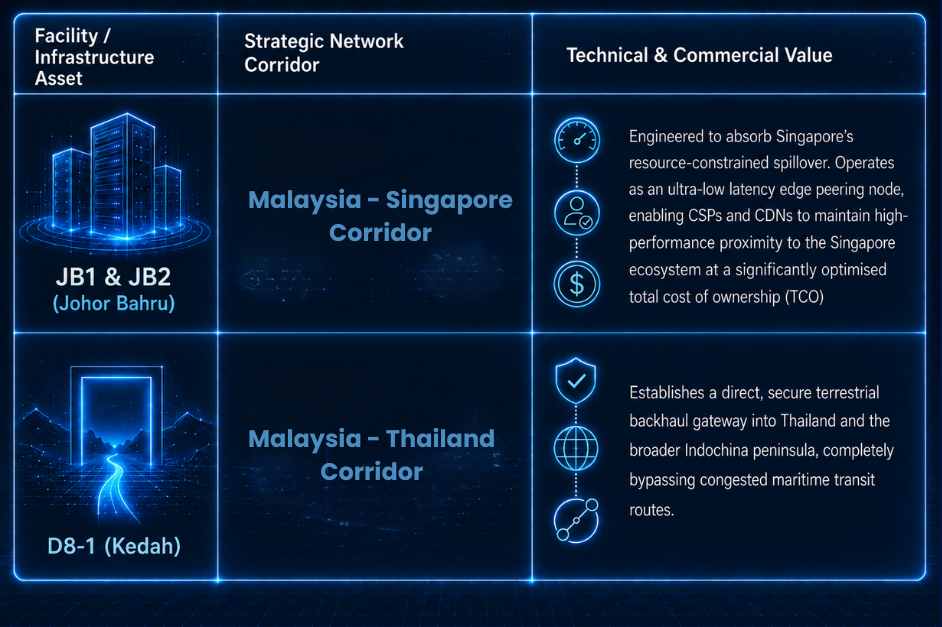
By deploying edge infrastructure across Open DC’s carrier-neutral footprint, enterprises establish an asymmetric competitive advantage:
In an era where regional digital demand is expanding at a 24% CAGR, network architecture dictates corporate resilience. Implementing a dual-corridor edge topology eliminates concentrated asset risk, safeguards enterprise SLAs, and ensures predictable operational scaling.
As digital architectures evolve, the line between technology and governance has entirely dissolved. Compute capacity can be purchased as a commodity, but geography dictates operational resilience.
When your leadership team reviews its regional growth strategy, a critical question remains: Are we positioning our digital infrastructure where the market was yesterday, or are we architecting it for the geographical realities of tomorrow? Centralisation offers comfort, but diversity guarantees survival.
Empowering Southeast Asia’s Digital Future
For further enquiries
☎️: 03 8888 8188 (General Line)
📱: 012 3188 0446 (Sales)
Operating Hours: Monday – Friday, 9am – 6pm



Copyright © Open DC Sdn Bhd (1138988-T) | All Rights Reserved.