

Malaysia has connected around 5.65 GW of data centre capacity to the electricity grid. It is currently using about 1.26 of them. That is the most informative pair of numbers in the sector, and it has had almost no coverage. It means the wires are in, the substations are built, the buildings are largely finished […]

Malaysia has connected around 5.65 GW of data centre capacity to the electricity grid. It is currently using about 1.26 of them.
That is the most informative pair of numbers in the sector, and it has had almost no coverage. It means the wires are in, the substations are built, the buildings are largely finished — and roughly three-quarters of what has been connected is not yet drawing power, because the machines that will eventually fill those halls have not been installed or switched on.
Which is to say: the building phase is close to finished. The running phase has barely begun.
That distinction has been missing from five years of argument about this industry, and almost every disagreement Malaysians have had about data centres makes more sense once it is in place.
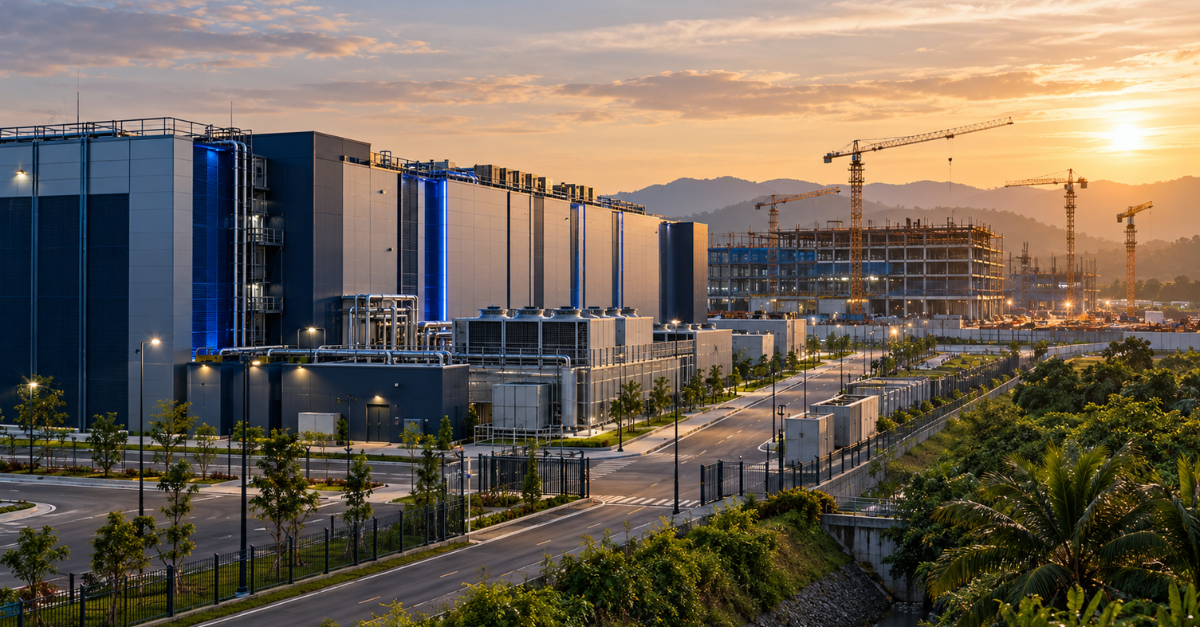
Since 2021, Malaysia has approved somewhere in the region of RM385.7 billion of data centre investment, including RM95.8 billion in the first half of 2026 alone — about 44 per cent of everything approved across the entire economy in that period.
Those figures need a caveat that rarely travels with them. Approved investment is money that has cleared a government approval gate. It is not money that has been spent. MIDA says so plainly in its own releases: approvals reflect potential investment, realised over a period that usually runs across several years. Some approved projects are built at half the announced scale. A few are never built at all.
What has been built is easier to count.
By early 2026 the country had around 36 operating data centres and roughly 23 more under construction. The electricity utility has spent heavily to keep up, committing about RM43 billion of grid investment for the current regulatory period, and it created a fast-track connection route that cut the wait for a supply connection from three or four years to around twelve months.
That is a genuine national achievement of civil engineering and electrical planning. It is also, almost entirely, a story about construction — and construction is the phase that produces the least useful evidence about whether any of it is good for the country.
This is where most of the public argument about jobs has gone wrong, on both sides.
Building a data centre employs numerous headcounts for a relatively short time: civil contractors, electricians, mechanical fitters, riggers, commissioning engineers. Those jobs are real, well paid and temporary by design. When the building is handed over, that workforce moves to the next site.
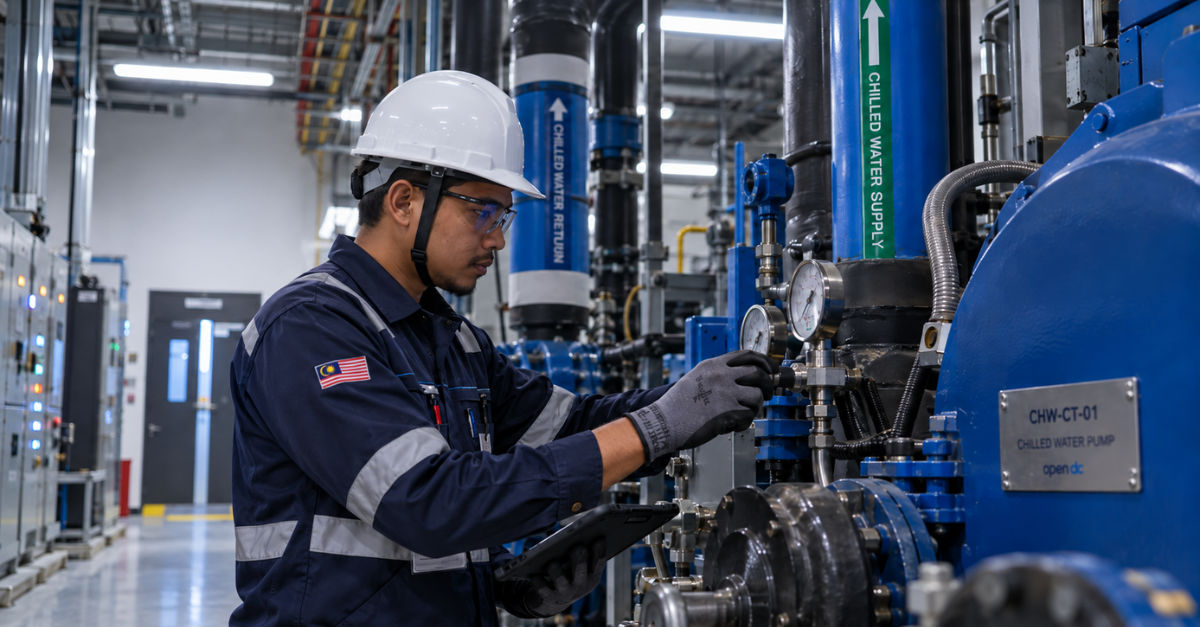
Running a data centre employs far fewer people, permanently, and the roles are different in kind. Facilities and critical environment engineers. Mechanical and electrical technicians who maintain the cooling and power systems. Network operations staff who watch the connectivity. Security. Change control and compliance. Procurement, because an operating building buys spare parts, chemicals, servicing and maintenance contracts every month for twenty years.
When the OECD looked at Malaysian data centres in July 2026 and found comparatively little employment against the scale of capital, it was measuring a sector still mostly in the first phase. That finding was fair and it will not be the final word, because the second phase has a different employment profile — smaller, permanent, more technical, and spread across suppliers rather than concentrated on site.
Two figures give a sense of the shape. Around 2,325 higher-value jobs were recorded as created between 2021 and 2023. And Malaysia’s Works Minister has put the national shortfall at 100,000 engineers beyond the roughly 200,000 currently registered. Against a gap that size, no single operator’s hiring is going to be decisive. What the operating phase changes is that hiring becomes continuous rather than project-shaped, which is the kind of demand a technical college can actually plan a syllabus around.
For most of the construction phase, the sector’s electricity consumption was a forecast. It has stopped being one.
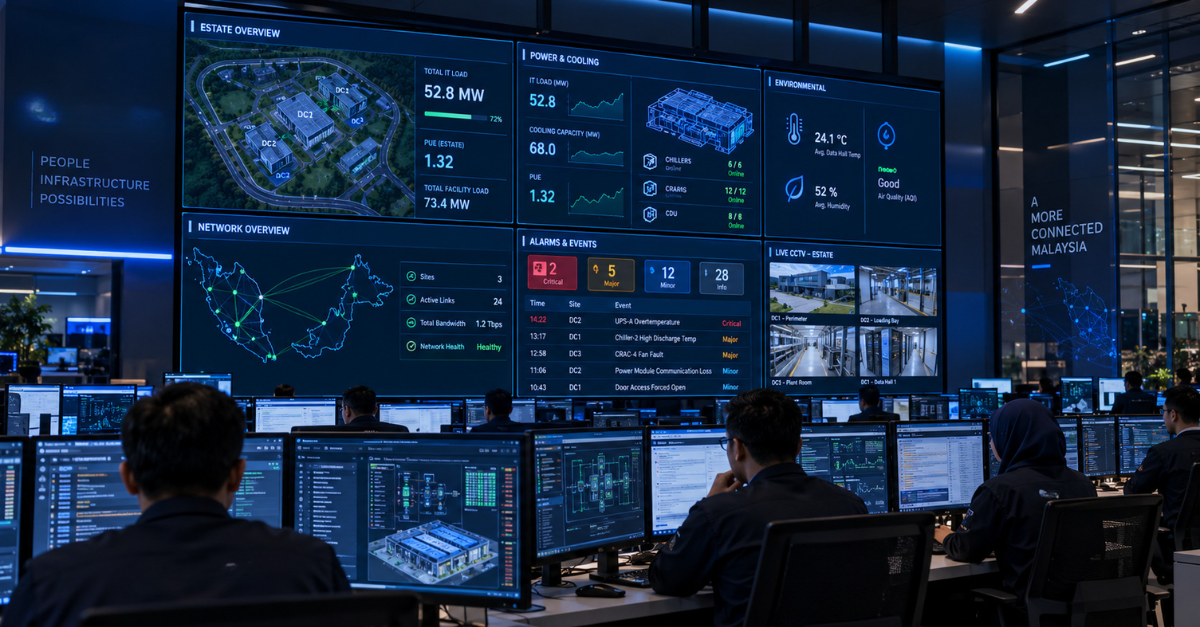
By the middle of August 2026, data centres accounted for roughly 9.28 per cent of Malaysia’s electricity consumption, up from around 6 per cent in the first half of the year. Actual peak demand from data centres in Peninsular Malaysia was recorded at about 849 MW in December 2025, with projections running to around 4,811 MW by 2030.
Longer-range forecasts vary depending on who is doing the forecasting, generally landing somewhere between 31 and 35 per cent of Peninsular Malaysia’s electricity by 2035. Forecasts that far out should be read as scenarios rather than predictions.
The reason this matters now rather than in 2035 is the gap in the opening paragraph. Most of what is connected is not yet drawing. As those halls fill, consumption rises without a single new approval being granted, which means the national conversation about generation, tariffs and grid capacity is about to become considerably more concrete than it has been.
That is uncomfortable for the industry and it is also, straightforwardly, better. An argument conducted over forecasts cannot be settled. An argument conducted over meter readings can.
The same logic applies to water, which has become the sharpest local objection to new facilities.
The current volumes are modest and not widely known. Johor’s operating data centres together draw about 9.07 million litres a day, roughly 0.6 per cent of state consumption, and since June 2026 about 12 million litres a day of treated effluent has been made available to them as an alternative to fresh supply. Johor has nonetheless stopped approving its two highest water-use categories and told developers relying on water cooling to expect a wait.
We set out the full picture in litres a week ago, including the figures the sector should be publishing and the ones we cannot yet publish ourselves. The short version is that the operating phase is when water use stops being a design assumption and becomes a monthly bill that somebody can be asked to produce.
An announcement cannot be verified. A rendering cannot be verified. An approved investment figure cannot be verified by anyone outside the approval process, which is precisely why the argument about this industry has been so unsatisfying for everybody involved.
An operating building is different. It produces four things every month that exist whether or not anyone chooses to publish them.
1. A meter reading. Exactly how much electricity the building used, and when.
2. A water bill. Exactly how many litres, from which supply.
3. A payroll. How many people, in which roles, on what terms, and how many of them are Malaysian.
4. A purchase ledger. Which suppliers were paid, for what, and how many of them are Malaysian companies.
Those four records settle nearly every question that has been argued in adjectives since 2021. They already exist in every operating facility in the country. Not one operator is required to publish them, and until recently almost none did.

For a reader who wants to follow this without waiting for the next announcement, these are the indicators that will actually show whether the operating phase delivers.
1. The gap between connected capacity and capacity in use. As 1.26 GW moves towards 5.65 GW, the sector’s real electricity footprint becomes visible. Watch the utility’s reported live load, not the approval figures.
2. Whether operators publish employment figures with definitions attached. A headcount without a definition — direct staff or contractors, citizens or residents, as at which date — is not checkable, and the definition matters more than the number.
3. Local supplier spend as a share of addressable procurement, meaning spend in categories where a qualified Malaysian supplier actually exists. Share of total procurement is a flattering figure and a meaningless one.
4. Measured efficiency and measured water use per site, rather than design targets. A design figure is an intention; a measured figure at a stated load is a record.
5. Whether apprenticeships convert into permanent roles. Places offered is a marketing number. Completions and conversions into permanent employment is the one that tells you whether a training pipeline exists.
Empowering Southeast Asia’s Digital Future.
For further enquiries
☎️: 03 8888 8188 (General Line)
📱: 012 3188 0446 (Sales)
Operating Hours: Monday – Friday, 9am – 6pm


Copyright © Open DC Sdn Bhd (1138988-T) | All Rights Reserved.