

For most of the past decade, sustainability in a colocation tender was a conversation conducted in adjectives. An operator described its approach, a buyer recorded that a description had been provided, and both parties moved on to the commercial schedule. Malaysia has ended that arrangement. The Guidelines for Sustainable Development of Data Centre put numbered […]

For most of the past decade, sustainability in a colocation tender was a conversation conducted in adjectives. An operator described its approach, a buyer recorded that a description had been provided, and both parties moved on to the commercial schedule.
Malaysia has ended that arrangement. The Guidelines for Sustainable Development of Data Centre put numbered thresholds against named facility categories, set a water figure, define a carbon calculation, and tie the whole thing to eligibility for the incentive scheme most operators are building against. There is a date on it: applications to MIDA under the Digital Ecosystem Acceleration scheme run to 31 December 2027.
None of that is addressed to tenants. All of it reaches them.
Power usage effectiveness — PUE — is the ratio of total facility energy to the energy delivered to IT equipment. A PUE of 1.6 means that for every kilowatt-hour reaching a server, six-tenths of a kilowatt-hour again goes to cooling, power conversion losses and everything else that keeps the hall running. Lower is better, and 1.0 is the theoretical floor.
The guidelines set the threshold by category rather than applying one figure to the whole industry, which is the detail most summaries omit and the one that matters most in an evaluation.
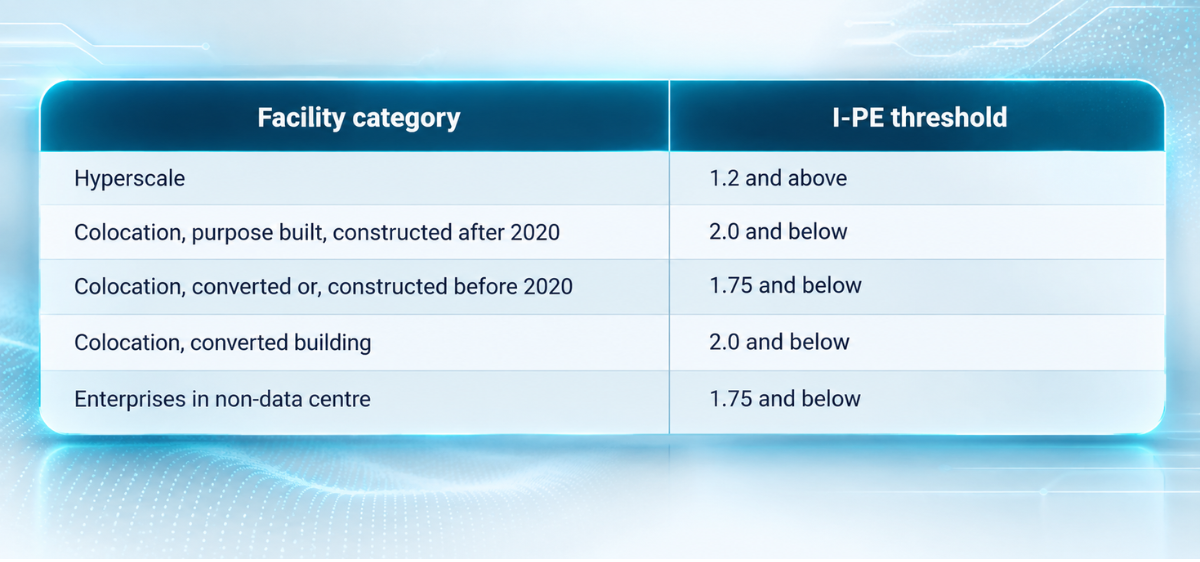
Read that table from a buyer’s seat and the consequence is immediate. A converted building reporting 1.68 is compliant. A new purpose-built colocation facility reporting the same 1.68 is not. Two operators can hand over identical efficiency figures and occupy opposite sides of the line, and an RFP that asks for PUE without asking for the category has collected a number it cannot interpret.
The guidelines run across six facility types with power capacities from around 0.85 MW up to above 21.25 MW, so size as well as type sits inside the framework.
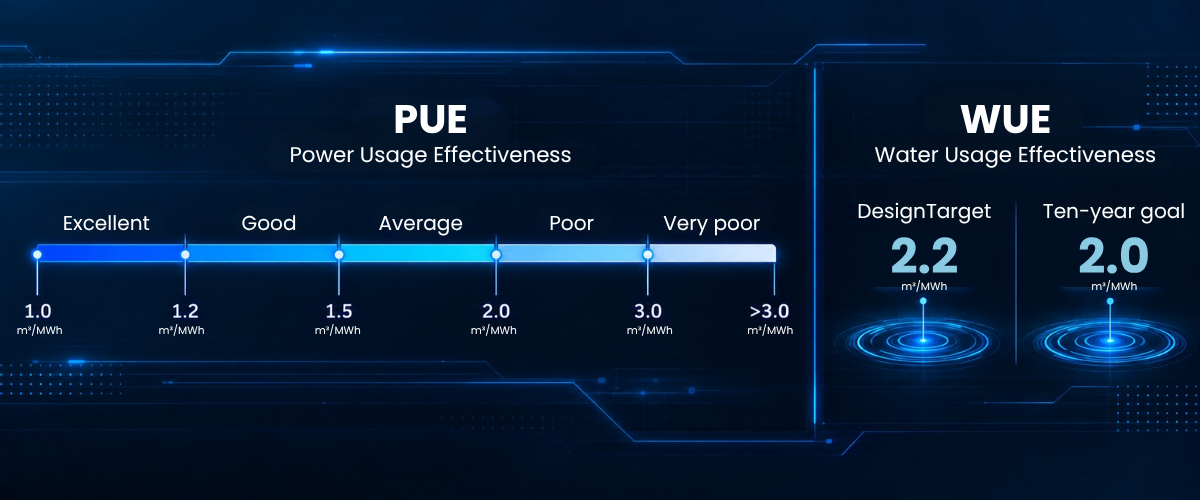
Water usage effectiveness — WUE — measures water consumed per unit of IT energy delivered, expressed in cubic metres per megawatt-hour. A cubic metre is a thousand litres, so a WUE of 2.2 is roughly 2,200 litres of water for each megawatt-hour of IT energy.
The guidelines set 2.2 m³/MWh or lower as the design target, with an expectation of reaching 2.0 or lower within ten years. There is a qualification worth noticing: the threshold applies in areas with a water stress index below 0.8, which covers Peninsular Malaysia.
A national threshold is not the whole exposure, though, because states have added their own layers. Johor stopped approving its two highest water-use tiers in November 2025 and has told developers relying on water-based cooling to expect a deferral of around eighteen months into mid-2027. A design that clears the national WUE threshold can still meet a state approval problem, and for a buyer whose expansion depends on a second phase in the same building, that is a schedule risk rather than an environmental one.
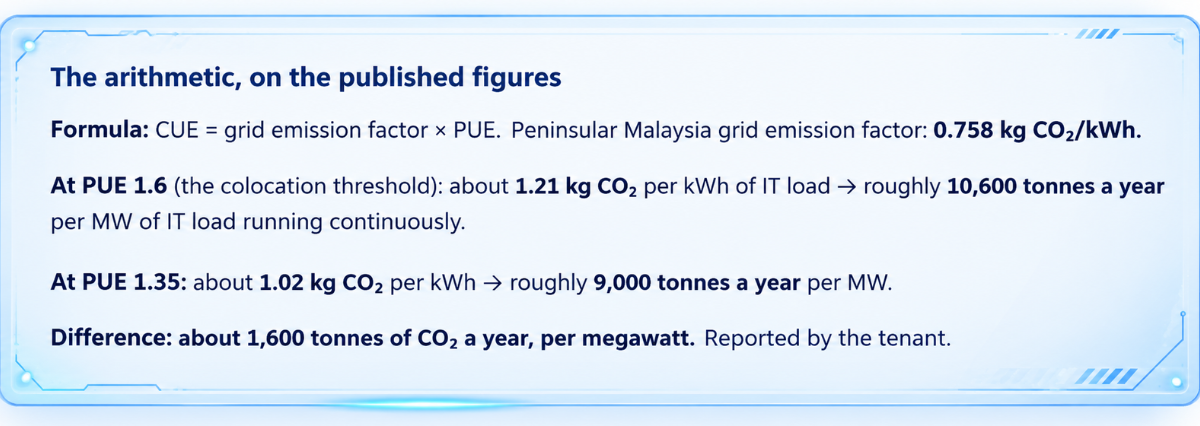
Carbon usage effectiveness — CUE — is defined in the guidelines as the grid emission factor multiplied by PUE, expressed in kilograms of CO₂ per kilowatt-hour.
The grid emission factor is the carbon intensity of the electricity supply. For Peninsular Malaysia the published figure is 0.758, which means roughly 0.758 kg of CO₂ for every kilowatt-hour drawn from the grid. The comparison figure used for solar photovoltaic generation is 0.046.
Multiply those out and the facility’s efficiency becomes the tenant’s carbon number.
A facility operating at the 1.6 colocation threshold produces about 1.21 kg of CO₂ for every kilowatt-hour reaching the tenant’s equipment. A facility operating at 1.35 produces about 1.02. Across one megawatt of IT load running continuously for a year — 8,760 megawatt-hours at the rack — that is roughly 10,600 tonnes of CO₂ against roughly 9,000. A difference of about 1,600 tonnes a year, on the same workload, in the same country, on the same grid.
That difference does not appear on the operator’s disclosure. It appears on the tenant’s, as they’re the one consuming the electricity. Any organisation with a science-based target, a regulatory reporting obligation or a customer asking about supply chain emissions has just found a material variable sitting inside a facility decision that its sustainability team was probably not consulted on.
Guidelines without consequences get filed. These have two sets of consequences, and they arrive from different directions.
The first is fiscal. Compliance is tied to the Digital Ecosystem Acceleration scheme, and applications to MIDA under it run to 31 December 2027. An operator’s incentive position affects its cost base, which affects its pricing and its appetite to invest in the building over a ten-year lease. A buyer signing a long term has an interest in whether the landlord qualifies.
The second is approval- The Data Centre Task Force, co-chaired by the Ministry of Investment, Trade and Industry (MITI) and the Ministry of Digital, received more than 40 applications to build or expand in 2026. Applications are assessed on investment value together with energy, water and connectivity requirements and the project’s contribution to Malaysia’s longer-term ambitions. Government has also signaled that standards for power, water and carbon efficiency are being formalized further.
The direction of policy is not ambiguous. Malaysia has approved around RM385.7 billion of data centre investment since 2021, including RM95.8 billion in the first half of 2026 alone, and MITI framed the position plainly in September: the next phase is about what that capacity delivers. Efficiency thresholds are one of the instruments through which that judgement will be made.
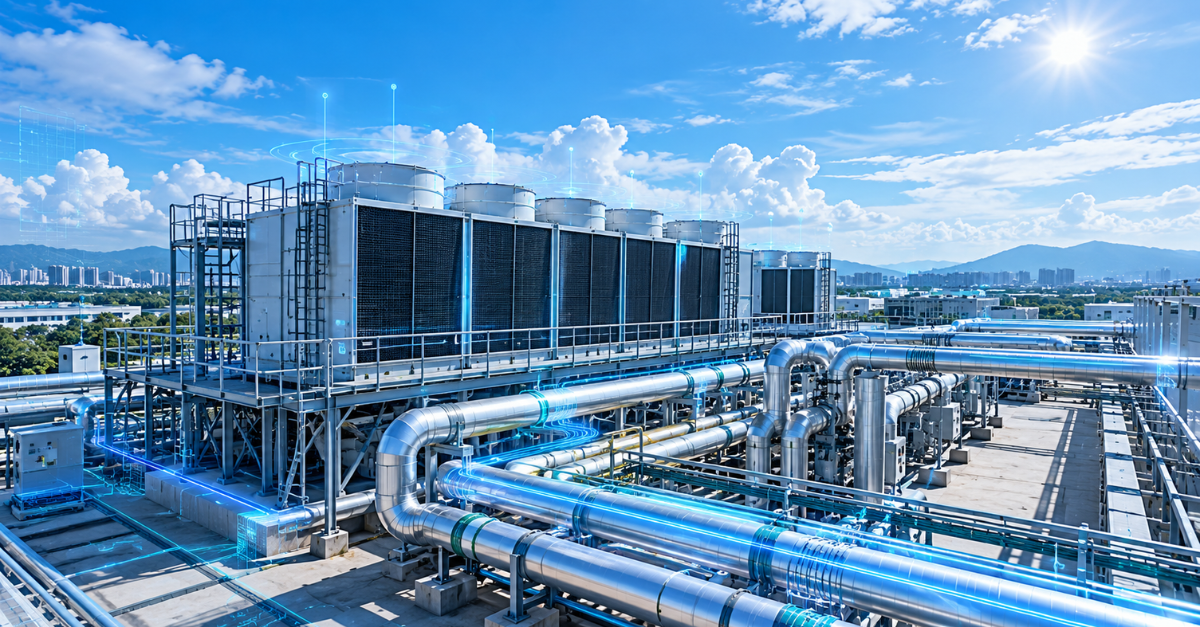
Each of these replaces a boilerplate request with something that produces a comparable answer.
1. State the guideline category this facility falls into and the applicable PUE threshold for that category. Without it, a reported efficiency figure cannot be evaluated.
2. Provide measured annualised PUE for the specific hall, with the load factor and measurement period stated — not the design target and not a portfolio average.
3. Provide the water usage effectiveness position for this facility, with source of supply and the share drawn from reclaimed water, and confirm whether any state-level approval condition applies to the site or to planned phases.
4. Calculate carbon usage effectiveness on the published grid emission factor at the facility’s stated PUE, and confirm what proportion of supply is contracted outside the standard tariff through a renewable scheme.
5. Confirm the facility’s incentive status and any efficiency commitments attached to it that persist through the lease term.
There is a reasonable objection to the second of those, and it should be acknowledged rather than argued away. Measured PUE moves with load factor, and a building at thirty per cent occupancy will report worse than the same building at eighty per cent, through no fault of its design. That is why the load factor is part of the request. An operator giving a measured figure with its load factor is being straightforward. An operator giving only a design figure is describing an intention, and intentions do not appear in the carbon calculation above.
Open DC’s purpose-built colocation facilities sit in the category carrying the 1.6 threshold, against a design and target PUE below 1.5 across the estate. That is a stated margin against the applicable line, not a claim of category leadership, and the distinction matters on a post about reading numbers accurately.
The certification position is a matter of record rather than description: TIA-942 Rated 3 at PE2 in Bayan Lepas, Uptime Institute Tier III facilities at D8-1 at Bukit Kayu Hitam, ISO 27001 and PCI DSS across the estate. Specifications are published per site rather than as portfolio totals — JB1 at 20 MW with 2 MW of critical load per floor, PE2 upgradable to 100 MW, D8-1 upgradable to 20 MW at 33 kV with cooling customisable to support direct liquid cooling. For a reader weighing high-density deployment against a fixed efficiency threshold, the cooling architecture is the part of that specification that decides whether the threshold holds as densities rise.
Sitting across three corridors also means sitting inside and outside the Johor tiering regime, which is a live approval variable for anyone planning a second phase in that state.

Empowering Southeast Asia’s Digital Future.
For further enquiries
☎️: 03 8888 8188 (General Line)
📱: 012 3188 0446 (Sales)
Operating Hours: Monday – Friday, 9am – 6pm

Copyright © Open DC Sdn Bhd (1138988-T) | All Rights Reserved.