

The largest data centre number in Malaysia this year is RM95.8 billion. It is also the furthest from anything you can plug a server into. That figure comes from MIDA, covering approved data centre and cloud investment in the first half of 2026 — 43.8% of the RM218.5 billion approved across the whole economy, itself […]

The largest data centre number in Malaysia this year is RM95.8 billion. It is also the furthest from anything you can plug a server into.
That figure comes from MIDA, covering approved data centre and cloud investment in the first half of 2026 — 43.8% of the RM218.5 billion approved across the whole economy, itself up 11.7% on a year earlier. It is a genuine, audited, significant number. MIDA is also careful to say what it is: approved investment “reflects potential investments” that “will be realised into actual inflows over a specified period, usually across multiple years.”
That caveat rarely survives the journey into a pitch deck.
By the time a buyer sits down with three proposals:
It is not. Somewhere between the approval and the rack there are four more numbers, each smaller than the last, and the market has developed a habit of adding them together rather than reading them in sequence.
For a bank running a regulator-facing dual-site mandate, a cloud provider moving workloads out of Singapore, or an AI platform trying to land 20 MW before the financial year closes, that habit is expensive. It is the difference between a signed contract and an eighteen-month wait nobody priced in.
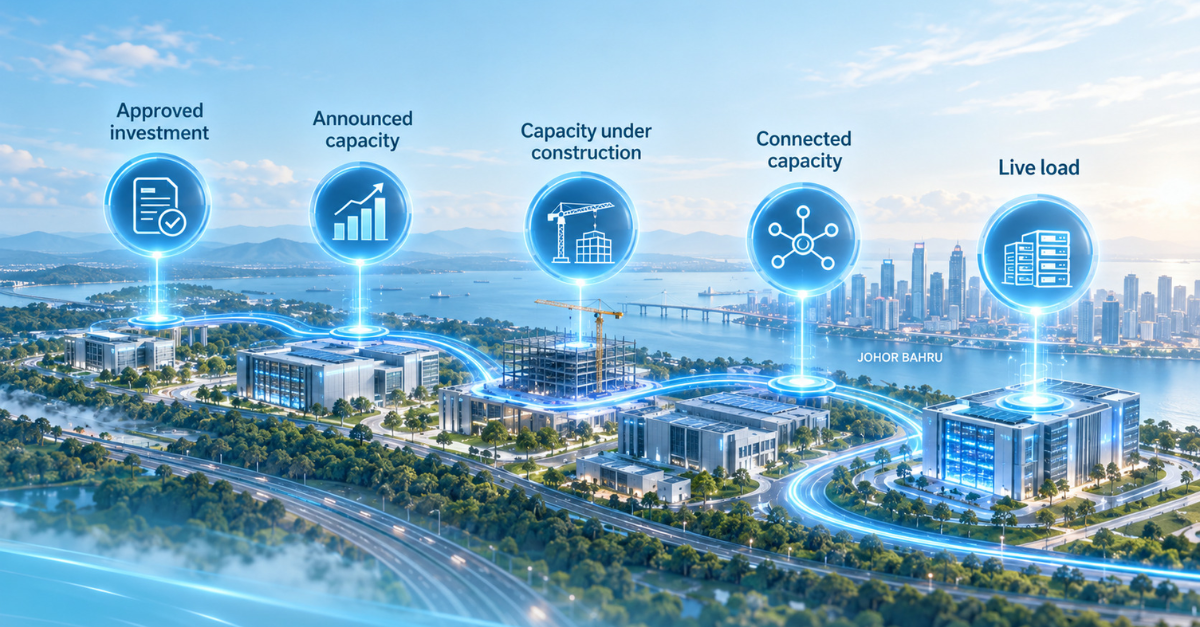
Approved investment. RM95.8 billion in six months. This is capital that has cleared an approval gate, not concrete. Projects at this stage may still be seeking land, power, water or community consent. Some will be built at half the announced scale. A few will never be built at all.
Announced capacity. The press release megawatt. Knight Frank’s 2026 atlas counts 8,542 MW of incoming capacity behind Johor alone; Cushman & Wakefield log 2,486 MW there specifically in the planning stage, up 19% in a single half-year. These are real intentions backed by real money. They are not halls. And the tally has a structural flaw: nothing ever removes a project that slipped, shrank or died, so the pipeline only grows.
Capacity under construction. Steel in the ground with a ready-for-service date. Malaysia leads South-East Asia here — 1.039 MW under construction as of H1 2026, ahead of Thailand’s 0.859 GW, with 0.602 GW of that in Johor. Far more reliable than the two figures above it, but still a forecast. This is capacity that will exist, not capacity that does.
Connected capacity. The utility’s number, and the one most often mistaken for availability. Tenaga Nasional has energised 36 data centre projects carrying roughly 4.5 GW of committed maximum demand, inside a wider secured portfolio of 59 projects and 8.3 GW. Around 68% of that capacity sits in Johor. Connected means the grid link exists and the contract is signed. It says nothing about whether the white space behind it is built, commissioned or already spoken for.
Live load. What is actually being drawn. TNB reported 1.05 GW of data centre load utilisation in the first quarter of 2026 — a 117% jump year on year, and still only about 23% of the connected 4.5 GW. The gap was starker eighteen months earlier: in December 2024, Electricity Supply Agreements covered 5.9 GW of maximum demand against roughly 0.405 GW in use.
Five numbers. Five different questions answered. Read in sequence they describe a market maturing at pace. Added together they describe nothing at all.
None of the five tells a buyer what they came to find out. The figure that matters is sellable capacity: commissioned white space, not reserved by an anchor tenant, at the rack density you actually need, with power on a date that can go into a contract.
Johor shows why the distinction bites hardest exactly where the headlines are loudest. The state holds 1.110 GW of operational IT capacity, up 24% on the second half of 2025, inside roughly 4.198 GW of total stock. Yet colocation vacancy there has fallen to 0.7% — after 0.212 GW came online during the half. New capacity is being absorbed on arrival, much of it pre-leased long before commissioning.
So the honest reading of Johor in 2026 is not “8.5 GW of capacity”. It is closer to: enormous ambition, 1.1 GW operating, and almost nothing on the shelf. Two figures that sound like the same market are describing opposite experiences of it.
The gap between announcement and delivery is no longer just a procurement irritation. It has become a credibility problem for the whole sector, and August made that visible.
The proposed Kota Damansara facility was withdrawn on 28 July 2026, the consultant citing a need to re-evaluate the site’s feasibility and development components. Behind it was organised local opposition — Gabungan Penduduk Kota Damansara, representing more than 500 households in Section 9, had formally objected on noise, round-the-clock operation, heat, energy consumption near the community forest and traffic. The Petaling Jaya City Council confirmed the project had not even reached its One-Stop Centre for approval.
Read that alongside the Prime Minister’s February 2026 confirmation that approvals for non-AI data centres had been held back for roughly one to two years on power and water grounds, and Wood Mackenzie’s June assessment that transmission and distribution — not generation — is now the binding constraint on Johor’s growth, and a pattern emerges. Announcements are cheap and loud. Withdrawals are quiet. Buyers have learned to apply a discount to everything, which punishes the operators telling the truth as much as the ones inflating.
The only way out of that is measurement. An operator who publishes numbers a buyer can check does not need to argue about credibility.

One correction worth holding onto, because it cuts the other way.
“There is no power left in Malaysia” is not what the data says. Roughly 1.05 GW is being drawn against 4.5 GW already connected, and those connections sit under five-year take-or-pay agreements — TNB recovers its capital regardless of consumption, which is precisely why contracted capacity looks like usage on paper when it is nothing of the sort. A hyperscaler holding headroom for a 2029 build appears in the same column as a facility running flat out today.
The grid is heavily committed. It is nowhere near consumed. What is genuinely scarce is deliverable capacity, in a specific corridor, on a specific date — and that scarcity is intensely local. Capacity queued behind one congested substation behaves nothing like capacity spread across several corridors.
Which is the strongest argument against concentration. With 68% of contracted data centre capacity and 0.7% vacancy, Johor is not a safe default anymore; it is a single point of contention. Penang’s semiconductor and AI cluster, the Klang Valley’s enterprise and financial base, and the northern border corridor all now carry capacity that is not competing for the same transformers.
Treat this as the minimum in any Malaysian RFP. Ask for it in writing, per site, and expect a straight answer.
An operator who cannot break their number into those five parts is quoting announced capacity, whatever they choose to call it.
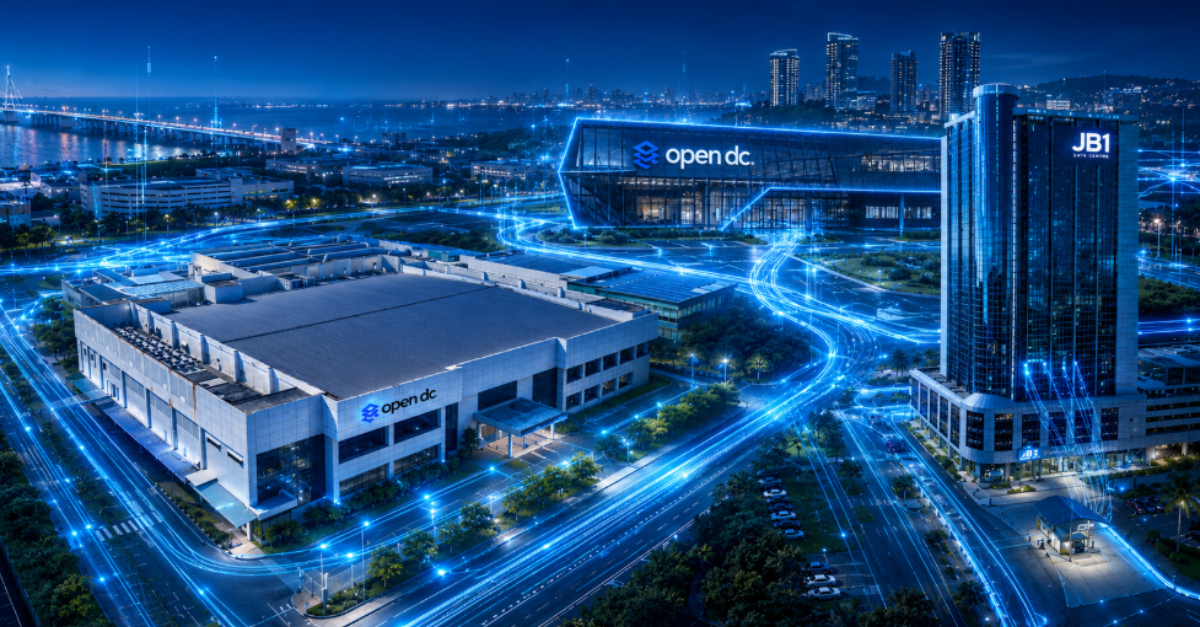
We report live, reserved and sellable capacity per site, with energisation dates and the dependencies attached to them — not a masterplan total, not a design figure, not a portfolio headline. Three examples, in public:
JB1, Johor Bahru. 20 MW, with 2 MW of critical load per floor across 200,000 sqft and 30 floors, two (2) kilometres from the main Causeway. On-net with the DE-CIX JB node and JBIX, 15 carriers, dark fibre to the Causeway and to JB2, DWDM and Metro Ethernet into Singapore. Chilled water, target PUE 1.5, ISO 27001, ISO 9001, PCI DSS.
PE2, Bayan Lepas. 10 MW live, upgradable to 30 MW, across 110,000 sqft. Target PUE below 1.5, TIA-942 Tier 3 certified, ISO 27001 and PCI DSS compliant, with a DE-CIX node and dark-fibre DCI back to PE1 — sitting inside Penang’s semiconductor and industrial AI cluster.
D8-1, Bukit Kayu Hitam. 5 MW live today, upgradable to 20 MW at 33 kV, with 40,000 sq ft of available floor space in a 47,000 sqft first phase. DE-CIX Premium-enabled, dark fibre to the Malaysia–Thailand border via Bukit Kayu Hitam-Sadao, and more than 20 terrestrial cable routes plus four cable landing stations carrying 16 subsea cables within a 120 km radius. Under six kilometres from the Thai border, inside the Delapan Special Border Economic Zone(SBEZ).
Add CJ1 in Cyberjaya, PE1 in Bayan Lepas and JB2 in Johor Bahru, and the portfolio spans three economic corridors rather than one. A buyer blocked by a substation queue in one is not automatically blocked in the others, and a genuinely diverse dual-site design can be built inside a single operator’s estate.
Every site is carrier-neutral and DE-CIX-enabled, with JBIX and Causeway Connect available for Singapore-adjacent workloads. Interconnection is live from handover, not scheduled after it.
Malaysia’s numbers will not get simpler. The approvals will keep landing, the pipeline will keep growing, and the totals will keep being added together by people with no reason to separate them. The practical defence is to stop accepting a single figure and start asking for the breakdown.
Request a capacity disclosure for any Open DC site — live, reserved and sellable MW, with energisation dates and dependencies. Get in touch, or book a walk-through of JB1, PE2 or D8-1 and see the halls behind the figures.
Empowering Southeast Asia’s Digital Future.
For further enquiries
☎️: 03 8888 8188 (General Line)
📱: 012 3188 0446 (Sales)
Operating Hours: Monday – Friday, 9am – 6pm



Copyright © Open DC Sdn Bhd (1138988-T) | All Rights Reserved.