

Most colocation is sold in kilowatts. Most of what runs in a rack is judged in milliseconds. If your servers talk to Google all day, through Workspace, Google Cloud APIs, YouTube or a SASE service, the path from your rack to Google matters as much as the power behind it. This post, written jointly by […]

Most colocation is sold in kilowatts. Most of what runs in a rack is judged in milliseconds. If your servers talk to Google all day, through Workspace, Google Cloud APIs, YouTube or a SASE service, the path from your rack to Google matters as much as the power behind it.
This post, written jointly by Open DC and DE-CIX Malaysia, shows how colocation with Google peering in Malaysia works in practice: one rack at Open DC, one cross-connect to DE-CIX, and Google’s routes on your port.
Because distance and extra networks both cost you. Light in fibre adds about a millisecond of round-trip time every 100 km, and every network between you and Google is another place where congestion can build. When the exchange is in the same building as your rack, the first hop to Google is a cross-connect a few hundred metres long.
Google now recommends that networks reach it through a Verified Peering Provider (VPP) rather than peering directly. DE-CIX is one of the first Internet Exchange operators globally to achieve Google VPP Gold status, the tier Google awards for metro-level redundancy. At DE-CIX, Google’s prefixes are on the route servers. Connect to the exchange and you receive them, with no separate agreement and no minimum bandwidth.
The starter design, for a company with an ASN running a single site.
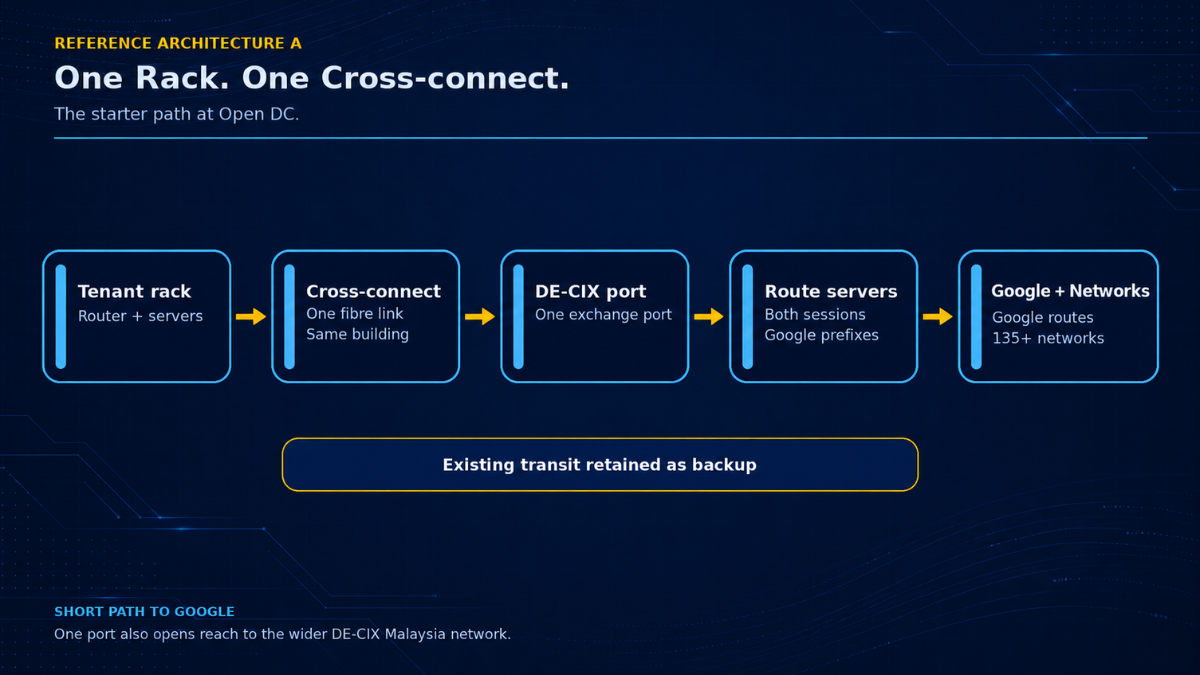
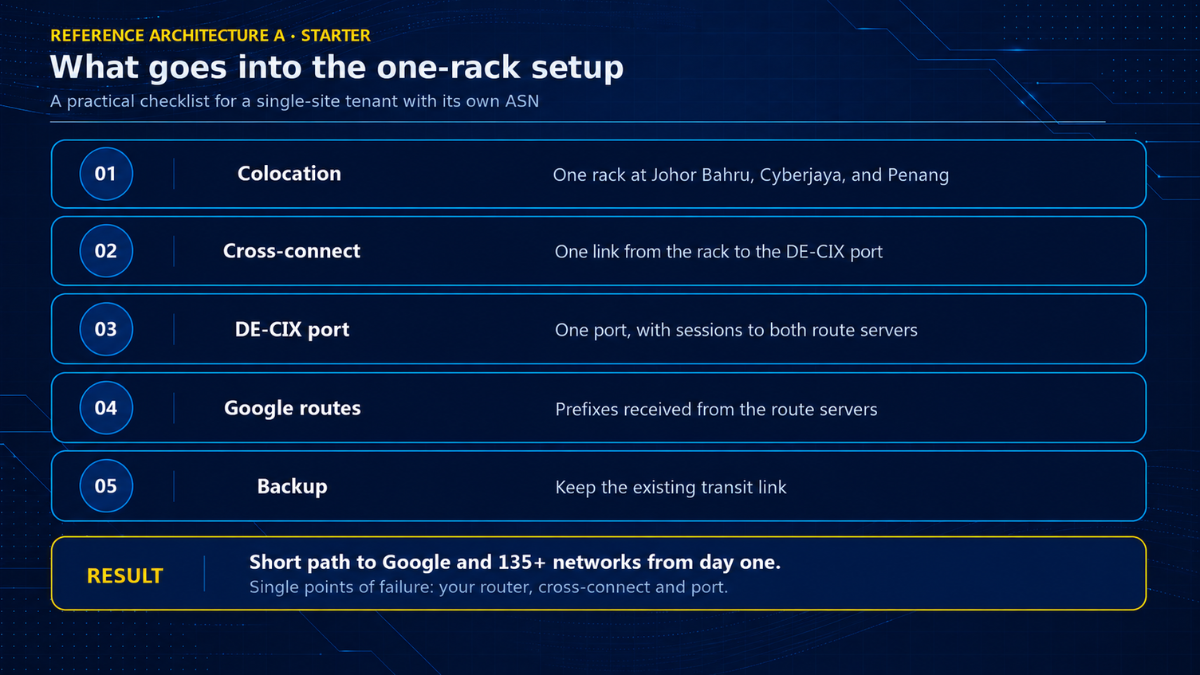
Gets you: a short path to Google and every network on DE-CIX from day one.
Single points of failure: your router, your cross-connect and your port. Fine for many workloads; not for critical ones.
For banks, SaaS platforms and anyone who cannot lose Google connectivity.
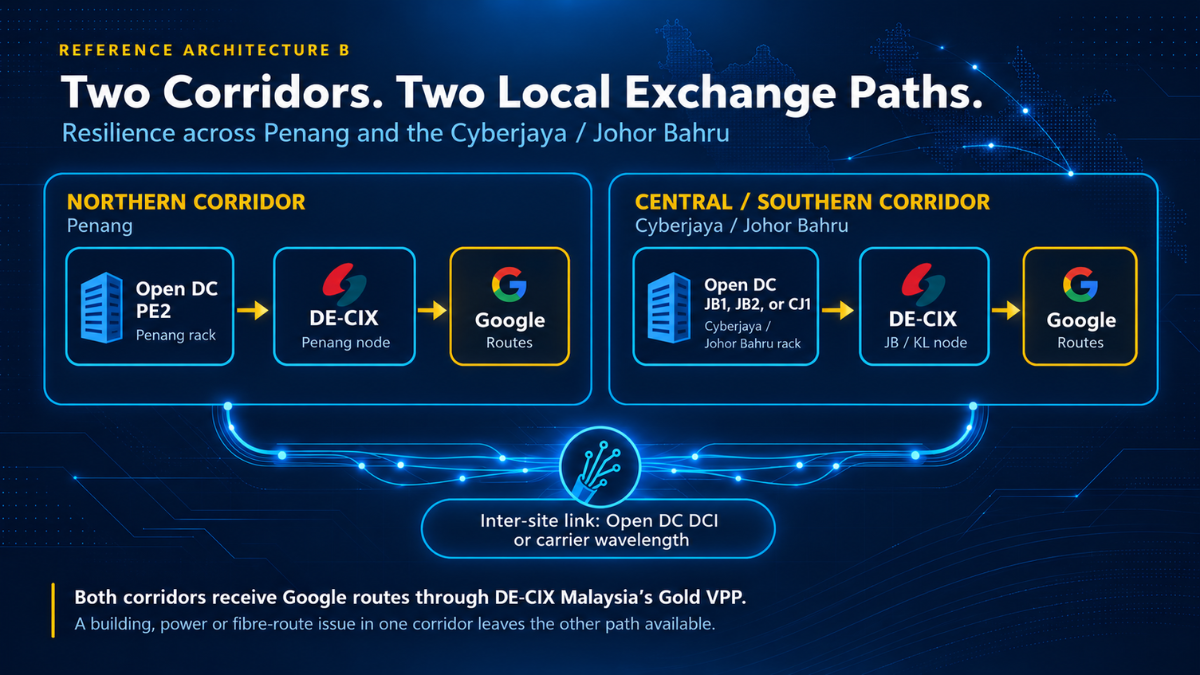
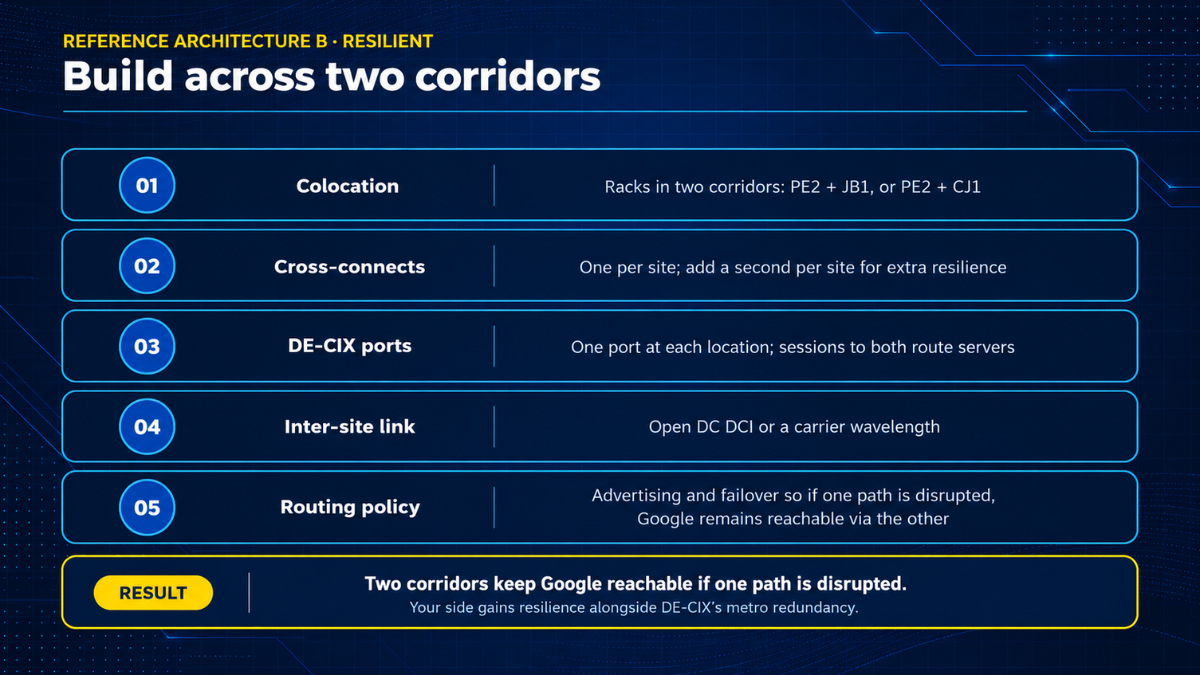
Gets you: your side is now as redundant as DE-CIX’s Gold-rated side. Lose a building, a city’s power or a fibre route, and Google stays reachable. It also matches the production-plus-recovery design that Bank Negara’s RMiT asks for financial institutions.
For companies with workloads inside Google Cloud as well as staff on Workspace.
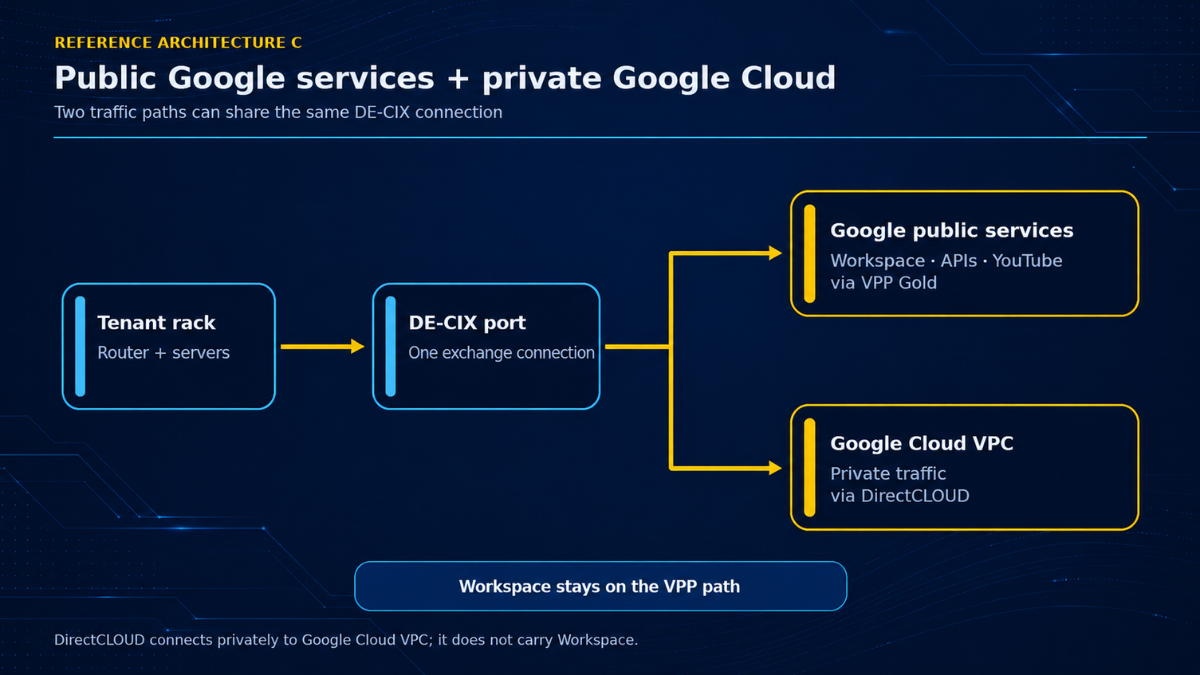
Add DE-CIX DirectCLOUD for Google Cloud Partner Interconnect to design A or B. VPP carries Workspace, Google Cloud APIs and other public Google services. DirectCLOUD carries private traffic to your Google Cloud VPC. Both can share the same DE-CIX connection. Remember that a private interconnect does not carry Workspace; Google says so itself.
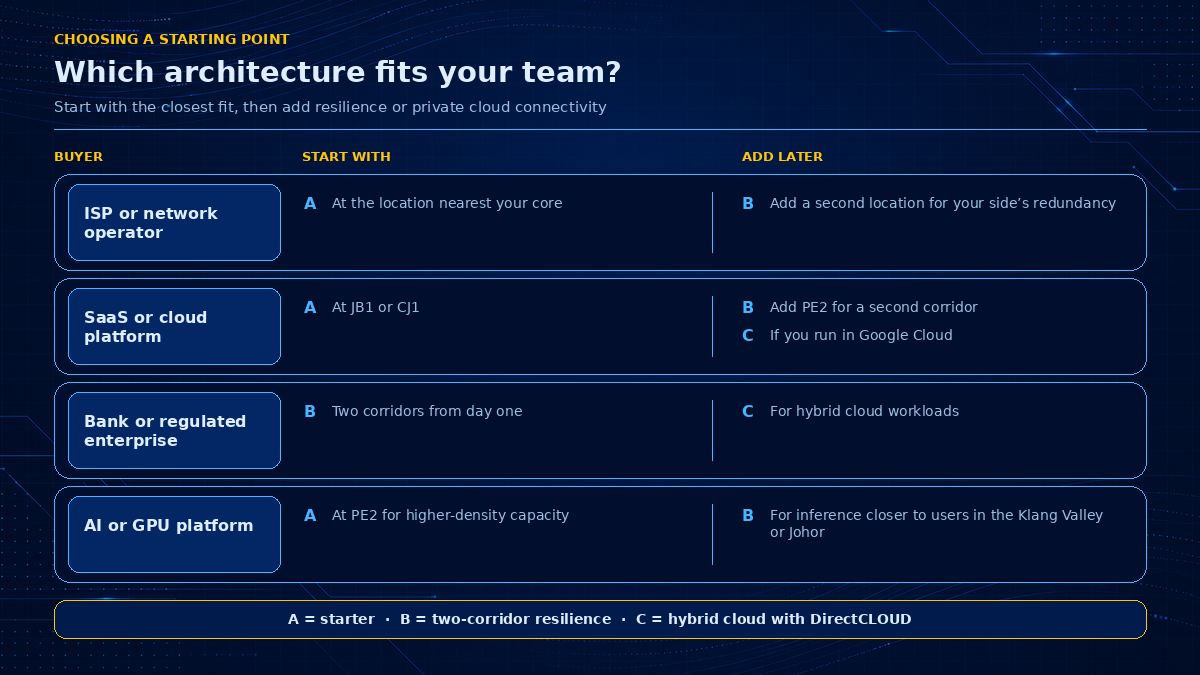
1. Choose your site: JB1 near Singapore, CJ1 in the Klang Valley, PE2 for high density in Penang.
2. Take a rack at Open DC.
3. Order a DE-CIX port and a cross-connect.
4. Peer with the route servers and receive Google’s prefixes. DE-CIX’s step-by-step guide covers the configuration.
No ASN? Choose a carrier in the building that reaches Google through a Verified Peering Provider; your servers still benefit from the short path.
One rack at Open DC, one cross-connect to DE-CIX Malaysia, and Google’s routes arrive on your port through a Gold-rated Verified Peering Provider, alongside 135+ other networks. Add a second corridor for resilience, and DirectCLOUD for private Google Cloud access.
Make a joint enquiry — one conversation with Open DC and DE-CIX Malaysia covering the rack, the cross-connect and the Google path. See also DE-CIX’s Google VPP FAQ.
Empowering Southeast Asia’s Digital Future.
For further enquiries
☎️: 03 8888 8188 (General Line)
📱: 012 3188 0446 (Sales)
Operating Hours: Monday – Friday, 9am – 6pm


Copyright © Open DC Sdn Bhd (1138988-T) | All Rights Reserved.