

Malaysia’s next digital infrastructure advantage will not be measured by how many MW are announced, but by how reliably capacity can be powered, cooled, connected and placed into service. Malaysia no longer needs to prove that it can attract data centre investment. MIDA’s 2024 investment report valued the national market at US$4.0 billion in 2024 and projected to reach US$13.6 billion by 2030. Between 2021 […]

Malaysia’s next digital infrastructure advantage will not be measured by how many MW are announced, but by how reliably capacity can be powered, cooled, connected and placed into service.
Malaysia no longer needs to prove that it can attract data centre investment. MIDA’s 2024 investment report valued the national market at US$4.0 billion in 2024 and projected to reach US$13.6 billion by 2030. Between 2021 and
June 2025, MIDA approved RM144.4 billion in data centre and cloud computing investments.
The power pipeline is equally striking. Tenaga Nasional Berhad reported that it had secured 56 data centre projects with approximately 7.5GW of total maximum demand by December 2025. These figures are a powerful vote of confidence. They also sharpen the question that matters most to infrastructure buyers in 2026: how much of that capacity is ready, resilient, sustainable and connected enough to carry production workloads?
The market will be judged less by land banks, launch ceremonies and headline capacity, and more by how quickly usable IT load can be brought online. The winners will be operators that can turn power, cooling, network choice and regional reach into a dependable service.
Power remains the entry ticket to the data centre market, but it is not the whole product. For a CIO or cloud architect,
the distinction between planned utility capacity, live facility power, sellable IT load and power available at the rack can alter a deployment plan by months. A capacity figure is meaningful only when its status, delivery date, redundancy design and operating conditions are clear.
Artificial intelligence makes that distinction more important. High-density compute concentrates electrical demand and heat in a smaller footprint. A data hall designed for conventional enterprise cloud cannot automatically be treated as ready for GPU clusters. Power distribution, chilled-water capacity, direct liquid cooling readiness, containment, monitoring and maintenance procedures must work as one system.
Malaysia’s Guideline for Sustainable Development of Data Centre reinforces this outcome-based approach. It asks operators to account for Power Usage Effectiveness, Carbon Usage Effectiveness and Water Usage Effectiveness, and recommends a design WUE of 2.2 cubic metres per MW or lower. Sustainability is therefore not a decorative ESG paragraph. It is evidence of resource discipline, engineering maturity and long-term operating resilience.
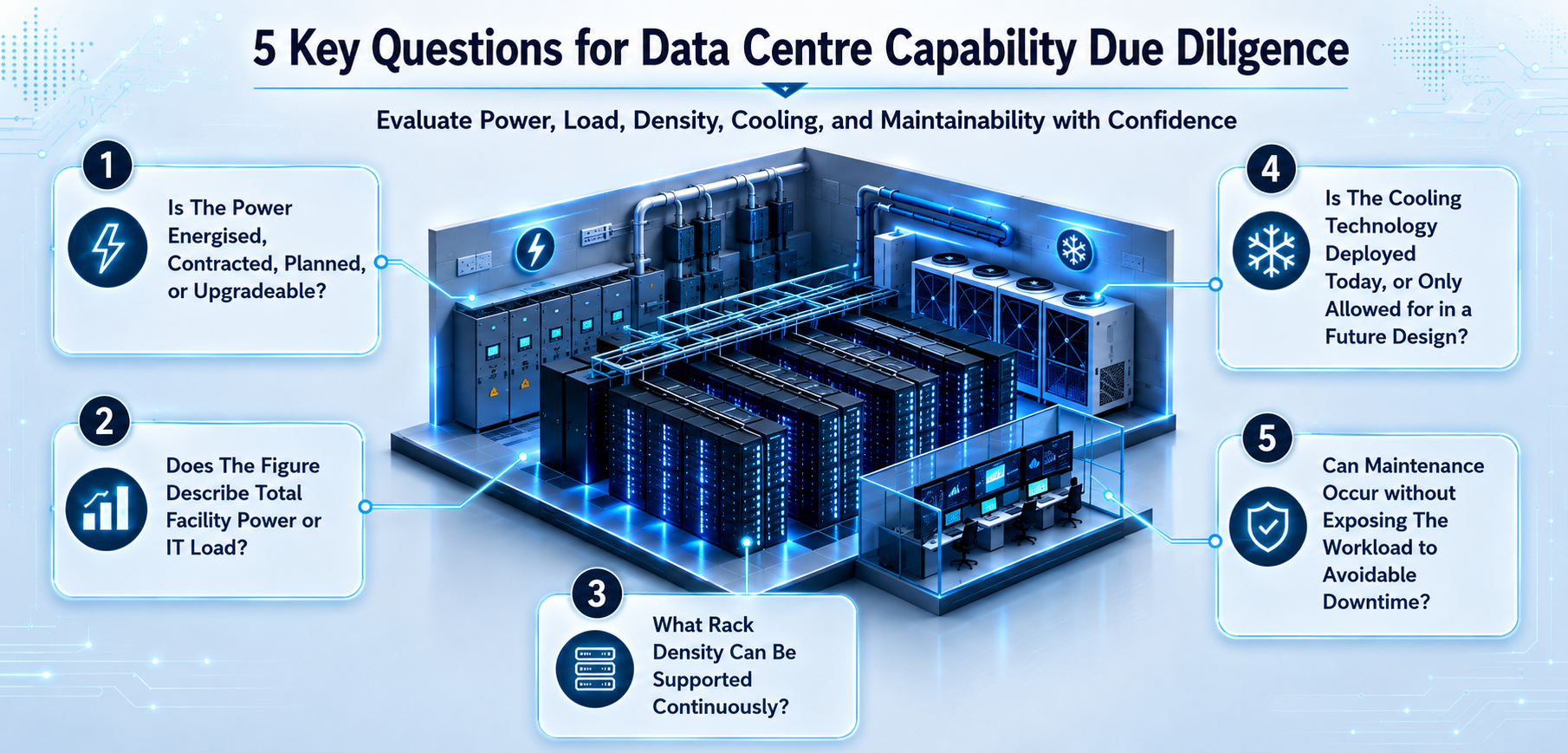
Buyers should ask precise questions:
Hosting an application in Malaysia does not guarantee that its traffic remains in Malaysia. Internet routes follow technical and commercial policies, not the shortest line on a map. Without sufficient local interconnection, traffic between two Malaysian endpoints can take an indirect path through an overseas transit hub before returning. This is commonly known as tromboning or hairpin routing.
The consequence is a hidden tax on digital performance. More network hops can mean higher transit expenditure, greater latency and jitter, more complex troubleshooting and exposure to additional failure domains. A physically close server can behave like a distant one if the route between user and application is poorly engineered.
An Internet Exchange Point, or IXP, gives independent networks a place to exchange traffic directly. The Internet Society explains that local peering can reduce latency and costs while improving network performance and resilience. For banking APIs, enterprise software, content delivery, gaming and AI inference, this is not merely a technical optimisation. It affects customer experience, cloud economics and business continuity.
Interconnection creates the greatest value inside a carrier-neutral data centre. In a single-carrier environment, an organisation’s resilience plan can remain dependent on one commercial and network domain.
In a neutral facility, the customer can combine multiple carriers, IX peering, cloud connectivity, cross-connects and dark fibre according to the needs of each workload.
That choice creates four forms of business value: route diversity, negotiating leverage, faster expansion and greater control over traffic engineering. It also reduces the cost and disruption of changing providers because the infrastructure does not have to be relocated simply to reach another network.
However, carrier logos alone do not prove resilience. Two services can still share the same duct, building entry point or upstream dependency. Serious due diligence should examine physical route maps, meet-me-room design, provider Points of Presence, cross-connect lead times, maintenance processes and the level of route visibility available to the customer.
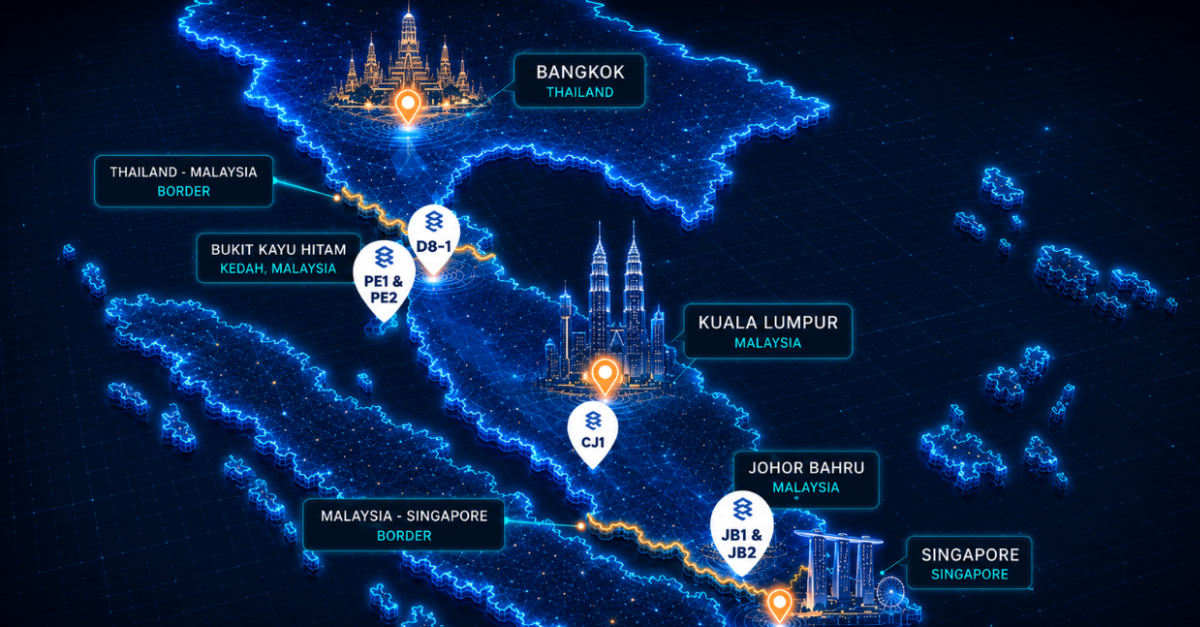
Malaysia’s geography creates several distinct infrastructure corridors. Johor supports close access to Singapore. Penang connects industrial and semiconductor ecosystems. Cyberjaya provides a central base for enterprise and regulated workloads. Kedah opens a northern route towards Thailand and the wider Indochina market. The correct location is therefore not the cheapest postcode. It is the site whose power, network and ecosystem fit the workload’s users, partners and risk profile.
Open DC’s D8-1 data centre in the Delapan Special Border Economic Zone illustrates this delivery-era model. Located less than 6km from the Malaysia-Thailand border, D8-1 spans 47,000 sq ft in Phase 1. Its power system is upgradeable to 20MW, its design targets a PUE below 1.5, and its chilled-water system can be customised to support direct liquid cooling.
The facility is carrier-neutral, hosts a DE-CIX node and connects by dark fibre towards the Malaysia-Thailand border. Open DC also reports that more than 20 terrestrial cables and four cable landing stations hosting 16 subsea cables sit within a 120km radius. D8-1 is certified to TIA-942 Rated 3, ISO 27001 and PCI DSS standards.
These capabilities matter more together than separately. Through the wider Open DC ecosystem, customers can combine carrier-neutral colocation, DE-CIX interconnection and connectivity backed by Extreme Broadband, including the northern Border Connect route and the southern Causeway Connect route. The result is an infrastructure platform designed around choice, route diversity and regional reach, rather than rack space alone.
1. Power status: What is live today, what is contracted, and what remains planned or upgradeable?
2. Workload fit: What sustained rack density, cooling method and redundancy design can the facility support?
3. Sustainability evidence: Are PUE, WUE, renewable energy and operating disclosures supported by measurable targets?
4. Interconnection depth: Which carriers, IX platforms, cloud routes and cross-connect options are physically available?
5. Physical diversity: Do backup services use genuinely separate paths, entry points and upstream dependencies?
6. Regional reach: Does the location shorten the path to the users, markets and partners that drive the business case?
Malaysia has already captured global attention. The next contest is to convert investment approvals and electricity demand into infrastructure that enterprises can actually trust. That requires a change in how data centres are evaluated. Space, power, cooling, interconnection and route diversity must be treated as one operating stack, not as separate procurement line items.
Open DC’s proposition is built around this integrated view. Carrier-neutral facilities provide the physical foundation. Extreme Broadband extends the network layer. DE-CIX access strengthens local and regional traffic exchange. Strategic sites such as D8-1 give customers additional options for northern connectivity and cross-border expansion.
For enterprises planning their next Malaysia data centre deployment, the question is no longer simply, ‘How many megawatts are available?’ The stronger question is, ‘How much usable, efficient and interconnected capacity can support our workload, and how confidently can it scale with us?’
Take the next step: Map your workload, rack-density, cooling and route requirements with Open DC.
Explore D8-1 and the wider Open DC ecosystem to build a deployment strategy designed for the delivery era.
Empowering Southeast Asia’s Digital Future.
For further enquiries
☎️: 03 8888 8188 (General Line)
📱: 012 3188 0446 (Sales)
Operating Hours: Monday – Friday, 9am – 6pm



Copyright © Open DC Sdn Bhd (1138988-T) | All Rights Reserved.