

Keeping internet traffic local can make digital services faster and significantly more resilient. As Southeast Asia’s digital economy expands, the volume of data travelling across borders and between networks is reaching unprecedented levels. For telecommunications providers and network operators, managing this traffic efficiently is a core commercial priority. This is where Internet Exchange (IX) peering […]

Keeping internet traffic local can make digital services faster and significantly more resilient. As Southeast Asia’s digital economy expands, the volume of data travelling across borders and between networks is reaching unprecedented levels. For telecommunications providers and network operators, managing this traffic efficiently is a core commercial priority.
This is where Internet Exchange (IX) peering becomes essential. In simple terms, IX peering allows different networks to connect and exchange traffic directly, rather than paying a third-party transit provider to carry the data across the internet.
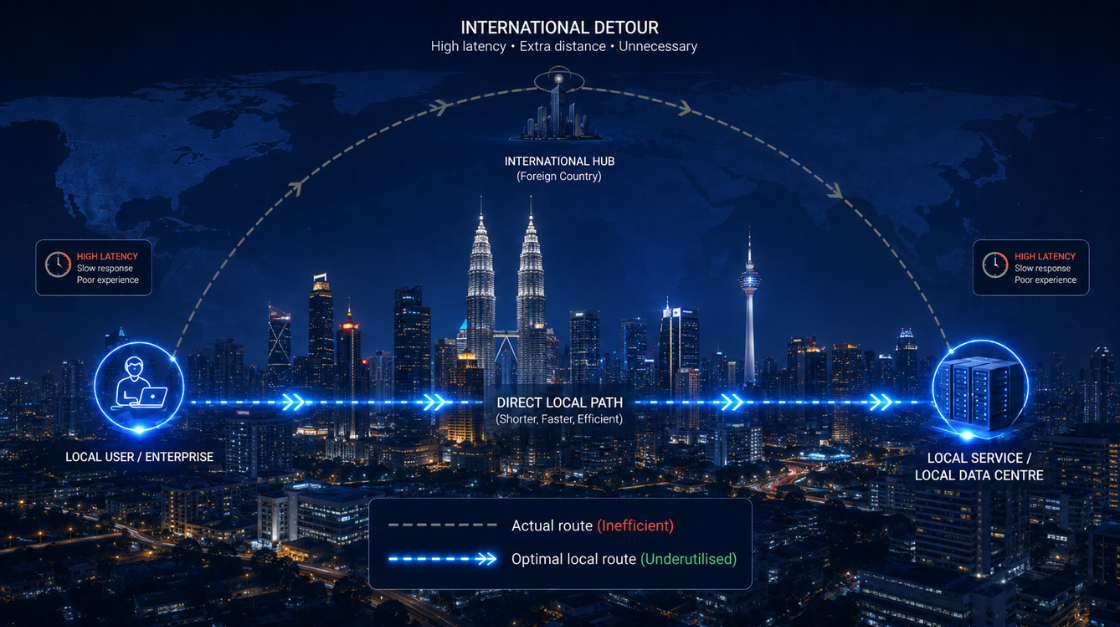
Without strong local peering infrastructure, internet traffic often travels through unnecessary routes. A local user accessing a locally hosted service might see their data routed to another country and back.
This creates immediate operational and commercial pain for Internet Service Providers (ISPs), content platforms, and enterprises. Traffic that takes unnecessary routes suffers from higher latency, increased risk of jitter, and a degraded user experience. Furthermore, relying entirely on public IP transit for all traffic is highly inefficient and drives up operating costs for carriers.
The market signal for better interconnection is clear. Internet traffic in Malaysia is expected to break records continuously as new data centres go online and the national digital economy rapidly expands. To handle this exponential data generation, operators need localized, high-capacity infrastructure.
For telcos, carriers, and peering teams, IX peering solves the inefficiencies of traditional transit routing. By participating in an Internet Exchange, operators gain several distinct advantages:
Building a cost-effective Point of Presence (PoP) requires a reliable data centre partner. Open DC provides
carrier-neutral facilities that integrate network, data centre and IX infrastructure under one powerful platform.
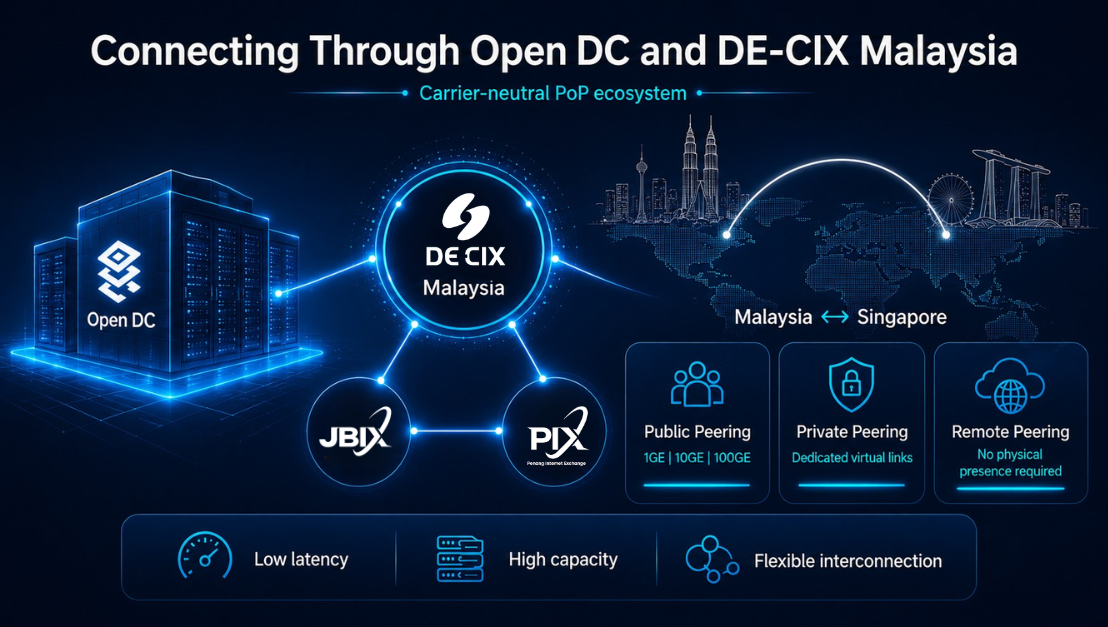
Through strategic partnerships, Open DC is the official reseller for DE-CIX Malaysia. Together, DE-CIX Malaysia, JBIX, and PIX form one of the region’s most advanced, carrier-neutral IX ecosystems. This ecosystem is designed to deliver
ultra-low-latency and high-capacity interconnection across Malaysia and Singapore.
For carriers seeking flexibility, the JBIX platform offers a membership-free peering environment that scales seamlessly from 10Gbps to terabit-class capacity. Network operators hosted in Open DC facilities can leverage multiple peering configurations to suit their technical requirements:
Seamless digital experiences happen when you eliminate the artificial distance between your infrastructure and the people using it. Positioning your network inside an open, interconnected ecosystem puts you back in control—making your services faster, more resilient, and remarkably cost-effective.
Curious how this shifts enterprise performance? Let’s map out a smarter route forward together.
Empowering Southeast Asia’s Digital Future.
For further enquiries
☎️: 03 8888 8188 (General Line)
📱: 012 3188 0446 (Sales)
Operating Hours: Monday – Friday, 9am – 6pm



Copyright © Open DC Sdn Bhd (1138988-T) | All Rights Reserved.