

While the enterprise technology market remains hyper-focused on GPU supply chains and software frameworks, the most immediate threat to scaling AI lies beneath the floorboards. For over two decades, enterprise data centre design followed a predictable baseline: standard rack footprints, air-cooled rows, and modest power envelopes of 5kW to 10kW per rack. It was a […]

While the enterprise technology market remains hyper-focused on GPU supply chains and software frameworks, the most immediate threat to scaling AI lies beneath the floorboards.
For over two decades, enterprise data centre design followed a predictable baseline: standard rack footprints,
air-cooled rows, and modest power envelopes of 5kW to 10kW per rack. It was a model built for steady, incremental cloud and database scaling.
Then came high-density compute.
Large language models, real-time inferencing engines, and complex predictive analytics do not just consume more power. They demand a fundamentally different thermal and electrical physics model. As enterprise workloads shift towards high-density clusters, the industry faces an uncomfortable reality: you cannot solve next-generation compute problems with last-generation facility engineering.

Many colocation providers claim to be “AI-ready” simply by offering larger power drops or lowering perimeter
air-cooling setpoints. To any experienced infrastructure architect, this is a stopgap measure, not a strategy.
Attempting to run 30kW to 100kW+ per rack inside legacy environments introduces structural friction that erodes enterprise margins and increases operational risk:
The Infrastructure Reality: True high-density readiness is not simply about how much power can be delivered into a room. It depends on how efficiently electricity reaches the silicon, how effectively thermal energy is removed from the footprint, and how quickly data can be routed to the network.
At Open DC, facilities such as D8-1 and PE2 in Malaysia were engineered by mapping the physical requirements of modern high-performance computing from the outset, rather than retrofitting outdated designs.
When evaluating colocation platforms, enterprise leaders must look beyond marketing headlines and assess the underlying engineering.
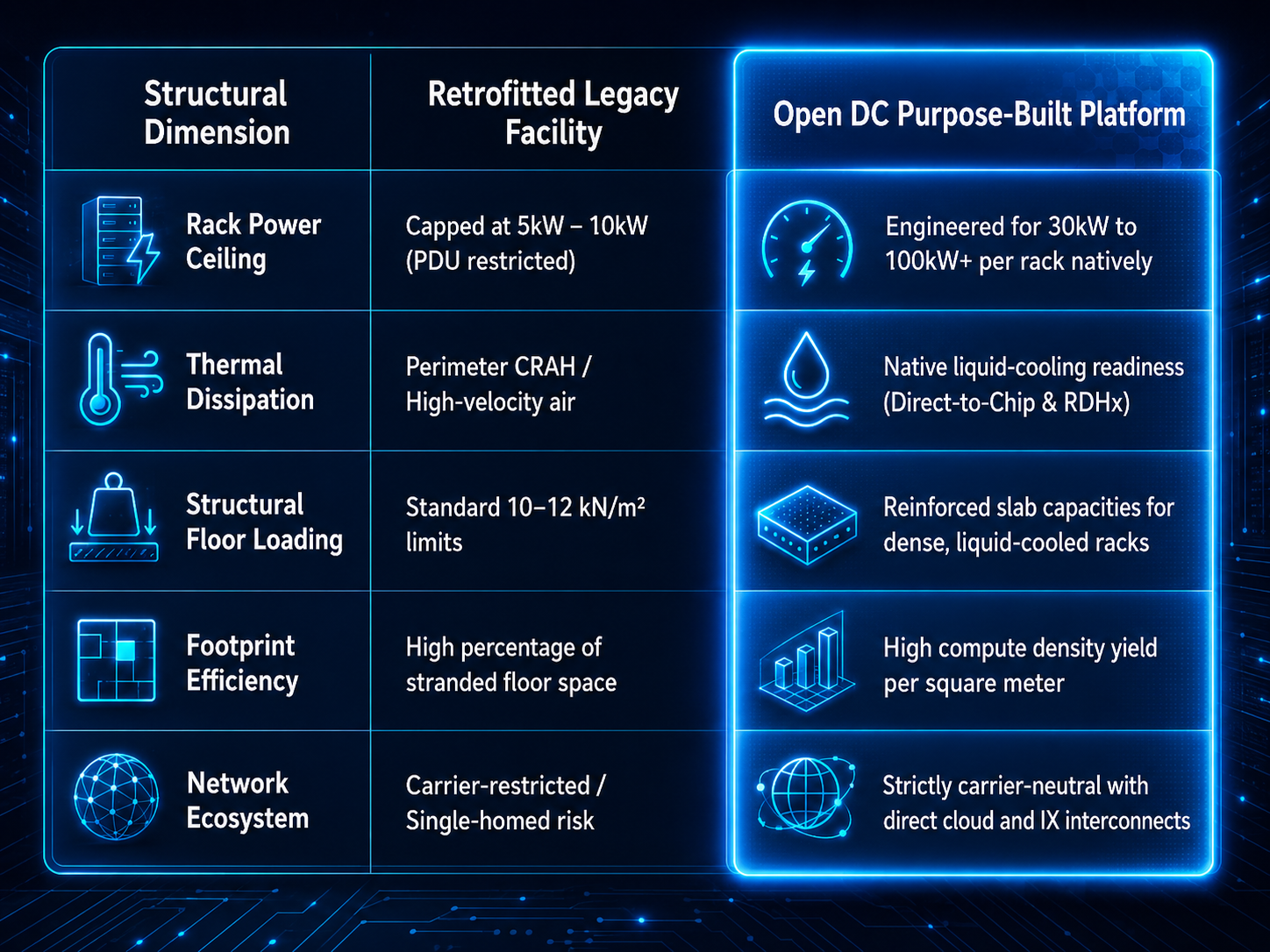
By deploying high-capacity overhead busway distribution systems and modular power taps, Open DC enables high-kW power delivery directly to the rack level. This eliminates the need for empty “buffer” racks, allowing enterprises to maximise hardware density and optimise Total Cost of Ownership (TCO).
The transition from air cooling to liquid cooling is not a question of if, but when. Open DC facilities are constructed with pre-engineered mechanical pathways, primary-loop manifolds and floor-loading capacities required to integrate advanced thermal management systems seamlessly.
This ensures that when an enterprise compute footprint crosses the liquid-cooling threshold, the facility is ready without requiring a disruptive migration project.
Dense compute requires dense connectivity. Open DC maintains strict carrier neutrality across its facilities, providing enterprises with direct, low-latency access to major global Tier 1 carriers, local Internet Exchanges (IXs) and
cloud on-ramps.
This allows network architects to design optimised routing topologies that reduce inter-node transmission delays and avoid unnecessary network dependencies.
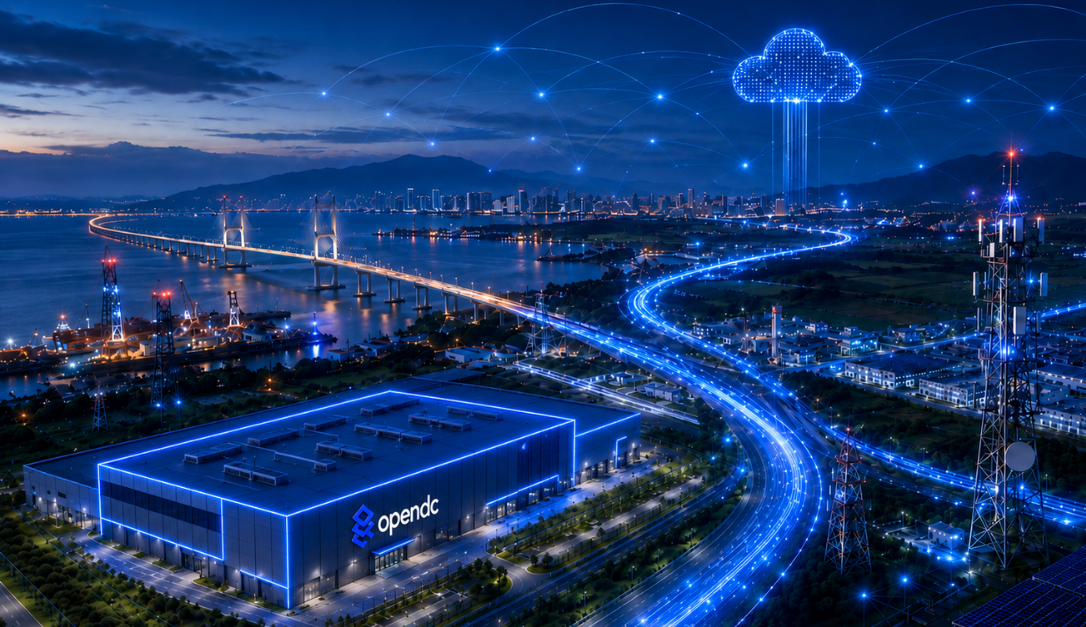
Situated within Malaysia’s primary digital infrastructure corridors, facilities such as D8-1 and PE2 provide an optimal balance of robust power availability, cross-border fibre connectivity and operational cost efficiency.
Together, these capabilities position Open DC as a resilient infrastructure platform for enterprise expansion across Southeast Asia.
Navigating the transition towards high-density architecture requires a structured assessment of long-term compute requirements.
Enterprise infrastructure teams should conduct a comprehensive audit covering:
Following this assessment, engage with Open DC’s infrastructure specialists to conduct a customised
capacity-planning and floor-space-modelling exercise for your deployment roadmap.
Empowering Southeast Asia’s Digital Future.
For further enquiries
☎️: 03 8888 8188 (General Line)
📱: 012 3188 0446 (Sales)
Operating Hours: Monday – Friday, 9am – 6pm



Copyright © Open DC Sdn Bhd (1138988-T) | All Rights Reserved.