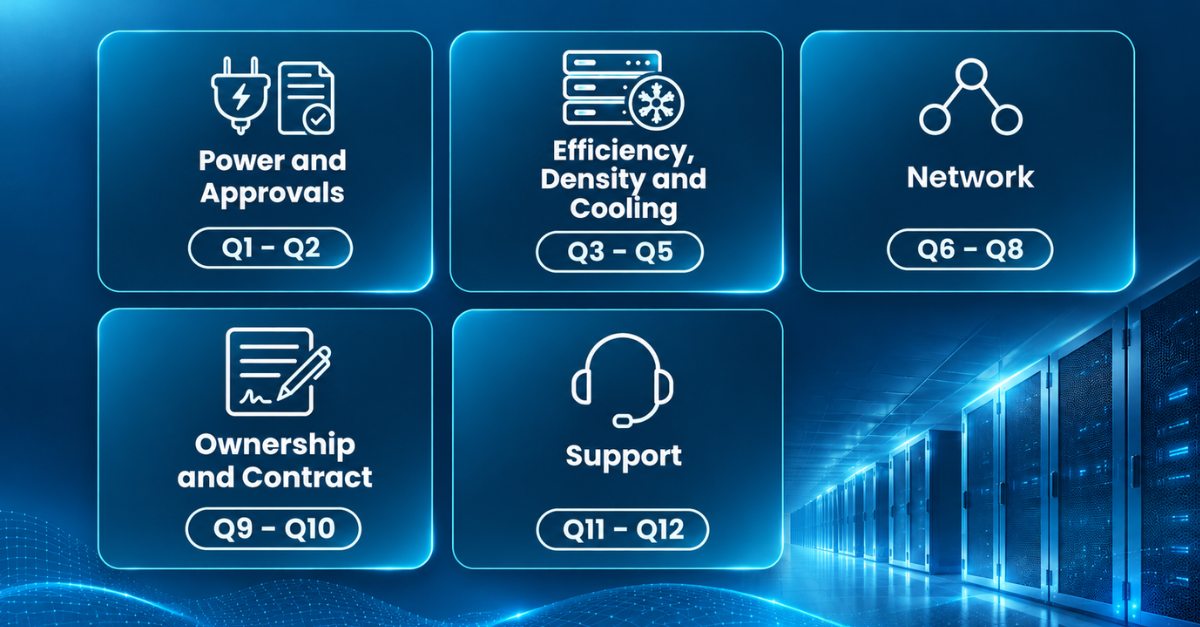
Choosing a data center company in Malaysia for a 2027 contract comes down to proof. A shortlisted provider should be able to show what is energised, what is approved, how efficiency is measured and what your contract costs if plans change. The twelve questions below, with a scorecard you can copy, separate a provider that can prove its position from one that can only promise it.
The ground shifted in 2026. Approvals for new data centres not related to AI were halted in February. In October, ministers told Parliament that operators will be charged for power they reserve but do not use, and the proposed Digital Infrastructure (Data Centre) Bill is due before Cabinet in 2027. Each question reflects one of those changes, and they fall into five groups.
Power And Approvals
- Energised capacity, shown separately from contracted capacity. Energised means power is flowing through commissioned plant to a data hall. Ask for energised and contracted megawatts per site, in writing, with the date each figure applies. The difference is large across the market: as of August, Malaysia’s 45 operating data centres drew about 1.37GW against 6GW of contracted maximum load. Then ask how much of the energised capacity is already committed to other tenants, because only the remainder is available to you.
- Approval status for the site and every phase you rely on. Approvals for new data centres not related to AI have been halted since 24 February. A phase still waiting for an approval, a substation or a water connection is a schedule of risk. Ask which approvals are held, which are pending, and which third-party milestones sit between today and your go-live date.
Efficiency, Density And Cooling
- PUE and WUE, with the method behind them. Power usage effectiveness (PUE) is total facility energy divided by IT energy. Water usage effectiveness (WUE) is water used per megawatt-hour of IT energy. The Ministry of Investment, Trade and Industry (MITI) guideline sets design PUE targets of 1.4 for hyperscale sites above 21.25MW, 1.6 for new purpose-built colocation and 1.7 for other categories, with WUE of 2.2 m³/MWh or lower. Ask whether a figure is a design target or an annualised measurement, where the meters sit and at what IT load it was taken. A design figure from one provider and a measured figure from another cannot be compared.
- Rack density in the hall you will occupy. Ask for kilowatts per rack in your hall, today and in three years, not the campus peak. Ask about floor loading as well, because dense racks are heavy. Modern AI racks can exceed 100kW, many times the load of a traditional enterprise rack.
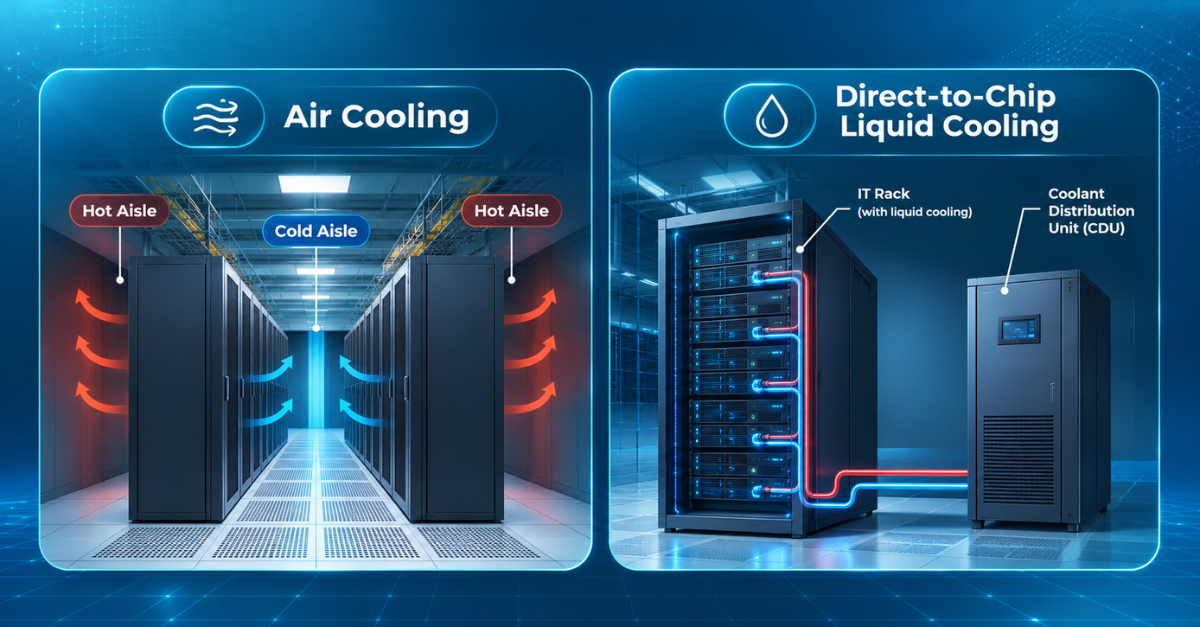
- Cooling that is installed, not only possible. Air, liquid or both. If GPUs are on your roadmap, ask whether coolant distribution is in place today or still a design option, and who maintains the secondary loop.
Network And Connectivity
- Carrier neutrality, with names. “Carrier-neutral” should come with a list. Ask for the carriers present in the building and the internet exchanges on-net or one cross-connect away. If your users depend on cloud and Google services, ask how traffic reaches them and whether it detours through Singapore.
- Cross-connect price and lead time. Ask for the one-off and monthly charge, and the time from order to live. Over a five-year term, cross-connects add faster than many buyers expect.
Ownership And Contract
- Who owns and operates the facility. Ask who owns the building and the land, who runs operations and how long any land lease runs. Stable ownership protects a five- or ten-year contract and tells you who will answer if the site changes hands.
- Exposure to reserved-capacity charges. On 15 October, Investment, Trade and Industry Minister Datuk Seri Johari Abdul Ghani said an operator that requests 200MW but uses 100MW will be charged for the other 100. The Connected Load Charge has also been raised to deter over-reservation. Ask how those costs would pass through to your contract, then size your reservation to what you will draw, with a written path to grow.
- Exit terms. Minimum term, notice period, renewal pricing, and the cost of removing equipment. A cheap entry price with a costly exit is not cheap.
- Sites outside Johor. Johor colocation vacancy was 0.7% in the first half of 2026, according to Cushman & Wakefield. Water is tightening in both main hubs: data centre water demand in Selangor and Johor is projected to rise from about 64 million litres a day to 389 million by 2030. A second corridor gives room to grow and a recovery site on a different grid and water catchment.
Support And Transparency
- Support written into the contract. Remote hands hours, response times, escalation and how incidents are reported should sit at the service levels, not the brochure. Ask too which operating facts the provider publishes on a regular schedule, such as capacity and efficiency, so you can track them over the term.
Open DC’s Position On Each Check
Open DC is a carrier-neutral, Malaysian-owned operator with six facilities across Johor, the Klang Valley, Penang and Kedah, serving more than 300 organisations. Every site is on our facilities page; here is a short guide.
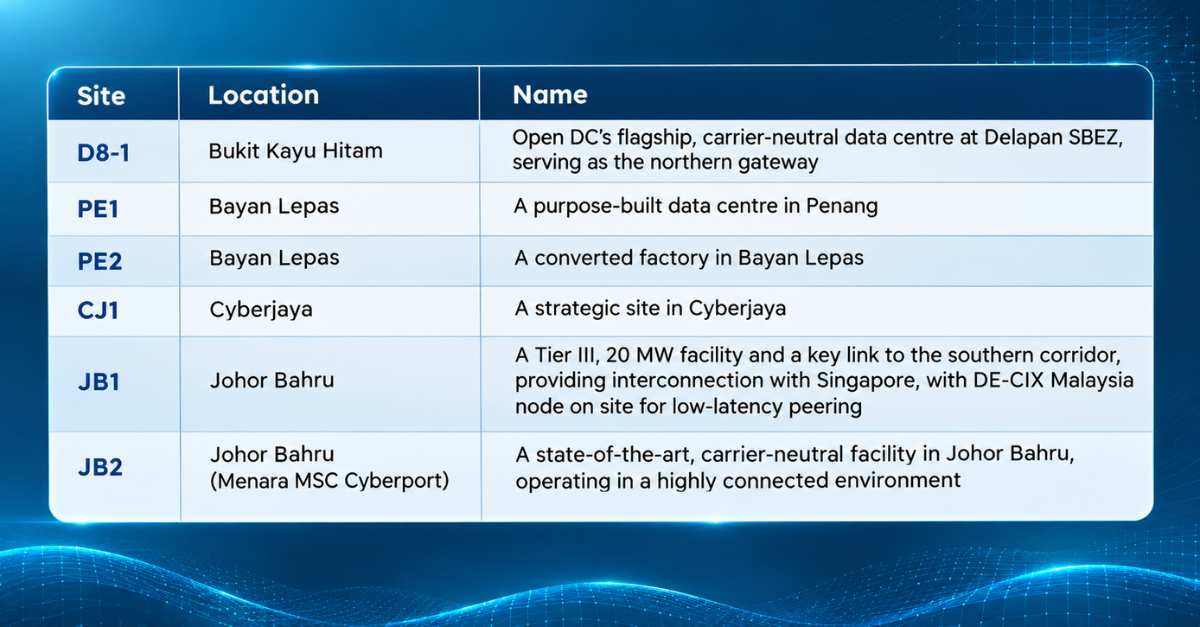
We publish energised and committed capacity because the first question deserves a straight answer. Our first quarterly capacity fact sheet follows on 5 November.
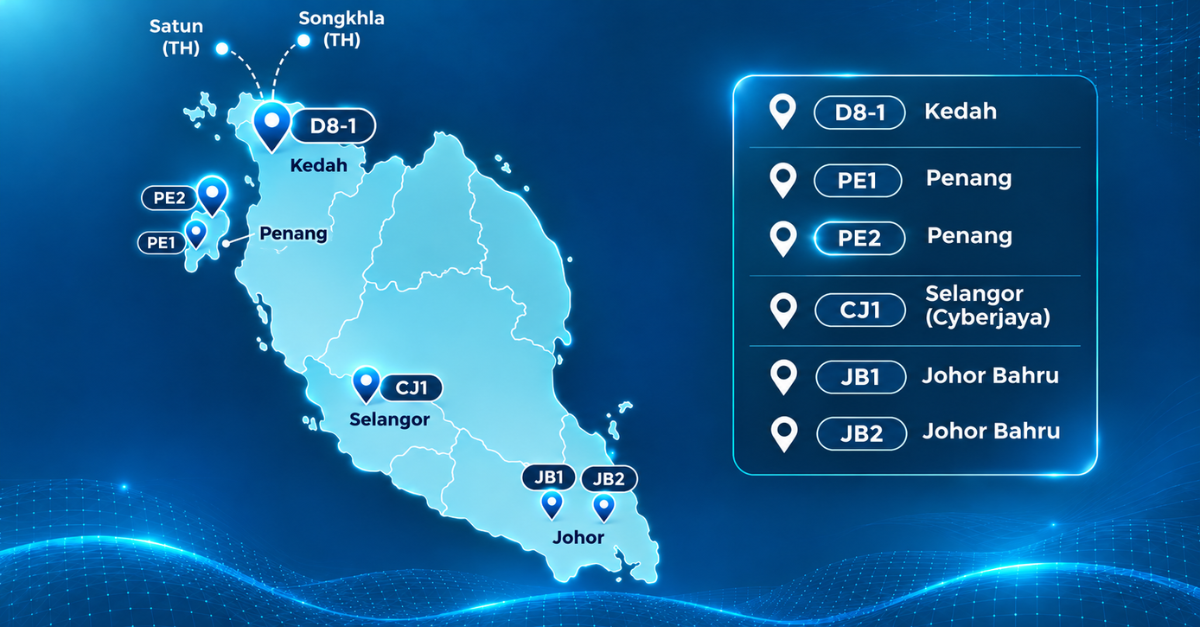
Empowering Southeast Asia’s Digital Future.
For further enquiries
☎️: 03 8888 8188 (General Line)
📱: 012 3188 0446 (Sales)
📧: enquiry@opendc.my
Operating Hours: Monday – Friday, 9am – 6pm