

On 19 October 2026, Malaysia’s National Economic Action Council (NEAC) agreed to draft a Digital Infrastructure (Data Centre) Bill for the Cabinet consideration in 2027. It caps a year in which data centre regulation in Malaysia moved from incentives to conditions. Power, water, efficiency, and local value are now things an operator must prove, not […]

On 19 October 2026, Malaysia’s National Economic Action Council (NEAC) agreed to draft a Digital Infrastructure (Data Centre) Bill for the Cabinet consideration in 2027. It caps a year in which data centre regulation in Malaysia moved from incentives to conditions. Power, water, efficiency, and local value are now things an operator must prove, not promise.
For buyers, the effect is practical. The rules of price capacity that is reserved but never used, and campuses that still need grid and water connections. Capacity that is approved, energised, and built on industrial land comes ahead. This guide sets out each change, whether it is in force or still proposed, and what it means for a colocation contract signed for 2027. More than 90% of our customers are based outside Malaysia, so we spell out each agency as we go.
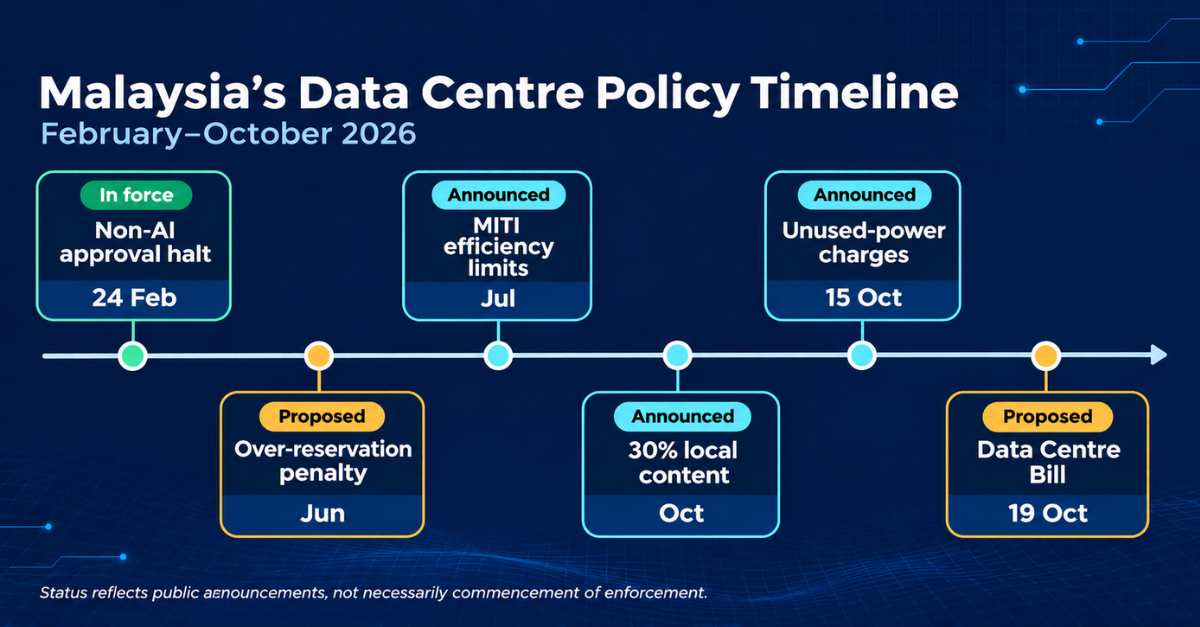
Four of these changes are in force or announced by ministers; two are proposals. Treat the proposals as planning signals rather than compliance obligations, but do not ignore them: all six points the same way.
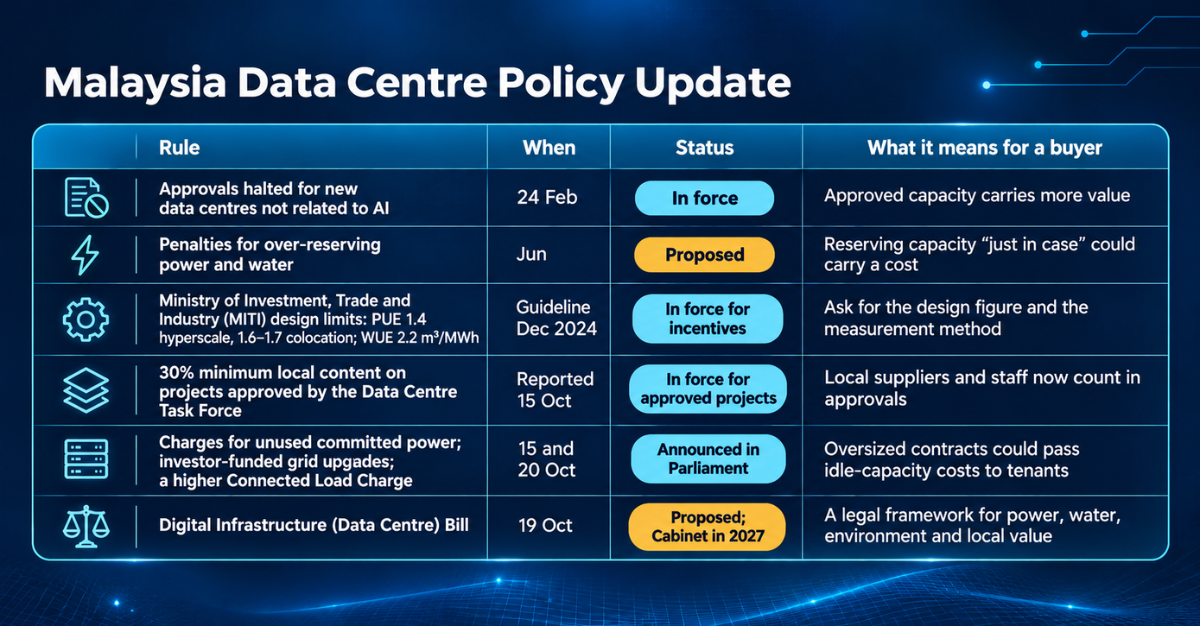
PUE (power usage effectiveness) compares total facility energy with IT energy; WUE (water usage effectiveness) measures water used per unit of IT energy.
The NEAC, chaired by Prime Minister Datuk Seri Anwar Ibrahim, wants a Bill that aligns data centre growth with power and water capacity, limits environmental impact and makes investment benefit the domestic economy. By July, the Data Centre Task Force had approved 27 projects worth RM225.97 billion, each with the 30% local-content condition.
The Bill is not law; and it could change before it reaches Parliament. Its direction, however, is clear from what ministers said in the same fortnight. On 15 October, Investment, Trade and Industry Minister Datuk Seri Johari Abdul Ghani told the Dewan Rakyat that an operator which requests 200MW but uses 100MW will be charged for the other 100. “We welcome them to come, but it is not about getting cheap energy from us,” he said. He added that investors must bear the cost of the transmission upgrades their projects require.
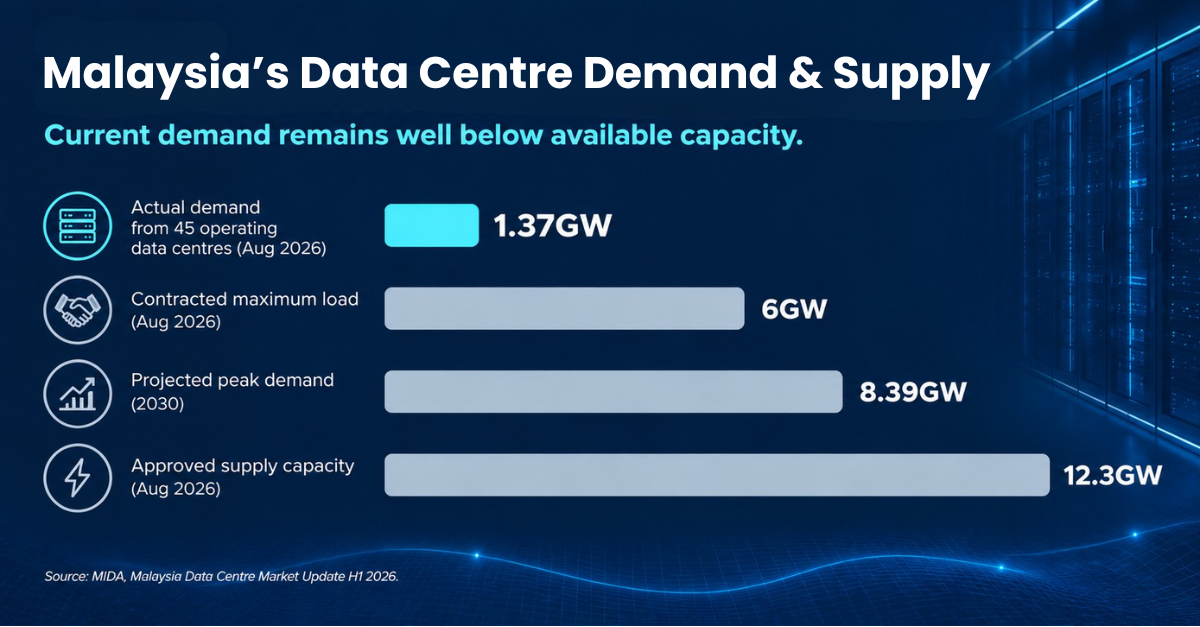
Five days later, a written parliamentary reply from Deputy Prime Minister Datuk Seri Fadillah Yusof put numbers on the gap. As of August, 12.3GW of electricity supply capacity had been approved for data centre projects, against projected peak demand of 8.39GW by 2030. The Connected Load Charge has been raised to deter applications for more capacity than a site needs.
Idle capacity gets a price. If you reserve 2MW and draw 1MW, the cost of the unused megawatt can reach you through power pass-through clauses. Right-sizing and phasing a contract matters more than it did a year ago.
New campuses get slower and more costly. Investor-funded grid upgrades, water approvals and community consultation add time to greenfield projects. A phase that still needs a substation carries more schedule risk than a live hall.
Evidence beats promises. Local value, water use, and efficiency now have to be documented. Operators with records will clear approvals and audits faster, and so will their tenants.
Every rule above prices something a greenfield campus still needs: an approval, a grid connection, water and the acceptance of its neighbours. An energised site on industrial land already has them.
The gap between the rules target is large. As of August, Malaysia’s 45 operating data centres drew about 1.37GW against 6GW of contracted maximum load. Measures aimed at that gap fall hardest on capacity reserved but not yet built.
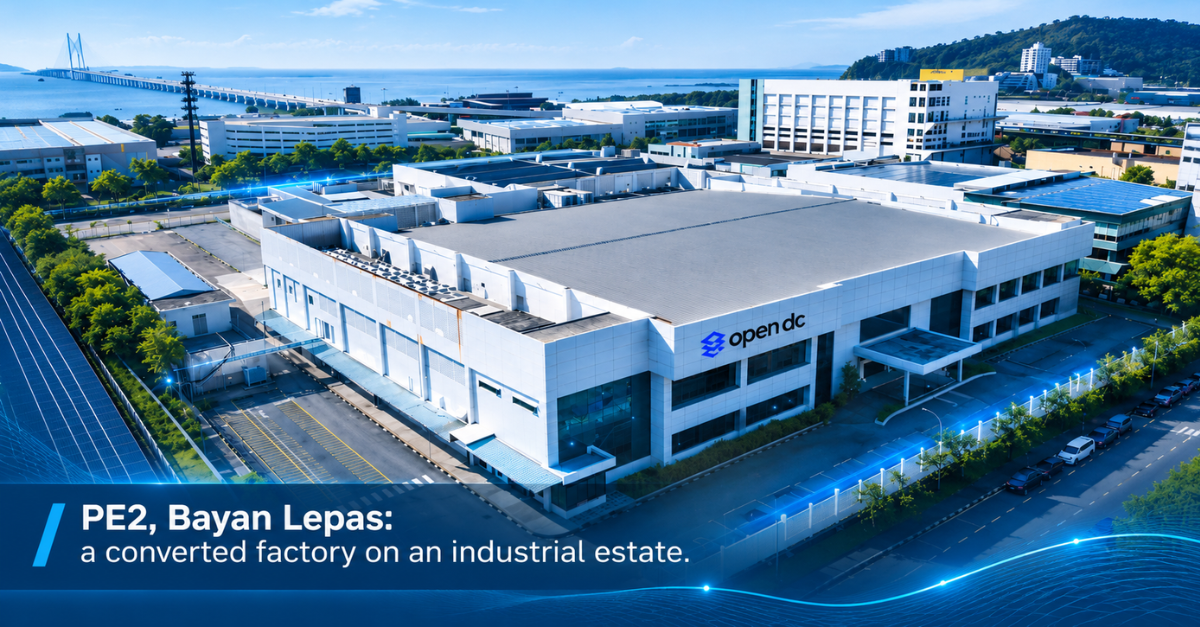
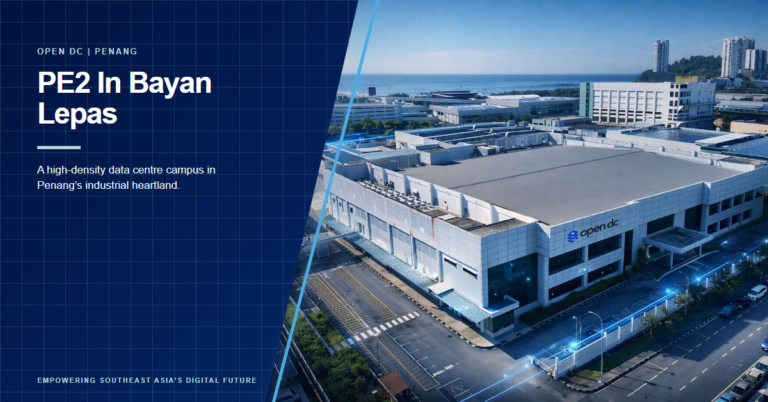
PE2 in Penang shows the other side. It is a converted factory on an industrial estate in Bayan Lepas, with about 15MW energised and roughly 80% of its first 30MW phase committed. It needed no new land beside homes, and it is live.
The new rules ask every operator to show what is real today, and we think that is the right test. Buyers should apply it too, and expect answers in megawatts, dates and meter readings rather than renderings.
Read more on why buyers choose Open DC.
Get each in writing before signing for 2027:
1. Megawatts energised today, shown separately from megawatts contracted or planned.
2. The approvals the site holds, and any still pending for the phase you rely on.
3. How idle-capacity or Connected Load Charge costs would pass through to you.
4. Design PUE and WUE, plus the meter boundary behind any measured figure.
5. Whether the site sits on industrial land, with its power and water already secured.
Empowering Southeast Asia’s Digital Future.
For further enquiries
☎️: 03 8888 8188 (General Line)
📱: 012 3188 0446 (Sales)
Operating Hours: Monday – Friday, 9am – 6pm

Copyright © Open DC Sdn Bhd (1138988-T) | All Rights Reserved.