

Two-thirds of Malaysia’s contracted data centre power sits concentrated in a single state. Combine that hyper-density with a colocation vacancy rate hovering at a record low of 0.7%, and an unpriced institutional liability emerges: most disaster recovery (DR) frameworks in Malaysia have not diversified their systemic risk—they have merely duplicated it inside the same catchment. […]

Two-thirds of Malaysia’s contracted data centre power sits concentrated in a single state. Combine that hyper-density with a colocation vacancy rate hovering at a record low of 0.7%, and an unpriced institutional liability emerges: most disaster recovery (DR) frameworks in Malaysia have not diversified their systemic risk—they have merely duplicated it inside the same catchment.
For technology risk officers, insurers, and Bank Negara Malaysia RMiT compliance leads, this creates a pressing audit challenge. When primary and secondary facilities sit behind the same macro infrastructure, calling them “redundant”
is an illusion.
Traditional compliance frameworks historically evaluated a DR site in Malaysia using a simple metric: linear distance in kilometres. Yet in modern digital infrastructure, physical separation is a weak proxy for resilience. The true benchmark of operational continuity is systemic dependency independence.
Placing primary and recovery facilities within the same sub-region—even 40 or 50 kilometres apart—exposes both footprints to identical macro constraints across six critical risk vectors:
True geographic redundancy for data centres in Malaysia requires architecting across distinct macro-corridors. Pairing a Southern primary hub with an alternate Central (Selangor) or Northern (Penang and Kedah) corridor establishes true operational decoupling across distinct state jurisdictions and utility grids.
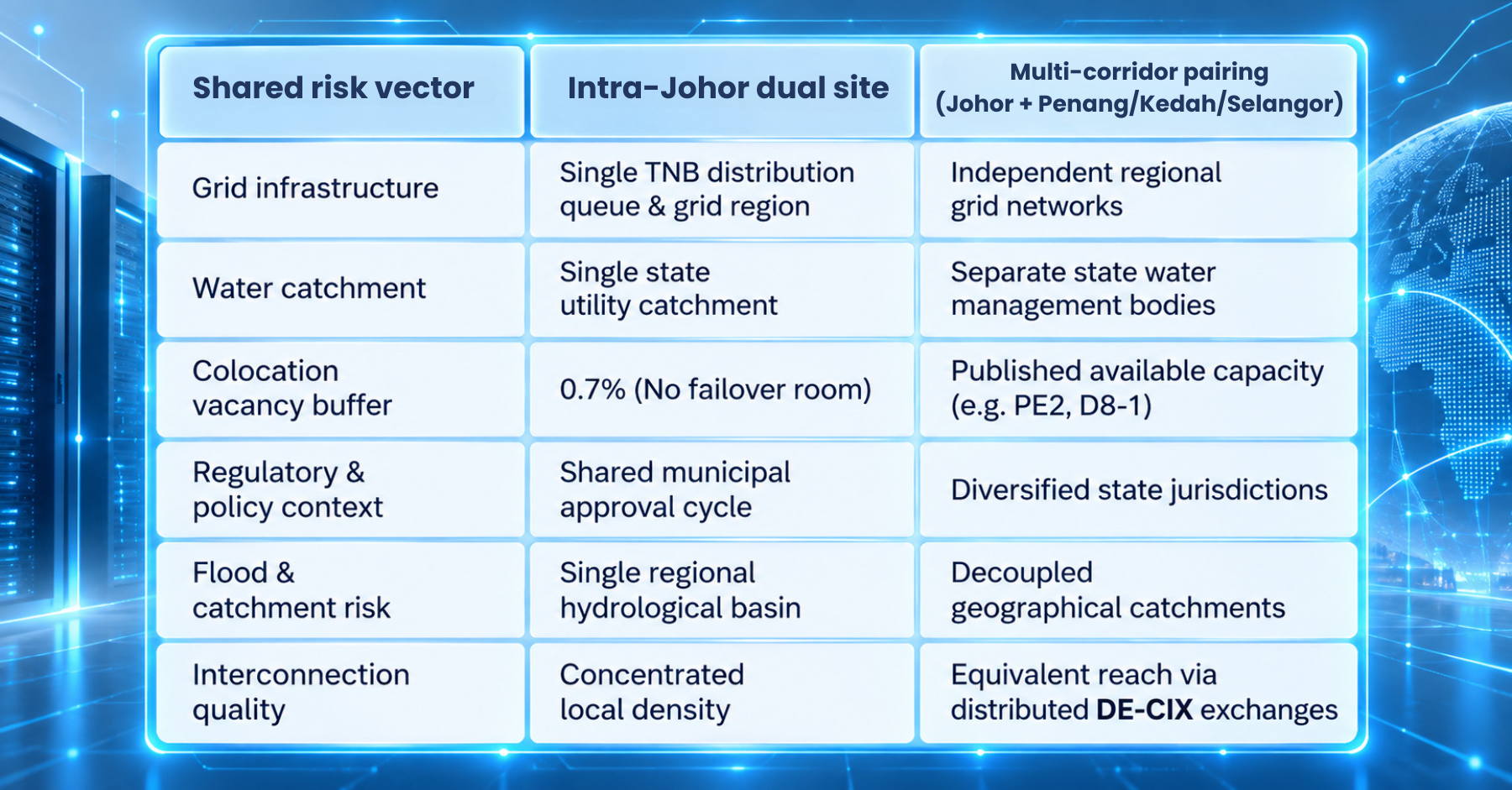
Solving corridor concentration requires infrastructure footprint depth, not just marketing claims. Open DC’s strategy delivers structural independence across four distinct Malaysian states rather than multiple buildings in one region:
Historically, multi-corridor business continuity plans were proposed and quietly abandoned due to network latency, carrier drop-off, and degraded routing at secondary sites. A resilient multi-corridor strategy requires carrier equity across both locations.
By integrating neutral internet exchange fabrics—specifically DE-CIX nodes operating natively across Kuala Lumpur, Johor Bahru, Penang, and Kedah—a Northern or Central recovery corridor retains direct access to the exact same carrier ecosystem and cloud fabrics (135+ ASNs on-net) as the primary hub.
This ensures that moving a secondary footprint to Penang (PE2) or Kedah (D8-1) introduces zero performance penalty. Primary and recovery workloads reach the same networks with complete carrier neutrality and full regulatory compliance.
Johor remains an exceptional primary location for scale and Singapore proximity. However, housing both primary and recovery footprints within one jurisdiction leaves corporate resilience untested against real-world corridor failure.
Empowering Southeast Asia’s Digital Future.
For further enquiries
☎️: 03 8888 8188 (General Line)
📱: 012 3188 0446 (Sales)
Operating Hours: Monday – Friday, 9am – 6pm



Copyright © Open DC Sdn Bhd (1138988-T) | All Rights Reserved.