

Regional digital infrastructure expansion in Southeast Asian markets has entered an operational maturation phase. The primary focus for enterprise architects, telecommunications strategists, and risk committees has moved beyond baseline capacity acquisition to the mitigation of topological concentration risks—specifically, where workloads physically reside, how traffic traverses regional boundaries, and which single points of failure exist across shared utility […]

Regional digital infrastructure expansion in Southeast Asian markets has entered an operational maturation phase.
The primary focus for enterprise architects, telecommunications strategists, and risk committees has moved beyond baseline capacity acquisition to the mitigation of topological concentration risks—specifically, where workloads physically reside, how traffic traverses regional boundaries, and which single points of failure exist across shared utility grids and transport corridors.
The sheer volume of capital allocation highlights the necessity of this evaluation. Data from the Malaysian Investment Development Authority (MIDA) records RM144.4 billion in approved data centre and cloud projects between 2021 and June 2025. However, approved capital commitment is distinct from commissioned, energised IT capacity. As central and southern clusters reach unprecedented power and space density, reliance on a concentrated set of utility substations, backhaul routes, and subsea landing points introduces systemic operational exposure.
Achieving true structural resilience requires deliberate geographical and network diversification. Integrating a northern compute and interconnection node into a regional architecture offers a concrete mechanism to isolate failure domains without sacrificing network throughput or regional reach.
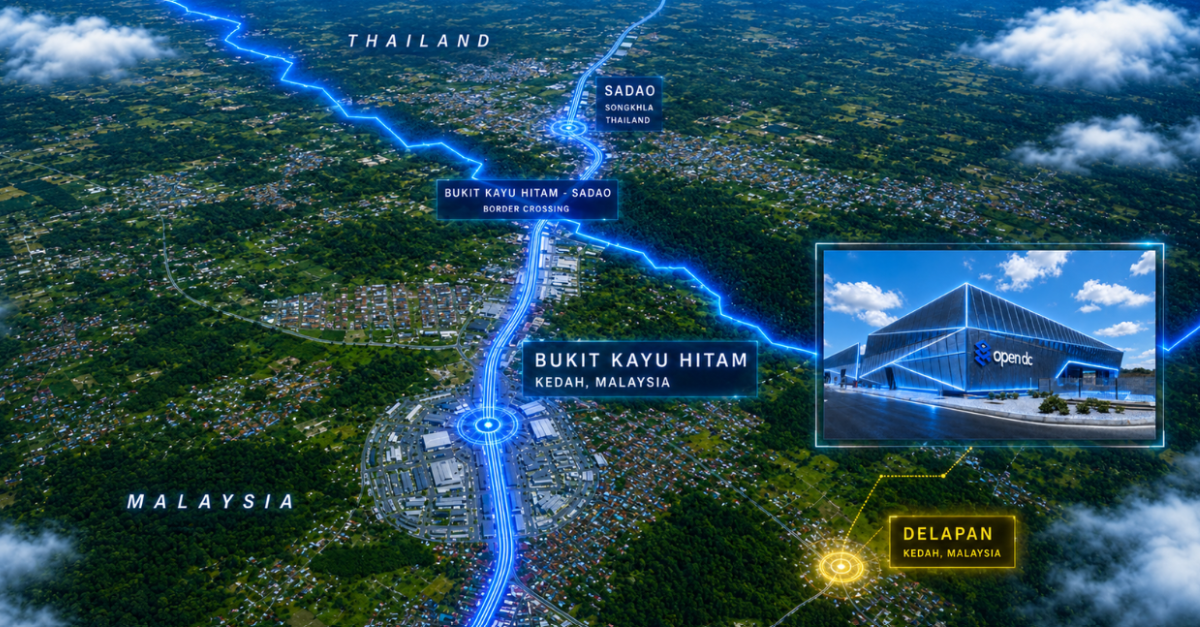
In enterprise network engineering, geographical diversification does not imply migrating primary workloads away from established central clusters in Cyberjaya, Kuala Lumpur, or Johor. Instead, it involves engineering independent network paths and secondary compute environments to eliminate shared failure domains.
Northern Peninsular Malaysia presents specific structural characteristics that support this approach:
The underlying macroeconomic framework is substantial. Bilateral trade between Malaysia and Thailand reached RM118.57 billion in 2025. In July 2026, both governments inaugurated the dedicated road alignment connecting the Bukit Kayu Hitam Immigration, Customs, Quarantine, and Security (ICQS) complex with Thailand’s Sadao Customs, Immigration, and Quarantine (CIQ) facility, streamlining physical cross-border logistics.
However, a digital corridor must be evaluated by a different set of technical criteria. The operational value of a border facility depends on the integration of compute availability, dark fibre access, carrier neutrality, autonomous peering, power provisioning, and facility management. Physical proximity creates an opportunity, but network and facility engineering determine measurable uptime and performance.
The Open DC D8-1 is located within the Delapan Special Border Economic Zone in Bukit Kayu Hitam, less than 6 km from the Thai border. Within a 120 km radius sit over 20 terrestrial fibre cable systems and four subsea cable landing stations hosting 16 international subsea cables.
While regional fibre density provides options, physical proximity does not guarantee route diversity. Two distinct network services purchased from separate carriers may quietly share identical physical trenches, conduit banks, border crossing points, or landing station entry vaults.
To establish genuine network sovereignty, infrastructure teams must require end-to-end physical duct mapping. Verification must cover every layer of the transport stack: specific carrier assignments, physical conduit rights-of-way, border crossing points, building ingress vaults, and active restoration protocols.
D8-1 operates as a carrier-neutral colocation facility, featuring dark fibre routes toward the border via Bukit Kayu Hitam and Padang Besar, an incoming ecosystem targeting up to 15 telecommunications carriers, and an on-site Internet Exchange node housing DE-CIX Kedah.
An on-site Internet Exchange allows participating networks to exchange traffic locally, reducing transit costs and removing unnecessary latency loops caused by backhauling local traffic to central exchange points.
However, peering does not automatically guarantee the shortest latency path. Border Gateway Protocol (BGP) routes traffic based on configured administrative policies and path attributes, not real-time physical latency measurements. Realizing network efficiency requires active validation of peer presence, port allocation, route-server settings, bilateral peering requirements, and secondary transit failover parameters. Peering provides the necessary control mechanism, but active traffic engineering determines actual performance.
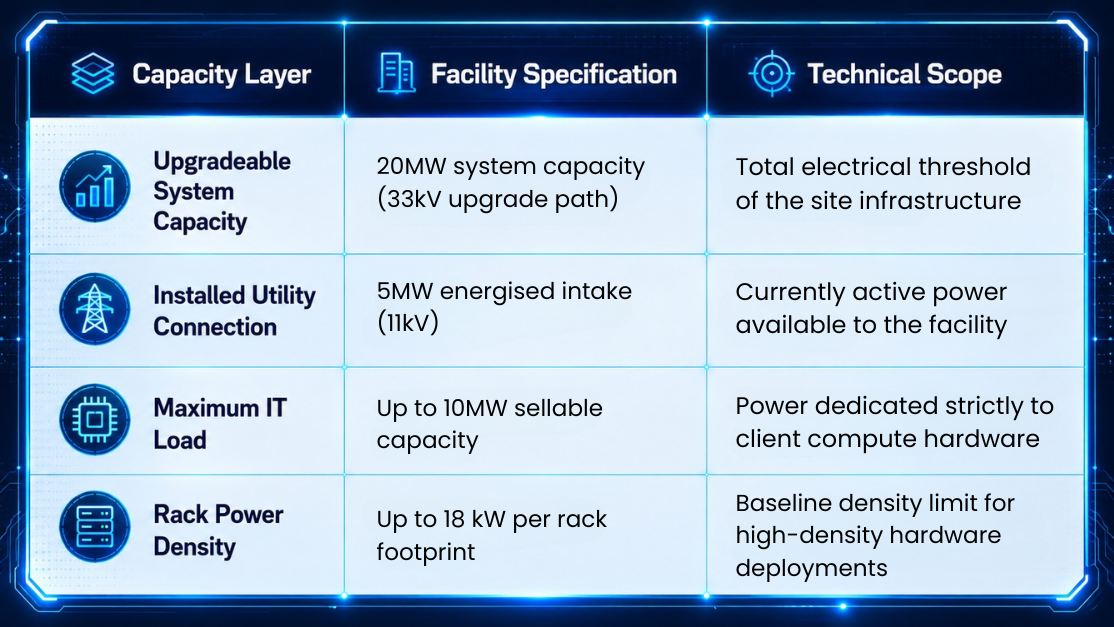
Phase 1 of D8-1 encompasses 47,000 square feet, providing 40,000 square feet of usable white space. The facility’s electrical architecture features an initial 11kV, 5MW power input, engineered with an upgrade path to a 33kV, 20MW utility connection. The facility design supports an IT load capacity of up to 10MW, with rack densities rated up to
18 kW per rack.
For procurement planning, capacity figures must be categorised by operational state:
For thermal management, D8-1 utilizes chilled-water systems, targets a design Power Usage Effectiveness (PUE) below 1.5, and includes structural adaptations for direct liquid cooling (DLC). Because design PUE reflects ideal operating conditions, high-density AI and high-performance computing (HPC) deployments require site-specific verification of supply and return fluid temperatures, mechanical N+1 redundancy, and cooling envelope tolerances under local
climate extremes.
Regarding facility compliance, D8-1 holds TIA-942 Rated 3 and ISO 27001 certifications, along with PCI DSS compliance. A TIA-942 Rated 3 classification verifies concurrently maintainable site infrastructure—confirming that capacity components and distribution elements can be serviced without disrupting active IT operations.
This rating defines physical infrastructure design; actual availability metrics, service credits, and maintenance parameters remain strictly governed by the Service Level Agreement (SLA).
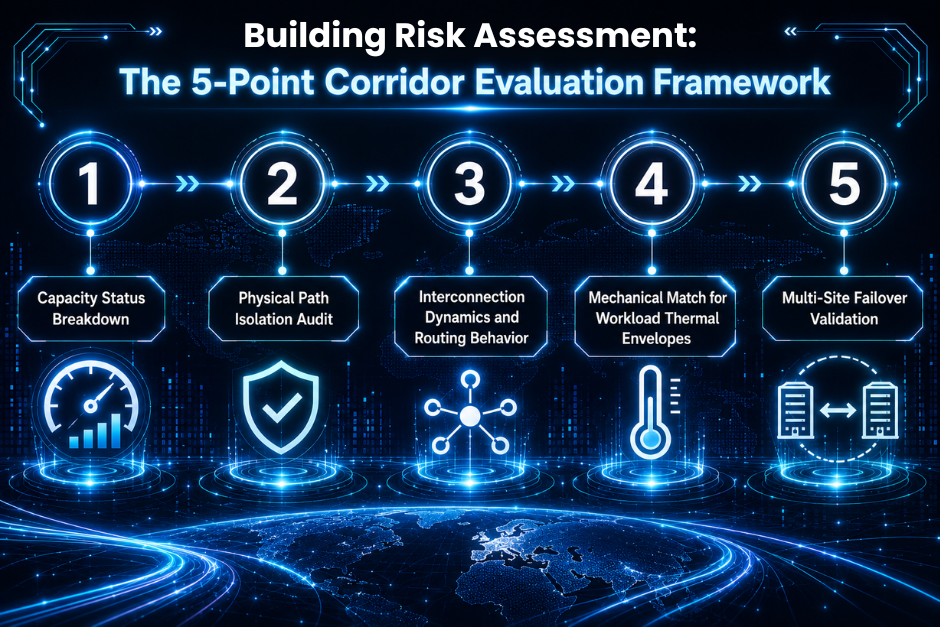
Before integrating a northern node into an enterprise topology, procurement teams should evaluate prospective facilities using the following parameters:
Obtain a dated capacity schedule separating installed utility power, committed grid allocation, available IT white space, and planned expansion phases. Utility acceleration initiatives, such as Tenaga Nasional Berhad’s Green Lane Pathway, streamline implementation timelines, but site-specific energisation dates must be independently verified.
Inspect the end-to-end physical pathing for primary and secondary circuits. Ensure that backhaul providers, physical conduit paths, border entry points, and building entry vaults maintain total separation.
Map target Autonomous System Numbers (ASNs), cloud direct-connect options, and content delivery platforms. Benchmark round-trip latency, packet stability, and route convergence behavior during simulated link outages.
Reconcile planned hardware power draw, floor weight limits, and heat dissipation profiles with the facility’s active mechanical design. Confirm fluid temperatures and supply parameters if deploying liquid-cooled systems.
Establish clear Recovery Time Objectives (RTO) and Recovery Point Objectives (RPO) across primary and secondary locations. Test disaster recovery workflows under full load conditions to confirm that authentication, access management, and database operations do not depend on a single central node.
Open DC D8-1 is designed to function as a complementary northern anchor within a distributed regional architecture, operating alongside established facilities in Cyberjaya, Kuala Lumpur, Johor, Penang, and Singapore.
When aligned with specific operational profiles, distinct enterprise deployment models emerge:
The decision to deploy infrastructure within the corridor must be driven by workload mechanics. A rigorous engineering evaluation measures application performance, transport overhead, power predictability, and operational risk factors before and after integrating a northern node into the wider network fabric.
Review the D8-1 technical profile and speak with Open DC to map your target markets, latency baseline, power envelope and end-to-end route diversity before deployment.
Empowering Southeast Asia’s Digital Future.
For further enquiries
☎️: 03 8888 8188 (General Line)
📱: 012 3188 0446 (Sales)
Operating Hours: Monday – Friday, 9am – 6pm



Copyright © Open DC Sdn Bhd (1138988-T) | All Rights Reserved.