

AI capacity is usually sold in megawatts. A megawatt tells you very little about whether a hall can run your GPUs. If you are planning AI in a high-density data center in Penang, you need four other numbers: how many kilowatts each rack can draw, how that heat is removed, how much capacity is energised […]

AI capacity is usually sold in megawatts. A megawatt tells you very little about whether a hall can run your GPUs. If you are planning AI in a high-density data center in Penang, you need four other numbers: how many kilowatts each rack can draw, how that heat is removed, how much capacity is energised today, and how long the next hall takes to deliver.
This post publishes those four numbers for PE2, our campus in Bayan Lepas.

Much more than a traditional one. Enterprise racks have run at five to ten kilowatts in years. Industry experts now put AI racks at 70 to 107 kW and expect direct-to-chip liquid cooling to become standard within five to seven years. In Johor, some AI deployments are already designed around racks of 100 kW and more.
That changes what a “5 MW hall” means. At 8 kW for a rack, 5 MW feeds over 600 racks. At 100 kW, it feeds 50. The hall must also deliver that power to each rack, and remove that heat from each rack, not just on average across the floor.
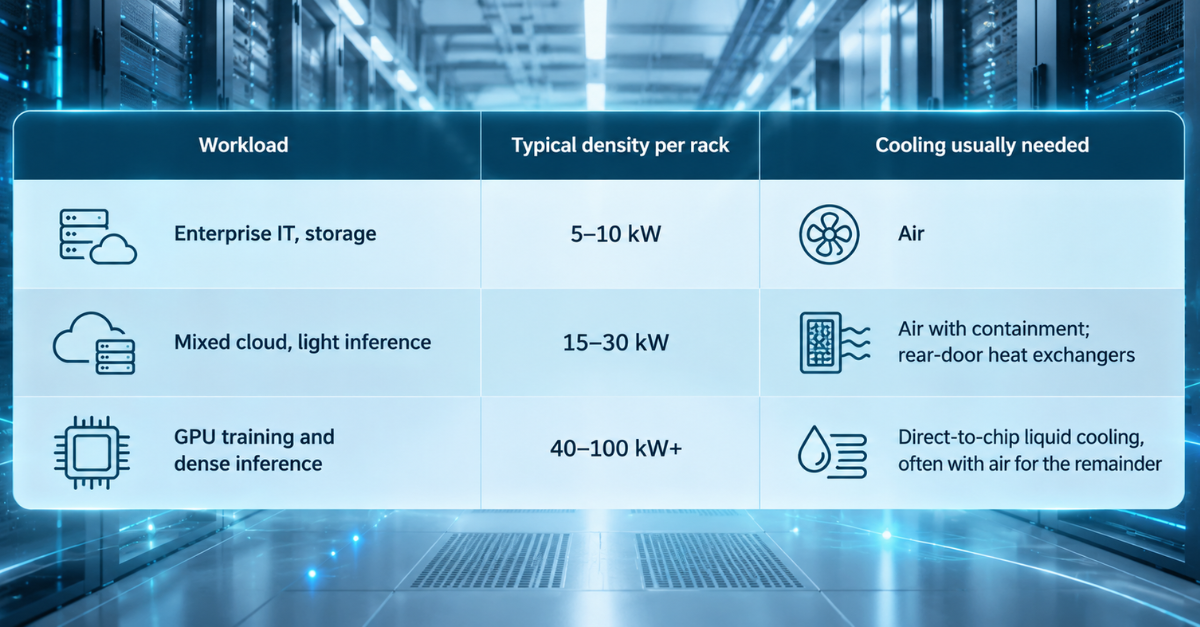
PE2’s expansion adds high-density modular halls designed for up to 150 kW per rack, in air-cooled and liquid-cooled configurations. That covers today’s dense GPU systems with headroom for the next generation.
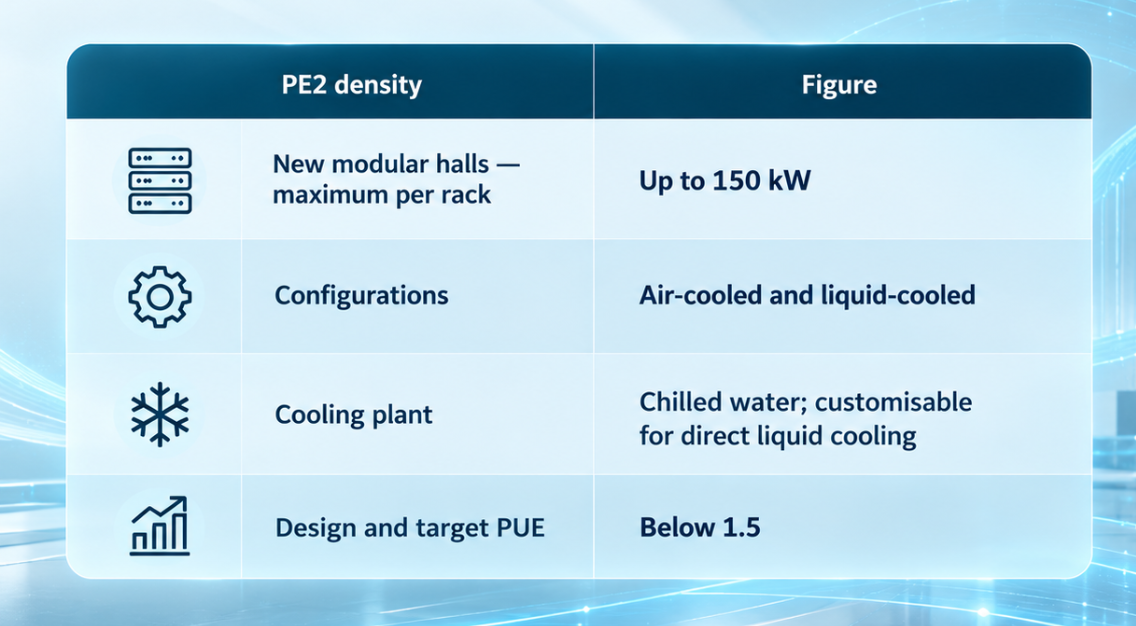
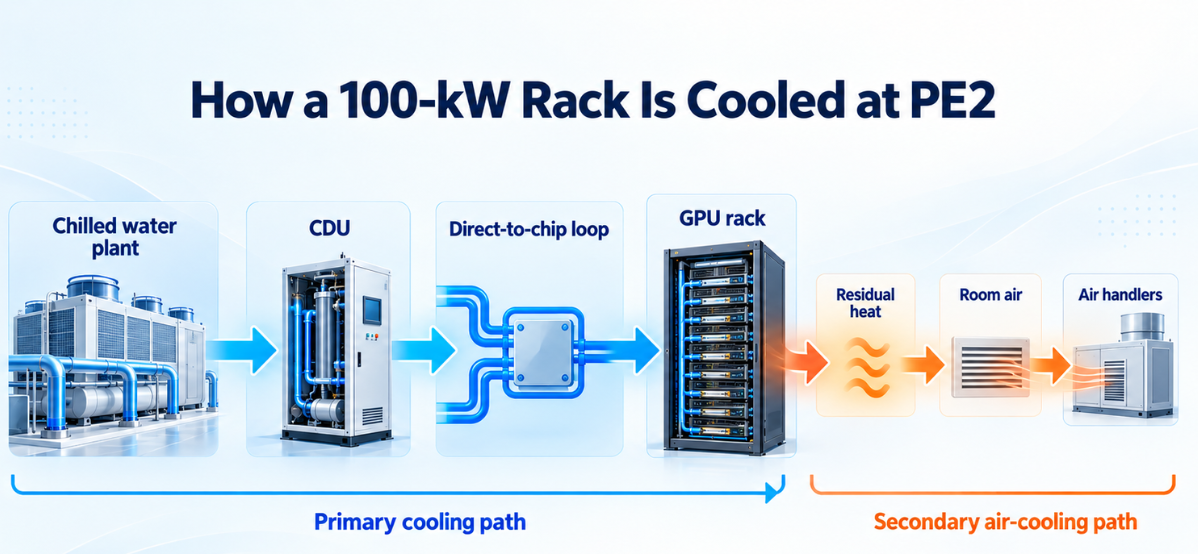
PE2 runs a chilled water plant with a design and target PUE below 1.5 and is built to support direct liquid cooling. For dense racks, liquid is the practical route. Water carries heat far more effectively than air, so a direct-to-chip loop can remove most of a GPU server’s heat at the chip, leaving the room for air to deal with the rest.
That matters in Malaysia’s climate. Data centres reached 9.3% of Peninsular Malaysia’s electricity use in 2026, and cooling is now one of the industry’s main challenges. Hot, humid air makes air cooling harder, and less efficient as density rises. Liquid cooling keeps the hall’s efficiency in check at high density, which matters for your power bill and for the efficiency thresholds Malaysia now attaches to incentives.
PE2 began operating in April 2025. Its first phase is 30 MW, and nearly 80% of that initial-phase capacity is committed to customers across semiconductor, AI, cloud, and enterprise workloads. We are expanding the 10-acre campus in phases towards 100 MW, in step with contracted demand.
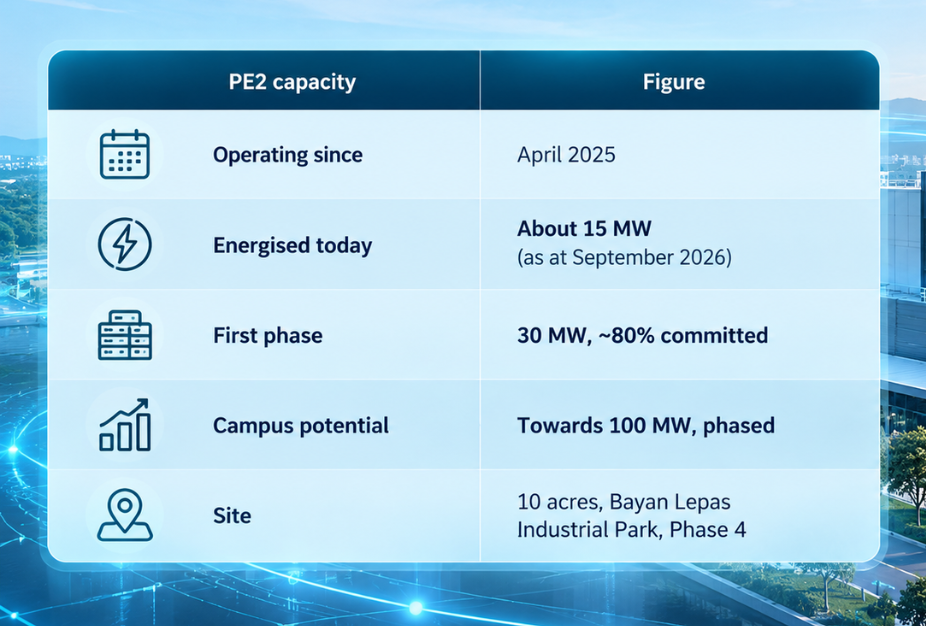
We publish the split because a single headline figure hides what a buyer can actually take. If ~80% of the first phase is committed, the remaining first-phase capacity and the next phase’s date are what matter to you.
Penang is Malaysia’s semiconductor and electronics heartland. For chip designers, test houses, and manufacturers running AI for design, yield and inspection, compute next door to the fab, and the engineering team cuts both latency and data movement.
PE2 is also well connected with many Carriers. PE2 hosts a transport node for DE-CIX Malaysia’s Penang Internet Exchange and has a data centre interconnect to PE1 in Penang Cybercity. And Penang sits outside the Johor concentration, in a different grid region and water catchment, which is useful for a second site.
For AI, ask for kW per rack, cooling method, energised capacity, and lead time, not just megawatts. PE2’s new modular halls support up to 150 kW per rack with liquid cooling. The first 30 MW phase is about 80% committed, and the campus is expanding towards 100 MW phases. Lead times and current energised capacity are below, signed off by our operations team.
Planning an AI deployment in the northern corridor?
Reserve PE2 capacity — we will confirm density, cooling and delivery date for your racks.
Empowering Southeast Asia’s Digital Future.
For further enquiries
☎️: 03 8888 8188 (General Line)
📱: 012 3188 0446 (Sales)
Operating Hours: Monday – Friday, 9am – 6pm



Copyright © Open DC Sdn Bhd (1138988-T) | All Rights Reserved.