

In August, data centres used a record 9.3% of Malaysia’s electricity, as hot weather pushed up cooling load. A year earlier, the figure was closer to 4%. Data centre power in Malaysia has gone from a planning assumption to a line on the national grid operator’s daily chart in less than two years. For a […]

In August, data centres used a record 9.3% of Malaysia’s electricity, as hot weather pushed up cooling load. A year earlier, the figure was closer to 4%. Data centre power in Malaysia has gone from a planning assumption to a line on the national grid operator’s daily chart in less than two years.
For a buyer, that headline matters less than what sits behind it. The next two years will be decided not by how many megawatts are announced but by how many are energised, and when.
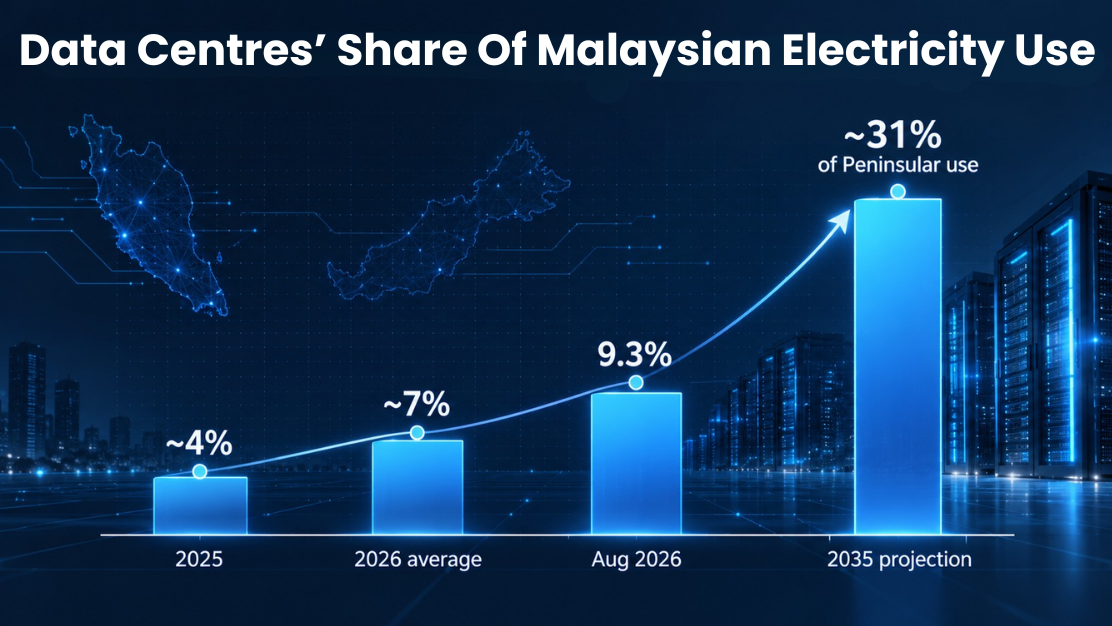
Data centres averaged around 7% of Peninsular Malaysia’s electricity in 2026 and hit 9.3% in August. Their consumption in the first quarter was 2.3 times higher than a year before. Forecasters expect the share to reach around 31% of Peninsular electricity by 2035.
Industry capacity is projected at about 2,055 MW by the end of 2026, up from 522 MW in early 2025. Pre-leased capacity rose to 1.2 GW in the first half of 2026.
Not in total, but in timing and in place. Three facts matter.
New generation. No new gas-fired capacity is expected before 2028. About 9 GW is planned by 2032. Moody’s estimates Malaysia needs 14–17 GW of new capacity over ten years, at a cost of up to RM95 billion, partly to replace retiring coal and gas plant.
Connected is not consumed. As at June 2026, about 5.65 GW of data centre capacity was connected to the grid but only around 1.26 GW was drawing power. As those halls fill, demand rises without a single new approval.
Constraints are local. Capacity behind one congested substation behaves nothing like capacity in a different corridor. Johor holds about 80% of Malaysia’s data centre capacity. There is not shortage in Penang or the Klang Valley, and the reverse.
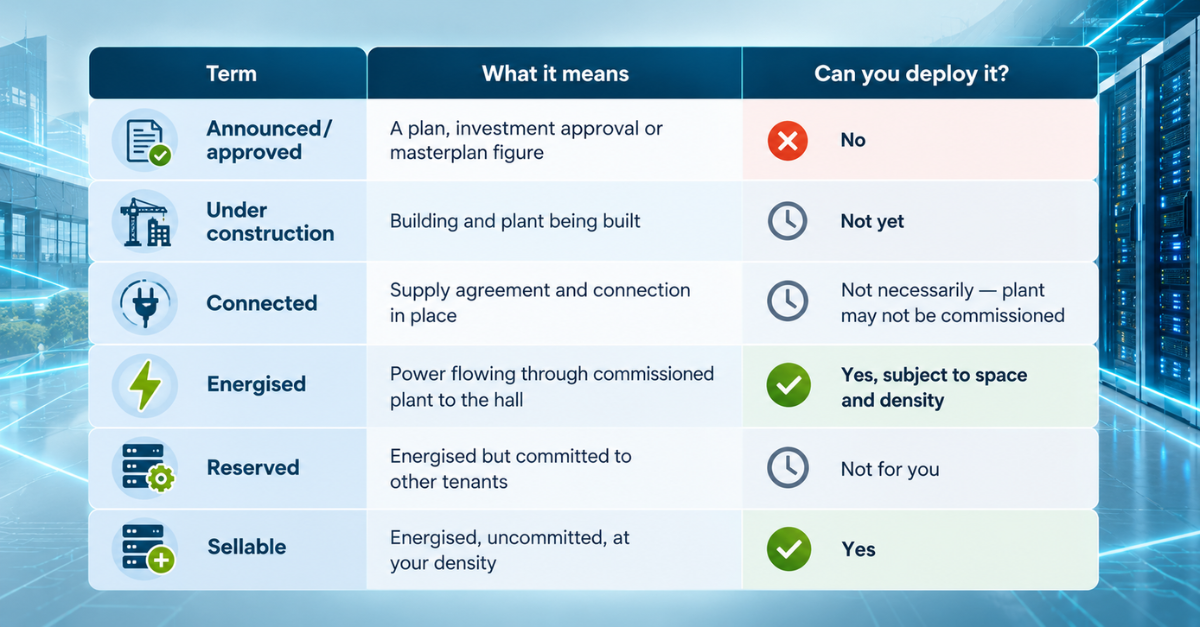
Only the last row is a product you can buy today. Every other row is a promise with a date attached, and the date has dependencies.
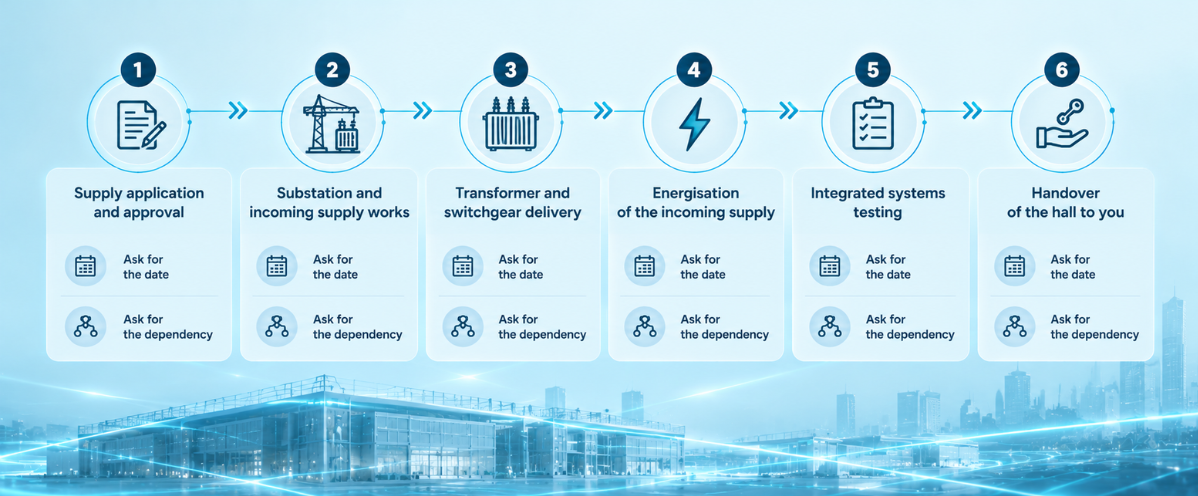
A credible energisation date is a chain of milestones, each with its own risk:
1. Supply application and approval with the utility.
2. Substation and incoming supply works, including the utility’s side.
3. Transformer and switchgear delivery. Critical equipment can now take more than a year to arrive.
4. Energisation of the incoming supply.
5. Integrated systems testing of power and cooling under load.
6. Handover of the hall to you.
TNB’s fast-track route has cut connection times for data centres to around 12 months, a real improvement. But a date that skips steps two, three or five is a wish, not a schedule. Ask which milestones are complete, which are pending, and who controls each one.
AI deployments are lumpy. A single GPU cluster can need several megawatts at once, at high density, on a fixed date set by hardware delivery. If the hall is not energised when the servers arrive, expensive hardware sits in boxes. Some large AI facilities announced in Malaysia this year are not due to be energised until the second half of 2027. For an AI buyer, the energisation date is the delivery date, and it should be treated with the same scrutiny as the GPU order itself.
Here is what we have said publicly about each site. It is not yet the full split described above and we would rather show you that than fill the gaps with estimates.
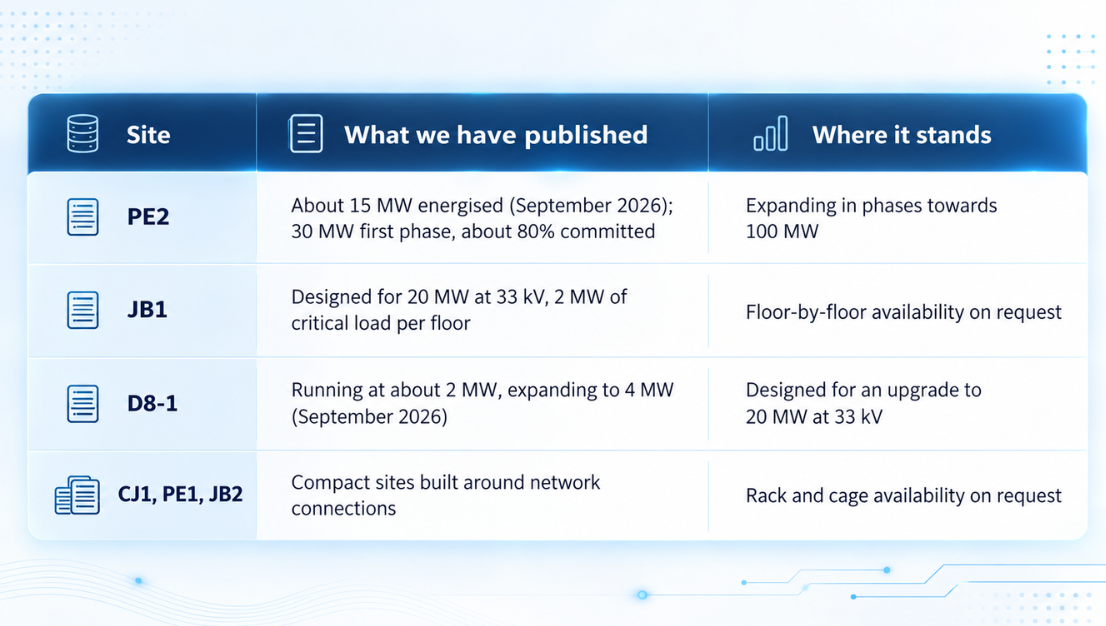
For any site, we will give you the full breakdown in writing; what is energised, what is already committed, what you could take, and the date and dependencies behind the next increment. That is the standard we have asked you to hold every operator to, including us.
Data centres used 9.3% of Malaysia’s electricity in August, and new gas generation does not arrive until 2028. Connected capacity is filling up. In that market, an energised megawatt is worth far more than an announced one. Ask every operator for live, reserved and sellable MW, and for each future date, the milestones and dependencies behind it.
Ask for our energisation schedule — live, reserved and sellable MW for every Open DC site, with dates and dependencies.
Empowering Southeast Asia’s Digital Future.
For further enquiries
☎️: 03 8888 8188 (General Line)
📱: 012 3188 0446 (Sales)
Operating Hours: Monday – Friday, 9am – 6pm


Copyright © Open DC Sdn Bhd (1138988-T) | All Rights Reserved.