

Bypassing the Transit Bottleneck: A Strategic Guide to Regional Interconnection In today’s fast-paced digital economy, keeping data traffic local is essential for achieving superior speed and operational resilience. Yet many digital services still suffer from inefficient, circuitous international routing, a phenomenon known as “tromboning”, simply because local peering infrastructures are underutilised. For telecommunications companies, content […]

In today’s fast-paced digital economy, keeping data traffic local is essential for achieving superior speed and operational resilience. Yet many digital services still suffer from inefficient, circuitous international routing, a phenomenon known as “tromboning”, simply because local peering infrastructures are underutilised.
For telecommunications companies, content platforms, and enterprises, this hidden bottleneck acts as a silent killer of application performance.
To build a scalable network capable of handling next-generation workloads, understanding and implementing
Internet Exchange (IX) peering is an absolute necessity.

Internet Exchange (IX) peering is a strategic networking arrangement that enables distinct networks to interconnect and exchange traffic directly. By bypassing expensive third-party transit providers, networks can route data locally rather than sending it on an unnecessary journey across the globe.
Consider a user in Johor trying to access a digital service hosted on a platform with infrastructure nearby. Without local peering, that data might travel to an international hub and back just to cross the road. An Internet Exchange Point (IXP) acts as a direct local highway, completely avoiding the international detour.
Relying solely on traditional IP transit routes introduces severe operational vulnerabilities for modern digital enterprises:
This challenge is intensified by recent market shifts. As regional internet traffic continues to break records alongside the rapid expansion of data centres, the strain on national utilities and network frameworks is higher than ever. Relying on weak local interconnection is no longer just inefficient; it is a significant business risk.
Transitioning to local peering fundamentally transforms how data moves across your infrastructure. The table below highlights the key differences between the two models:
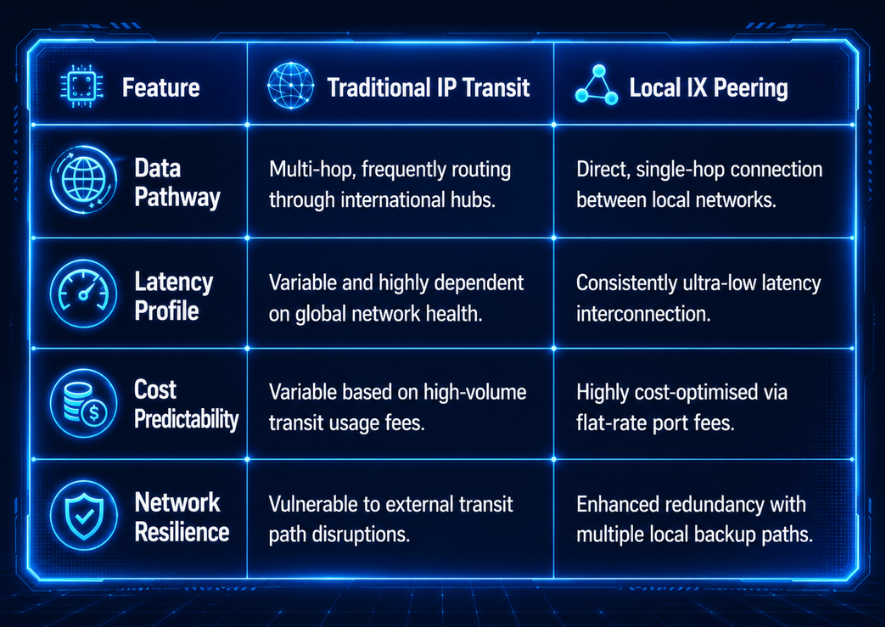
To truly maximise the benefits of local peering, networks must establish a presence where data naturally converges. This requires a deliberate combination of robust data centre infrastructure and world-class exchange ecosystems.
True network interconnection thrives within carrier-neutral facilities. Because these spaces operate independently of any single telecommunications provider, they foster an open marketplace where telcos, ISPs, carriers, and content platforms can cross-connect freely.
By establishing a physical presence within these hubs, network operators gain immediate entry into premium local and international exchange ecosystems.
Integrating with platforms like DE-CIX JBIX connects your network directly to a dense fabric of regional peers,
cloud on-ramps, and global content providers. Through physical cross-connects within the same data centre room, you can radically shorten the distance your data travels.
As enterprise cloud adoption and dense AI workloads drive data volumes to unprecedented heights, internet architecture must evolve to support cross-border digital connectivity. Open DC is actively addressing this demand through a strategic expansion in northern Malaysia designed to strengthen the Thailand, Indochina, Malaysia, and Singapore digital corridor.
With a focus on a peering-led, carrier-neutral design, Open DC is rolling out next-generation infrastructure across northern Malaysia:
With a combined power capacity exceeding 80MW across six data centre facilities, Open DC provides the scale, power readiness, and network density required by modern enterprises to eliminate unnecessary routing and safeguard their digital assets.
Optimising your routing strategy via local peering keeps your data safe, your costs controlled, and your user experience seamless.
If you are ready to eliminate high transit fees, mitigate latency risks, and elevate your application performance, it is time to transition to a more resilient framework.
Connect with Open DC for IX-enabled interconnection and explore our specialised ecosystem to kickstart your network optimisation journey.
Empowering Southeast Asia’s Digital Future
For further enquiries
☎️: 03 8888 8188 (General line)
📱: 012 3188 0446 (Sales)
Operating Hours: Monday – Friday, 9am – 6pm



Copyright © Open DC Sdn Bhd (1138988-T) | All Rights Reserved.