

For decision-makers, it simply means expansion planning must move beyond procurement logic. It must become an exercise in long-term infrastructure discipline.
1. Start with business outcomes, not just available space
A good expansion plan begins with the question “Which location best supports our market, application, and risk profile?”, and not “Where can we rent space?”
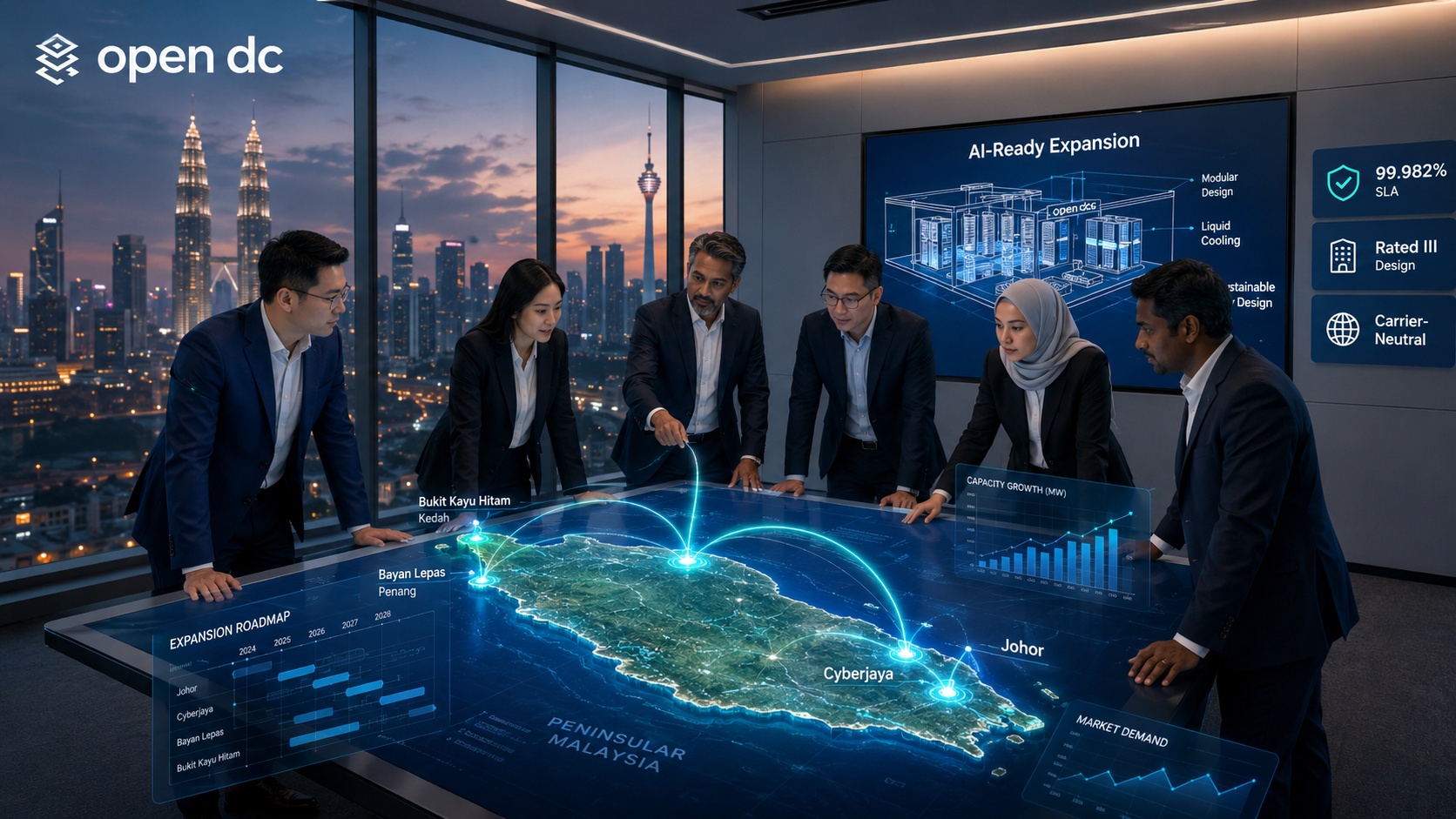
For some organisations, the priority is low-latency access to Singapore-linked ecosystems and regional traffic flows. For others, it is proximity to manufacturing clusters, cloud on-ramps, or cross-border markets. In Malaysia, those outcomes vary by corridor. Johor continues to matter because of its proximity to Singapore; Penang matters because of its role in industrial, semiconductor, and enterprise digitalization; Kedah is gaining relevance as a northern gateway; and Cyberjaya remains important for centralised digital ecosystems and established enterprise demand. Johor, Cyberjaya, Penang, and Kedah are key growth locations within Malaysia’s evolving data centre landscape.
DC footprint matters. Open DC’s six data centres span across four states and positions itself at strategic locations of the northern, central, and southern economic corridors. This is a geographically distributed, carrier-neutral platform designed to support business continuity, reach, and redundancy across West Malaysia.
2. AI-readiness must be tested, not assumed
One of the biggest mistakes in expansion planning is treating “AI-ready” as a marketing label instead of an operating requirement. Mordor Intelligence’s 2026 report shows that newer Malaysian sites are already being measured against higher rack-density expectations, with average AI-ready environments moving into the 15 kW to 40 kW range and some liquid-cooled GPU clusters going beyond 100+ kW per rack.
That is a different planning model from legacy enterprise environments. It affects cooling design, power provisioning, floor loading, upgrade paths, and the speed at which infrastructure can be scaled without major retrofits. This is why decision-makers should scrutinise all angles prior to committing:
- How much IT load is available today versus contractually committed?
- Can the site support higher-density growth without major redesigning?
- Is there a realistic path to advanced cooling readiness?
- Can the operator scale your workloads, not just house them?
Open DC emphasizes AI-readiness at its core positioning. Its facilities are built on Rated 3 standards, with modular expansion, high-density support, and integrated interconnection. PE2 in Bayan Lepas is positioned as the next-gen site in Penang for AI and high-density workloads, with advanced cooling approaches and a target PUE below 1.5. The other purpose-built DC, D8-1 in Kedah, is also an AI-ready site with scalable power and a border-edge role for regional traffic.
The takeaway is simple: do not buy future demand with yesterday’s design assumptions.
3. Treat interconnection as core infrastructure, not an add-on
For many decision-makers, expansion still gets evaluated mainly through colocation economics. In reality, the more strategic question is how efficient data moves once it is inside the facility?
Latency is now a business metric, not a mere network metric for colocation, interconnection, data centre planning, uptime and resilience. That is where interconnection, carrier-neutrality, and internet exchange access become critical. Open DC’s facilities serve as the integrated platform that combines network, data centre, and internet exchange infrastructure:
- Data centres in Kedah and Cyberjaya are hosting DE-CIX Malaysia.
- DECIX-JBIX are nestled in both the facilities in Johor.
- Penang Internet Exchange (PIX) are in both Penang data centres.
Open DC’s locations are strategically located, assuring a seamless interconnection:
- JB1 and JB2 are just 2 km from the Malaysia-Singapore Causeway, with dark fibre, DWDM, and MetroE links.
- PE1 and PE2 (Bayan Lepas) are in the semiconductor hub known as the Silicon Valley of the East.
- D8-1 in Kedah is 5km from the Malaysia-Thailand border, offering proximity to Satun and Songkhla’s cable landing stations.
For decision-makers, this changes the economics of expansion. The right site is not merely where servers sit. It is where ecosystems meet telcos, cloud, content, carriers, and enterprise networks on one resilient platform.
4. Resilience and operational maturity still decide who scales well
In a high-growth market, not every expansion problem is solved by having more capital. Many are solved by operational discipline. That means resilience cannot be treated as a checklist item. It must be visible in design, staffing, and day-to-day operations.
The six data centres by Open DC encompass:
- More than 360,000+ sqft of total data centre size.
- 99.982% SLA.
- 80MW+ power across its footprint.
- Design philosophy centered on Rated III resilience.
- N+1 configurations.
- ASHRAE-aligned environments.
- 24/7 security and support for mission-critical applications.
This matters because poor expansion decisions rarely fail on day one. They fail later, when utilization rises, maintenance windows narrow, workloads become more sensitive, and the cost of downtime becomes unacceptable.
5. Sustainability and total cost of growth need early attention
A modern expansion plan must also account for the cost of operating at scale, not just the cost of entering the market. Rising electricity costs, water scarcity, and grid constraints are real planning issues in Malaysia. Green incentives from MIDA, such as GITA Project and GITE Solar Leasing, enable businesses to align with the nation’s sustainability agenda.
Expansion planning should include:
- What is the site’s efficiency profile?
- What is the operator’s approach to renewable energy participation?
- How exposed is the site to water or grid constraints?
- How will energy strategy affect long-term operating margins?
Purpose-built facilities by Open DC are well aligned with sustainability. PE2 focuses on high-efficiency design and advanced cooling, while D8-1 offers scalable solar-powered renewable energy positioning.
The broader point: in 2026, the cheapest expansion path on paper is not always the most efficient expansion path in reality.
What decision-makers should do next
A disciplined expansion plan should answer five questions clearly:
- Which location best supports your target users, applications, and markets?
- Is the facility genuinely ready for rising power density and AI-related cooling demands?
- Does the ecosystem reduce latency and vendor lock-in through carrier-neutral interconnection?
- Are resilience, security, and operations mature enough for long-term scale?
- Will the site still make financial and sustainability sense as workloads grow?
Malaysia’s growth story remains compelling, but the strongest outcomes will come from choosing the right infrastructure model, in the right location, with the right operating discipline.
Share this with a decision-maker who is reviewing their next infrastructure move. Explore how Open DC can support a resilient, AI-ready expansion strategy.
Open DC — Empowering Southeast Asia’s Digital Future